
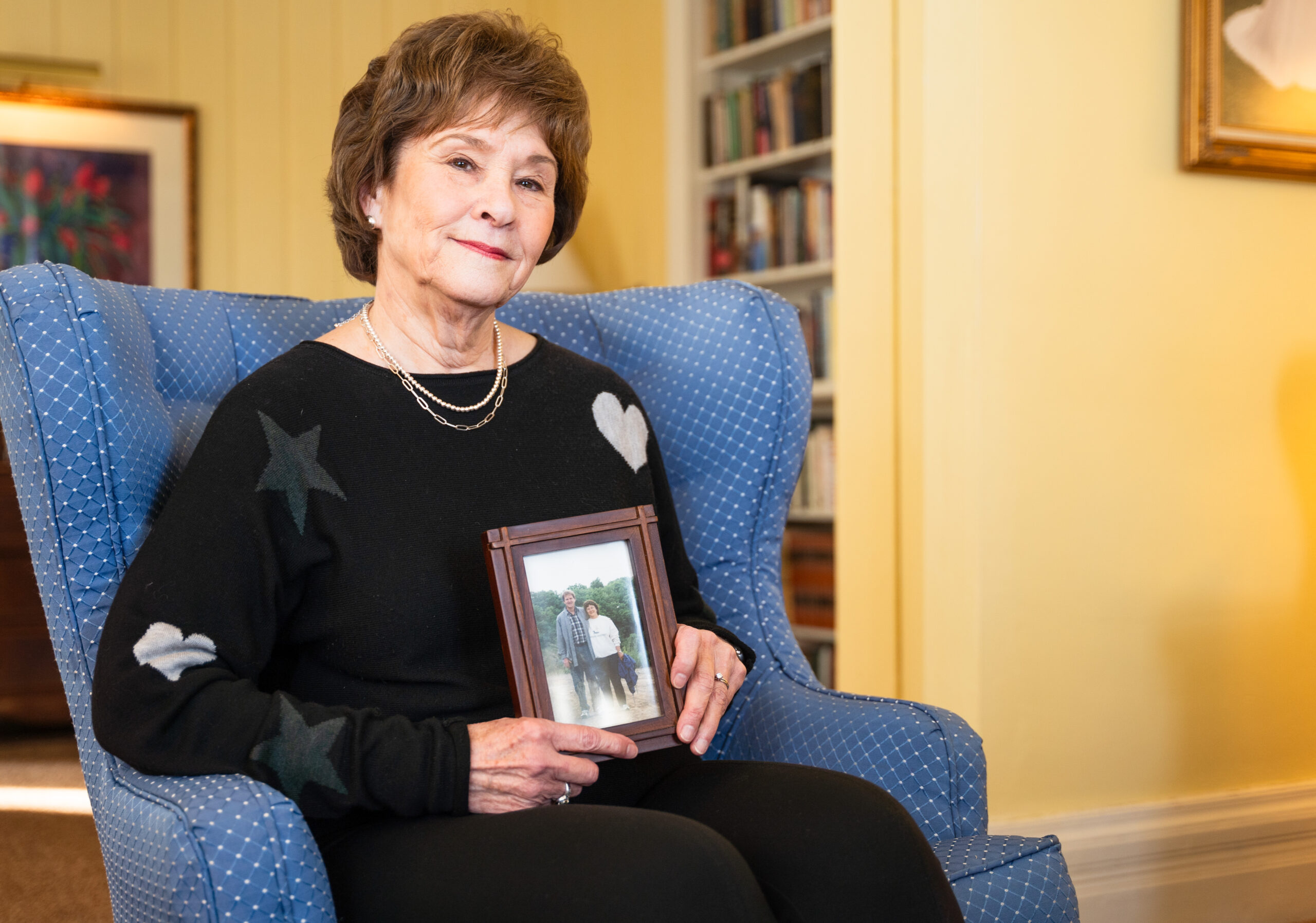
Patricia Ransford has lived in the same white wooden house on Union Street for 47 years. Inside, it has all the color and tidy charm of a dollhouse. Hymns float through the sunlit rooms and a candle burns in her kitchen. Her walls are lined with bookshelves; Ransford loves historical fiction most.
“Every room in my house has bookshelves,” Ransford said. “That’s my weakness.”
A fan of American author Lynn Austin and American history stories, Ransford said she’s always looking for the next good book. She admits, though, that she isn’t a fan of book clubs.
“I just want to read for the sheer joy of reading,” Ransford said.
Besides reading, the longtime Hillsdale resident and widow of Hillsdale College professor Charles Ransford invests time in her church, where she led a Community Bible Study for years, babysits occasionally, and keeps up with her family. She spent all day yesterday at her grandson’s high school wrestling tournament.
“I’m learning all about the sport. Not my favorite,” Ransford said with a laugh.
Ransford first came to Hillsdale when her late husband, Charles Ransford, joined the college’s psychology department in 1973.
“He was the love of my life,” Ransford said.
When Charles died in 2001 from a brain tumor, she didn’t remarry.
Ransford recalled stories of her husband’s time with his psychology students, including an escapade with a monkey named Jojo. The monkey first belonged to a couple in Jonesville who donated him to Charles.
“What they didn’t tell him was that this monkey was very aggressive and hated men,” Ransford said.
When Charles took the monkey to class, chaos ensued.
“This monkey went after him and shredded his shirt,” Ransford said. “One of the college girls in the class sweet talked it back into its cage. Needless to say, Jojo didn’t last very long with the college.”
Ransford grew up in Grand Rapids, the second of six girls. She attended a Dutch Christian Reformed church with her family and went to Christian schools from kindergarten through college.
“I had a very close knit family,” Ransford said.
She attended Calvin College, now Calvin University, in Grand Rapids from 1964 to 1968, where she met Charles.
“At mandatory chapel, he sat behind me,” Ransford said. “I had been dating someone, and that didn’t work out, so I was kind of looking for someone. I came out after chapel and flashed him a big smile. Nothing. Oh well!”
Their story wasn’t over. Ransford worked for Calvin’s registration office, where she manually handled each student’s registration.
“He came through a little late,” Ransford said, since he had been working at a local hospital as a pre-med student. Ransford helped him process his registration.
“After that, he called me up and asked for a date,” Ransford said. But I already had a date!”
But Charles persisted, and soon the two were planning a wedding.
While her soon-to-be husband attended graduate school at Wayne State University in Detroit, Ransford began teaching second grade in the nearby Madison Heights public school. After four years there, Ransford moved with her new husband to Hillsdale in 1973. In 1976, the two settled into a white house on Union Street. It’s been Ransford’s home ever since.
Ransford was drawn to teaching since her influential kindergarten and second grade teachers.
“I always dreamed I could help students learn in a little better way,” Ransford said. “When I was in school, they didn’t hang up my papers. They used to hang up all the best papers on the wall. I felt so bad about that, and I just thought there are better ways to motivate kids.”
Once in Hillsdale, Ransford dedicated her time to her children, raising them while she took a break from teaching professionally. She had two daughters, Jennifer and Amy, and a son Mark.
After 10 years, Ransford returned to the classroom, teaching first grade for a decade at Bailey Early Childhood Center. Ransford trained 18 educational assistants to meet the needs of disadvantaged students.
“There were students who had a hard time learning to read,” Ransford said. “I wanted to figure out how that worked. How do they learn?”
Ransford talked the superintendent into letting her lead Reading Recovery, working with the first grade students most at risk of falling behind.
“You help them be successful,” Ransford said. “It takes about 20 weeks, and you can have them be average or above average in reading and writing.”
Ransford went on to do professional development for the school district and teach literacy workshops around Michigan. She taught kindergarten at the now-closed Mauck School on Fayette Street, which her children also attended.
Ransford said she can remember a time before Union Street boasted an assortment of dorms and student housing. It used to be a neighborhood — her neighborhood.
“At one time, all five of us in my family could walk wherever we were going to go,” Ransford said.
Her children ice skated and swam in the Arboretum, sold lemonade to college football game attendees, and sledded by the field houses.
“When my son was little, he was into earthmoving equipment,” Ransford said. “They were building the track. So we packed a little picnic lunch and sat on top of the hill and watched all those big earthmoving trucks go around.”
Ransford loved raising her family on Union Street.
“We always felt like we were part of everything,” Ransford said. “There was such camaraderie in the neighborhood.”
Union Street has changed in the past few decades, but Ransford has happily welcomed her college-aged neighbors.
Junior Caris Fickenscher met Ransford when she needed a ride from the airport. The two connected through Hillsdale’s United Brethren Church, where they both attend. Despite not having met Fickenscher before, Ransford offered to make the drive.
“After a long travel day, it was lovely to be welcomed with such kindness,” Fickenscher said. “She and I chatted the whole way to Hillsdale, and she told me stories about her family and her involvement with Hillsdale. She is very connected to the community here, to athletes and independents alike, as well as professors and their families.”
The airport ride was the beginning of a friendship between the two.
“It was such a blessing not only to be graciously given a ride from the airport from someone I had never met before but also to have found a new friend who lives on the street just behind me,” Fickenscher said.
Will Smith ’22, son of Dean of Humanities Stephen Smith, remembers Ransford as his neighbor and kindergarten teacher at Mauck.
“She was such a kind and gentle woman,” Smith said. “It was my first school experience, and it was positive through and through.”
Even after Smith left Mauck, Ransford continued to reach out to her neighbor.
“All the years following, when I was no longer in Mauck, I would bump into her and she would always remember me,” Smith said. “She was always checking in on me. And I was just some random kid.”
Smith remembers Ransford asking questions beyond the usual small talk.
“It’s special when someone goes out of their way to remember you,” Smith said. “She actually cares. She’s an incredibly kind and genuine human being.”
Laura Smith, Will’s mother, appreciated the way Ransford nurtured her son’s strengths.
“She always tried to draw out each student’s gift and help it to grow,” Smith said. “With Will, she was always helping with his creativity and his love of story and music. What’s so beautiful is that all these years later, that’s really what flowered.”
Ransford has plenty of wisdom to share after her decades as a teacher.
“You’ve got to love kids,” Ransford said. “You’ve got to love being able to share your life with them.”
While teaching has gained increasing political and cultural attention, Ransford said some things haven’t changed.
“There’s so much dysfunction in our society, and it makes its way into the classroom,” Ransford said. “Teachers nowadays have to have a lot more tools in their toolkit to be able to manage all those challenges.”
Despite evolving circumstances, kids remain the same, Ransford said.
“You’ve got to love kids. And then you’ve got to be able to set clear and consistent expectations. You have to enforce consequences fairly and consistently,” Ransford said. “Kids know if you’re being fair. They’re watching you.”
In Ransford’s experience, a flourishing classroom can spring from this order and justice.
“You turn that classroom into a community, a family,” Ransford said.
