
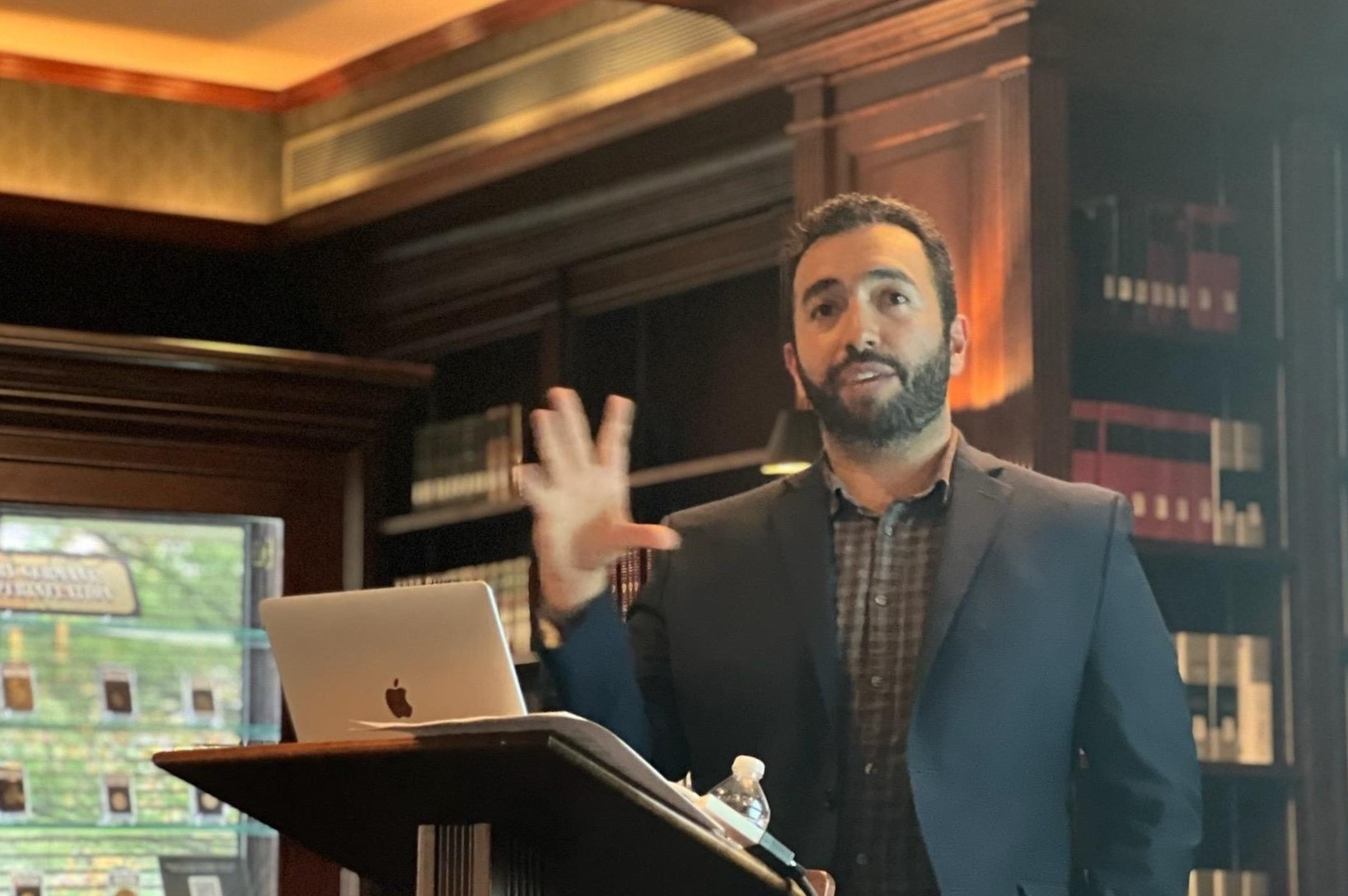
Paul Rezkalla gave a talk on Aristotle and biology. Malia Thibado | Collegian
Modern biology and medicine should take a lesson from Aristotle, according to Paul Rezkalla, a postdoctoral research fellow at Baylor University, who was a visiting professor of philosophy at the College last year.
Dozens of students and faculty gathered in the Heritage Room on Nov. 6 to hear Rezkalla’s talk entitled “The Normativity of Life, How Morality Informs Biology and Medicine.” Rezkalla specializes in the intersection of ethics, philosophy, and science.
“To do biology is to, in some sense, do ethics, because to talk about life, to classify life, to evaluate life, all of these are normative assumptions,” Rezkalla said.
Rezkalla said that normative assumptions come from comparisons between an individual and the general characteristics of its species. Rezkalla said there are different standards for different species, in accordance with Aristotelian philosophy. When evaluating an individual’s traits, they are classified as “good” if they conform to the characteristics of the species.
Aristotle, though he was not correct on every conclusion, set an important precedent of insatiable curiosity, Rezkalla said. He said Aristotle was the first biologist to use normative assumptions and took extensive notes describing a variety of animals and their habits.
“For the Aristotelian, life and non-life is the hard, deep distinction in the world,” Rezkalla said. “Once you’ve got living things, it changes everything. There’s a unique language there, a unique set of concepts and ways of speaking that capture the uniqueness of the activity that is life.”
Organisms can’t simply be reduced to their genetics, according to Rezkalla.
“Organisms are integral to biological theories,” Rezkalla said. “Unique from chemistry and physics, biology has a built-in bulwark against reductionism because organisms are the object of study.”
Rezkalla advocated for the return to a normative approach to biology and medicine, arguing that the study of an organism must involve the organism itself and not just abstract patterns.
“They’re claims about what humans ought to be and ought to look like, and failures of this are what we call disease or illness and things like that,” Rezkalla said.
Senior Luke Hollister, who had Rezkalla as his Philosophy 101 professor during his freshman year, said the talk was insightful.
“He was very self-aware of different objections that could be raised and preemptively addressed them in a way that did not distract too much from his ultimate point,” Hollister said. “He was extremely clear about what his thesis was.”
Junior Lauren Smyth also attended Rezkalla’s philosophy class during her freshman year.
“I was excited to come see the talk,” Smyth said. “I like the logic of it. I enjoy the opportunity to think through fundamental ideas.”
