
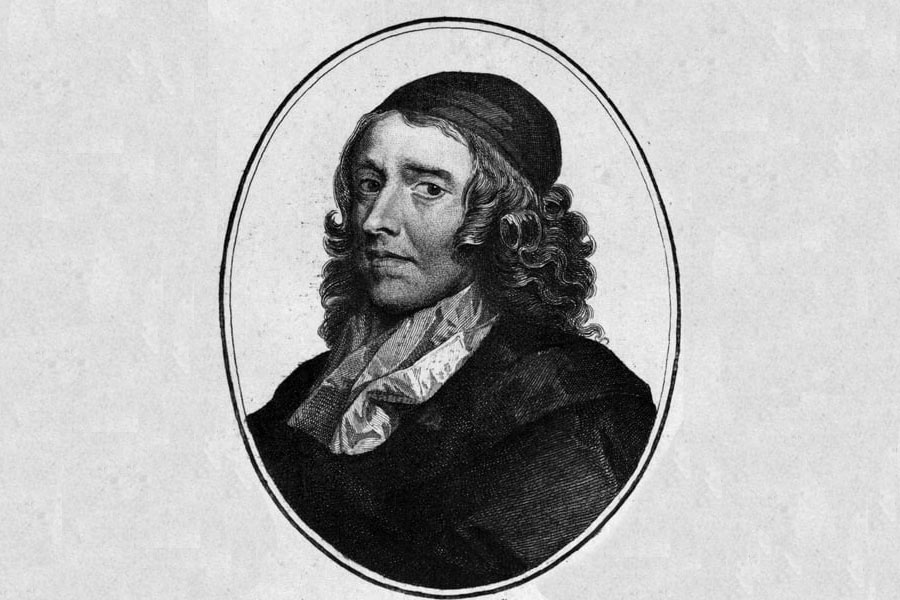
Puritan John Owen was a “thoroughgoing Protestant” who believed salvation was by grace alone, according to British scholar and Church of England clergyman Lee Gatiss at a Drummond Lecture in Christ Chapel last week.
Gatiss is the director of Church Society, a Church of England fellowship dedicated to the renewal of Biblical faith, as well as a lecturer in church history at Union School of Theology in the United Kingdom.
In a lecture titled, “John Owen: The Genius of English Puritanism,” Gatiss said the 17th century Puritan was a Christian statesman, scholar, reformed theologian, and prolific Biblical commentator.
Though Owen was an imperfect, sinful man and prone to anger, he left a mark on faith and history, Gatiss said. Owen guided Oliver Cromwell as his chaplain, working to reform England through Christian principles.
“He built up a network of contacts with the deliberate purpose of bringing about godly religious reform in England and freedom of conscience,” Gatiss said.
A fine scholar, Owen also knew his classics, according to Gatis.
“His Greek, his Hebrew, and his Latin were all very much up to scratch,” Gatiss said. “He earned the respect of the academy for his deep schools of learning.”
Owen was also a firm Anglican who loved the Reformation and an ordained Anglican minister, Gatiss said.
“His focus on the doctrinal basis of Anglicanism could serve as a rallying cry for all Protestants,” he said.
Assistant Professor of Politics Adam Carrington, an Anglican, said he thought Gatiss’ introduction to Owen’s life and theology was thoughtful and valuable.
“In Owen, we see the views of an Englishman who defended the fundamental principles of the broader Protestant Reformation shared by the Church of England,” Carrington said. “At the same time, Owen came to hold different views from the ecclesiastical and liturgical distinctives of the English Church. That tension is a helpful, even fruitful one for Gatiss to introduce to us.”
Humans cannot earn their way back into God’s good graces by our own works, Gatiss said Owens believed.
“Having no righteousness of our own, God then clothes us with the perfect righteousness of Christ, and he loves us as he loves his own son, despite our deep unworthiness,” Gatiss said.
Owen did not believe in the separation of church and state, according to Gatiss. The Puritan was deeply attached to the protestant doctrine of the Church of England.
“The state had a duty to stop anti-trinitarianism from infiltrating the church and reject those who didn’t believe in justification by faith alone,” Gatiss said of Owen’s beliefs. “Salvation was too important for the state to be entirely neutral about it.”
Owen was a reformed theologian as well as a reformed scholastic who believed the Reformation’s principles needed to be passed to the next generation, according to Gatiss.
Reformed scholasticism is “a method, not a conclusion, adopted to ensure the institutionalization of the Reformation’s basic principles”
“One has to defend against false teaching with a comparable level of backing,” Gatiss said.
Owen is also the author of a seven-volume exposition on Hebrews. The more than two-million-word commentary is approximately 20 times longer than the Bible.
“In his commentary, he sought to unwrap as much of the message of Hebrews as he was able,” Gatiss said. “His exposition is in English, based on the original Greek, interacting with many other commentaries, liberally peppered with Greek and Hebrew, but not so obsessed with minutiae that it neglects doctrinal and practical application.”
Gatiss commended Owen’s Biblical commentary to the audience, saying it has “enduring value.”
“His preaching, his mastering, his Trinitarianism, his eschatology and readings of divine providence in the events of the day, his church politics, his pleas for toleration, all with careful study, never go out of style,” Gatiss said.
Senior Vivian Tork, a history major, said she enjoyed that the Drumond lecture pertained to 17th century Christianity.
“Rev. Gatiss delivered a clear depiction of John Owen, both as a man and as a major contributor to Christian scholarship and politics,” Tork said. “I was left with much to mull over, and enjoyed being on the receiving end of some wildly expressive glances from members of the history faculty, aroused by one comment or another from Gatiss.”
