
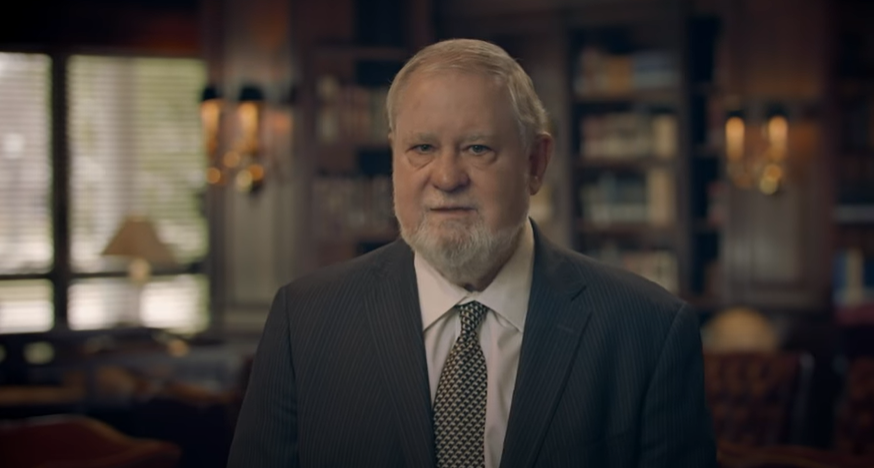
The Foundation for Individual Rights and Expression has a fundamental misunderstanding of college education, according to College President Larry P. Arnn in an op-ed titled “There’s More to Education Than Free Speech.”
“I wrote the piece to assert what education is,” Arnn told The Collegian. “FIRE seems like most activists: they want to do education policy, which is not the same thing as education.”
FIRE is a nonprofit advocacy group “dedicated to defending free speech rights across the country,” particularly on college campuses, according to its Director of Policy Reform Laura Beltz. When FIRE released its 2024 College Free Speech rankings earlier this year, it labeled Hillsdale College a “warning” school. Arnn addressed this in his op-ed, published in The Wall Street Journal on Oct. 19.
“A college’s purpose isn’t merely to encourage speech,” Arnn wrote. “A college’s purpose, through speaking and thinking — the two go together — is to teach students to think and speak better in search of knowledge.”
FIRE categorized Hillsdale as a “warning” school because it doesn’t have a “clear, written commitment to free speech” and because of clauses in its student conduct guidelines requiring behavior in correspondence with the academic, religious, and moral facets of the college’s mission. It requires civility in conversation and disagreement, maintenance of “good order,” and avoidance of “disorderly, lewd, indecent, or obscene conduct or expression.”
The purpose of the warning rating, according Beltz, is so prospective students are aware the school doesn’t promote “unfettered freedom of expression.”
“We just put the warning rating in place to be doubly sure that prospective students who are considering Hillsdale are aware of these policies,” she said. “Private institutions, like private colleges, do have association rights to set their own rules, and so that’s well within Hillsdale’s right, because they do value other values over free speech.”
Arnn said setting boundaries in these areas is essential for a college.
“Asking one’s colleagues to treat each other reasonably in speech and deed is simply a condition of learning together,” Arnn said. “I wonder if the Jewish students at the fancy colleges, hearing taunts of ‘kill the Jews,’ are finding it easy to learn? FIRE appears to think that does not matter, because after all the screamers are only ‘talking.’”
Beltz said FIRE takes issue with the civility argument.
“In FIRE’s experience, requirements of civility have been frequently used to restrict the speech of others because it’s a really subjective concept. You know, what is civil and what isn’t?” Beltz said. “A lot of protected speech per First Amendment standards isn’t civil, and sometimes having to conform to standards of civility actually limits speech. Because you can’t use the sort of impassioned advocacy that you may need if you’re trying to conform your speech to a subjective person’s idea of what civility means.”
Arnn argued complete free speech is not required to pursue things aligned with Hillsdale’s purposes.
“We often argue about the meaning of these things. But we consider them transcendent — a sin in FIRE’s book, in which only freedom of speech is transcendent,” he wrote. “We invite our critics at FIRE to visit our campus and see free speech work in a way that students learn its highest purpose and true meaning — the purpose and meaning it had for the authors of the First Amendment.”
Students, faculty, and staff are made aware of these expectations before they arrive to study or work at Hillsdale, Arnn said.
“Everyone who matriculates or joins the faculty or staff acknowledges the age-old purposes of the college and agrees to assist rather than obstruct the college in pursuing them,” he said. “All learn in advance about Hillsdale’s speech code and every other fundamental practice of the college.”
Assistant Professor of History Miles Smith IV said he agreed with Arnn’s point that FIRE misunderstands what college education is supposed to be.
“Education isn’t predicated on free speech. This is the thing we’ve kind of tricked ourselves into believing,” Smith said. “No — education is predicated on knowing what is good, true, and beautiful. That’s the point of education, not limitless psychosocial self actualization.”
