
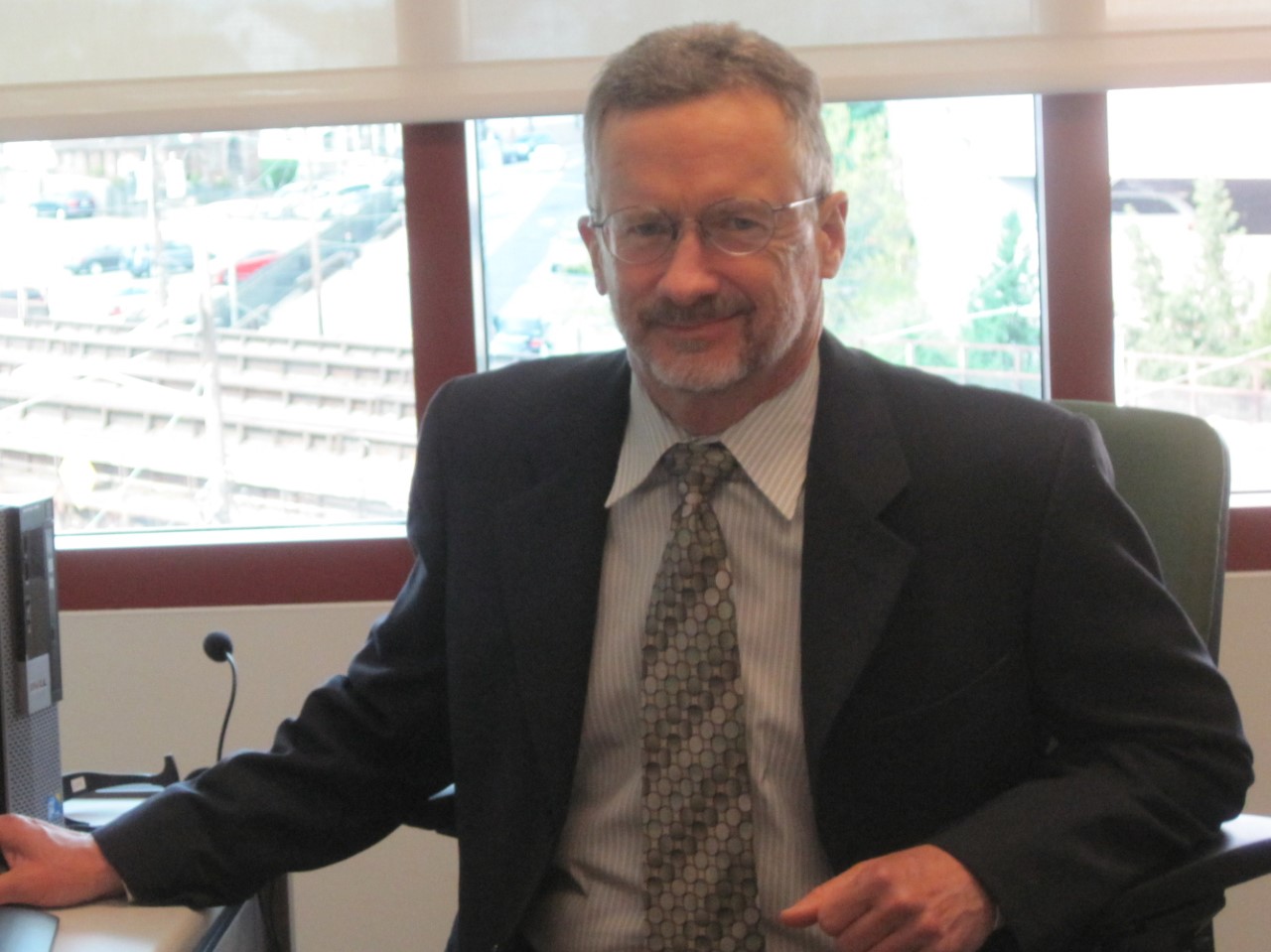
Research, a visit to Franconia, and prosthetics make up just one professor’s sabbatical months.
Fred Yaniga, associate professor of German, is researching and writing several papers during his sabbatical this fall.
“A sabbatical is often years in the making,” Yaniga said. “I know when my sabbatical is coming, and I start planning what I’m going to do and gathering resources for it. I know that my colleagues do that as well.”
Yaniga will spend some time in Germany and Austria in October to find resources for his paper on the use of prosthetics and amputation in German literature.
“Since I came to Hillsdale, I started to see in German literature a lot of characters who had had amputations and who were wearing prosthetics,” he said. “I thought, ‘That is so strange! Why does this keep on coming up?’”
Yaniga said an author’s inclusion of something grotesque like an amputation is often intentional and in service of something deeper.
“I always teach that the grotesque is there to highlight something,” he said. “It grabs our attention and highlights the conspicuous absence of the amputated limb. You, as the reader, are attracted to it viscerally and emotionally. You want to know why; you want to ask questions, but you cannot, because it is impolite.”
Yaniga also said he believes an interesting aspect of amputation in literature lies in the prosthetic devices characters use to make up for the lost faculties that come with an amputation.
“You have something that most humans take for granted like a limb, and now it is being replaced with something mechanical,” he said.
There is a certain level of artificial and technological change that was an especially popular literary trope in the 19th century, according to Yaniga.
“In some cases, there is a conspicuous absence which one would view as negative, and it isn’t always,” he said. “Sometimes, that moment of artificiality that comes from the use of a prosthetic becomes productive, and I find it to be interesting when it happens.
Yaniga said there are certain advantages of taking a sabbatical rather than pursuing research projects only during the summer.
“I’ll be visiting archives, museums, and institutes,” Yaniga said. “I would never have been able to do that during the semester. That has a distinct advantage because, in Germany, the academic semester doesn’t start until October, so there will be things going on there that would never happen in the summer.”
Associate Professor of Philosophy Ian Church, who was on sabbatical last year, agreed sabbaticals are more useful for research than a summer break. He found this especially true while on project, which is an ongoing research effort into the problem of evil.
“The project had a lot of sub-grants at different institutions that were doing their own research for the first year,” Church said.
Church said sabbaticals provide professors the opportunity to continue intellectual projects without the constraints of grading and lesson preparation.
“It gave me a chance to read more deeply into texts that I’ve been trying to get to for a long time,” Church said.
They can also allow professors to pursue personal projects in tandem with academic research. In between research projects, Yaniga plans to visit Oberweißenbrunn, his ancestral village in lower Franconia, south-central Germany.
“It’s a town much smaller than Hillsdale, so there’s a church, a graveyard, a main street, and that’s just about it,” Yaniga said. “It was hit very hard in the Thirty Years’ War and destroyed, and later it was hit hard in the 19th century by the ravages of poverty and starvation. That was what caused my ancestors to leave in 1881.”
Yaniga said he had never explored much of his German heritage because of his Slovak last name, but he had always known about it.
Charles Steele, chairman of economics, business, and accounting, is currently working on three projects while on sabbatical for the year. Even though he isn’t teaching, he said he still enjoys spending time advising students and going on hikes with the Outdoor Adventures Club.
One of his papers is on the development of private property rights in space.
“A couple of years ago, I presented a paper at a conference on this subject, and so I want to really develop that idea and come up with a theory about it that is not prescriptive, but which describes and predicts what will happen,” Steele said.
Another paper discusses scientist Paul Ehrilich’s 1968 book, “The Population Bomb.” Steele said he hopes once the paper is published, Ehrlich will be able to respond to the critiques that Steele made of his arguments.
“I hope to do a serious, dispassionate analysis of his book,” Steele said.“In his book, Ehrlich made a lot of predictions, most of which never came to pass.”
Ehrlich is one of the main scientists who popularized the idea of an overpopulation crisis.
“Some of the predictions did come true, but pretty much everything that he predicted correctly had nothing to do with overpopulation. In fact, he was wildly wrong,” Steele said. “Empirically, his overpopulation thesis was refuted, but the true believers don’t get rid of it, and that is very dangerous.”
Steele’s final project is an analysis of an increasingly popular set of criteria in the investing world called ESG, or environmental, social, and governance factors.
“ESG is a new proposal for accounting and analyzing procedures that is different from benefit, costs, profits, and losses and instead tries to analyze environmental, social, and governance goals,” Steele said. “It really is a kind of back-door central planning, and it is very popular in business schools and industry groups, but it is obvious that it is a tool by which the well-connected will crush competition.”
Steele said this paper will dovetail nicely with a conference in April for the soon-to-be-developed Center for Commerce and Freedom in which panelists will address ESG.
