
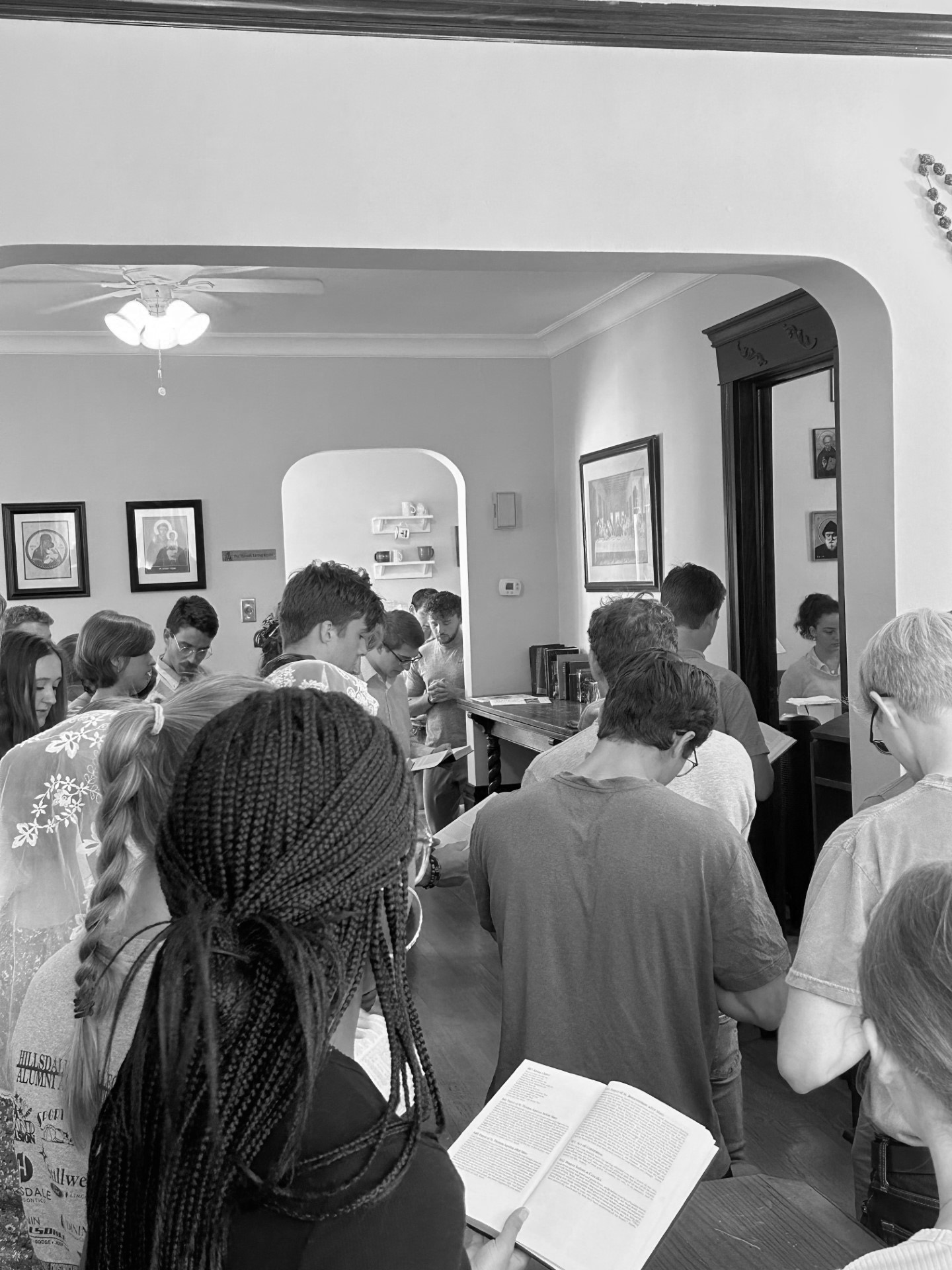
When no floor space remains, students kneel on couches to pray.
Every Thursday evening, students gather at the Grotto, St. Anthony of Padua Catholic Church’s student outreach house, for Convivium. After enjoying a home-cooked meal, they join in an opening prayer before the week’s speaker takes the stage. Students pack onto couches or vie for floor space, spilling into the kitchen and staircase when the three main rooms fill up.
Catholic students have attended Convivium in past years, but not like this, according to Ben Hufford, director of campus ministry for St. Anthony’s.
“Our first Convivium of the year was 190 people,” Hufford said. “The biggest Convivium ever before that was around 110.”
Hufford and his wife, Shelby, live on the second floor of the Grotto, ministering to students and making events like Convivium possible. More than anyone else, the Huffords have noticed changes in Catholic activity on campus in the last few years — just a decade after St. Anthony’s bought the Grotto. They said they see it as a reflection of the type of student Hillsdale College draws, and a natural response to the foundations laid by earlier generations of Catholic students and professors.
Attendance at a range of events has increased compared to fall 2022, Hufford said.
According to Hufford, the Masses celebrated every Tuesday at the Grotto average 70 people this year, while only the largest masses last year reached that size. The Grotto’s rosary group has grown from 40 to 45 people last fall to 55 to 60 people this fall.
The Welcome Bonfire is the Grotto’s largest event, held every August for new and returning students. Last year, it drew a crowd of 200 to 210 people. This year, 250 people attended — roughly 16% of campus.
Things were different in 1994 when David Whalen, associate vice president for curriculum and professor of English, arrived at Hillsdale to teach.
“There wasn’t much of a Catholic culture on campus,” Whalen said. “That didn’t surprise me. This was more or less a Protestant institution. But they were friendly and welcoming, and there was no problem with my being a Catholic.”
According to Lee Cole, chairman and associate professor of philosophy, Hillsdale Catholics didn’t always have a solid communal identity.
Cole attended Hillsdale as a student in the early 2000s. He had heard that a significant minority of the student body was Catholic but failed to see signs of it.
“I would see a number of students at Mass, but I didn’t know who those students were,” Cole said.
His junior year, he assumed a leadership role in the Catholic Student Council, which Cole described as a “quasi-bureaucratic entity that was meant to play a mediating role between the administration and Catholic students.”
Most Catholic events at the time were driven by professors, rather than students, he said.
“The number of activities we were able to do was extremely limited because we only had a handful of participating students,” Cole said. “We said the rosary together twice a week, but typically about five people would show up.”
As president of Catholic Student Council, Cole decided the group needed a rebrand. He suggested the name Catholic Society. It stuck.
That same year, Cole conceived the iconic maroon Catholic Society shirts as a marketing idea for the group.
“If you want to be a group on campus that has an identity and visibility, the first thing you need to make is T-shirts,” Cole said.
Cole’s future wife Kelly Cole ’02 designed the shirts. The idea succeeded: Cole’s senior year, Catholic Society had doubled its numbers from his sophomore year.
Like the name, the maroon shirts have remained a quintessential feature of Hillsdale’s Catholic student community.
Less than a decade later, the Catholic community found a home at the Grotto, which wasn’t always a ministry center.
In 2010, then-senior Mary Tillotson ’11 and five of her friends settled in an off-campus house on Union Street. They decided to name it The Grotto to honor the mother of God, even planning parties for the Marian feast days that fell during the school year.
The Grotto even played a part in Tillotson’s marriage.
“I remember going back to my friends at the Grotto,” Tillotson said. “I told them, ‘I’ve wanted to marry Luke Tillotson for several months now, and he just asked me out, and I don’t know what to do.’”
Fortunately, the women at the Grotto encouraged Tillotson to accept the date.
The year after Tillotson graduated, St. Anthonys bought the Grotto. The parish has owned it as a site for campus ministry ever since.
In his nearly three decades at Hillsdale, Whalen said he has noticed increasing numbers of Catholic students and professors seeking out the college. He attributes it to an organic shift in demographics and a response to Hillsdale’s founding principles.
“In Catholic intellectual tradition, reason has a high dignity,” Whalen said. “I think it’s virtually inevitable that Catholics are going to be drawn into a place like Hillsdale, which is committed to reasoned inquiry rather than trendiness, wokeness, and political correctness.”
A 2023 Pew Research survey reported that 60% of U.S. Catholics don’t attend Mass weekly. That said, many of the young Catholics in the U.S. that do seriously practice their faith say they find a place like Hillsdale attractive, according to senior Charlie Kacal, president of Catholic Society.
“I got here as a relatively lukewarm Catholic,” Kacal said. “St. Anthony’s and the Catholic Society upperclassmen really set examples that I wanted to imitate. I had a lot of upperclassmen really living and loving the faith, talking about it amongst each other, and sharing it with me when I asked.”
In line with his own experience, Kacal said he finds the Catholic student population grows organically.
“Make internal conversion your priority, and people will notice,” Kacal said.
Kacal, Whalen, and Hufford all said they see the growth of the Hillsdale Catholic community as a gradual, grassroots movement.
“Catholic communities that exist outside of Hillsdale are falling in love with the school and talking amongst themselves about how robust the faith is here,” Kacal said. “They’re sending more and more family members and friends. I think it’s really a national phenomenon.”
According to Whalen, the increase in Catholic community at Hillsdale also has to do with the growing commitment of its members.
“The kind of Catholic drawn to Hillsdale College is not the accidental Catholic,” Whalen said. “It tends to be the more devout, the more serious, and the better catechized Catholic.”
Hillsdale’s nonsectarian Christian identity may serve to increase the commitment of its Catholic community, Whalen said.
“Hillsdale College does not carry your Catholic identity for you,” Whalen said. “At Catholic colleges, in an accidental and unintended way, the college can be seen to relieve its students of the burden of carrying the flame of Catholicism themselves.”
Twenty-one years since Catholic Society’s founding, it boasts a wealth of participants and activities. According to Reilly Demara, vice president of Catholic Society, 1,053 students, professors, and parents are on the Catholic Society’s mailing list.
“How do you know how the Catholic culture is? It’s not just a feeling,” Whalen said, highlighting the many devotional and intellectual activities that Catholics on campus participate in, such as talks by visiting religious sisters, in-dorm Bible studies, and movie nights.
As Conviviums stretch the Grotto’s limits by the week, Hufford says he looks to God’s providence.
“God is sending all these people to the Grotto because it draws them close to him,” Hufford said. “And if he’s going to send all these people, then he’s going to provide the space. I think God really smiles on the Grotto. I’m not totally sure what the future is. But pray for us.”
Cole said students should embrace Catholic Society’s growth with humble gratitude.
“The language of grace takes on a very concrete meaning and becomes palpable when you see how something so modest has grown into something so vibrant,” Cole said. “It blows my mind.”
