
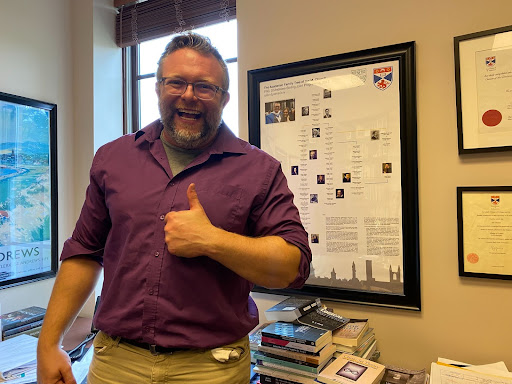
College means “partnership,” but Professor of Philosophy Ian Church’s academic genealogy project highlights a more “familial” side of learning.
Over the course of the past five years, Church has compiled an academic family tree tracing back student-adviser connections to the twelfth century. Church received his doctorate in 2012 from the St. Andrews and Stirling Graduate program in philosophy.
“It all began when my wife was pregnant with our fourth child,” Church said, “She had ‘morning sickness’ in the evenings, so she would go to bed early and leave me to my own devices.”
Church’s wife, Corrie, said she was not suprised by her husband’s new obsession.
“We had been married for 13 years at the time,” she said, “So Ian’s tendency to dive in deep to whatever he is interested in was not new to me. I mostly just thought it was funny and was glad he was enjoying himself!”
Church discovered several websites that traced supervisor-student connections through history. One website, Philosophy Family Tree, traced students back to their thesis supervisors, then those supervisors’ supervisors, creating a diagram of academic influence similar to a family tree.
When Church discovered the Philosophy Family Tree website was shutting down, he saved PDFs of the trees available and began doing some digging of his own.
Church had two primary supervisors, two secondary supervisors, and an external and internal examiner. Drawing upon the Philosophy Family Tree records as well as the Mathematics Genealogy Project database and his own personal research, Church built an 8-foot long version of his academic family tree.
Church can trace his academic lineage through figures such as G.E.M. Anscombe, Ludwig Wittgenstein, Bertrand Russell, Immanuel Kant, David Hume, Gottfried Leibniz, Galileo Galilei, Nicolaus Copernicus, Gregory Palamas, William of Ockham, and John Duns Scotus.
“The connections are interesting on the face of things, but it’s not the kind of thing that someone should put a feather in their cap for,” Church said, “Being connected to Isaac Newton or Copernicus really doesn’t mean much of anything because hundreds of thousands of people are academically descended from them.”
Many of the connections are direct supervisor-student relationships in a university setting, but the chart also includes connections that represent significant personal influence.
“A lot of the claimed connections are based on tradition, and there is a lot of debate,” Church said, “For example, people want to say that Ockham was supervised by Peter Espagna and through him, Albert the Great, the teacher of Thomas Aquinas. I haven’t been able to find anything to that effect. I try to go onto those databases and correct those errors when I see them.”
Church begins his research with encyclopedia articles, which often list supervisor-student relationships and then checks them against other sources.
“Sometimes I compare with other encyclopedia articles, other times I find myself looking at scholarly articles on supervisory practices in the middle ages at the University of Paris,” Church said.
Church’s research has even called into question major narratives of medieval scholarship.
“Traditionally people say that Ockham was the supervisor of Buridan, the best medieval logician,” Church said, “There is a lot of influence from Ockham in Buridan’s writing, but my research has found that the University of Paris assigned supervisors based on where the students were from, and since Ockham and Buridan were from different places, it is unlikely that Ockham would have been his supervisor.”
When he’s not busy cleaning up misleading websites, Church hopes to continue the project by tracing the academic lineage of more Hillsdale faculty to see where they overlap. Some of the faculty he has researched so far don’t meet up on his tree until quite a ways back.
“Tom Burke doesn’t overlap with my tree until Leibniz,” Church said.
Church said he found himself sympathetic with various projects he later realized are part of his academic ancestry.
“I wonder if I chose my supervisor because he was a descendant of those kinds of projects,” he said.
Church’s supervisor, Professor Patrick Greenough at the University of St. Andrews in Scotland, said he also wonders how much supervisors pass down to their students.
“What gets passed down from academic supervisor to supervisee is not a body of doctrine, but a way of thinking, a way of approaching and trying to resolve difficult questions,” Greenough said. “It’s for this reason that academic ancestry, in its various guises, is not only intriguing but highly enlightening.”
Church said the real value of this academic family is rather philosophical.
“I think it is really useful for demystifying the past,” Church said, “This is a humanizing exercise in that we are able to see that we were all students at one point, and we all have our time to take our turn on the front line of the academic world.”
