
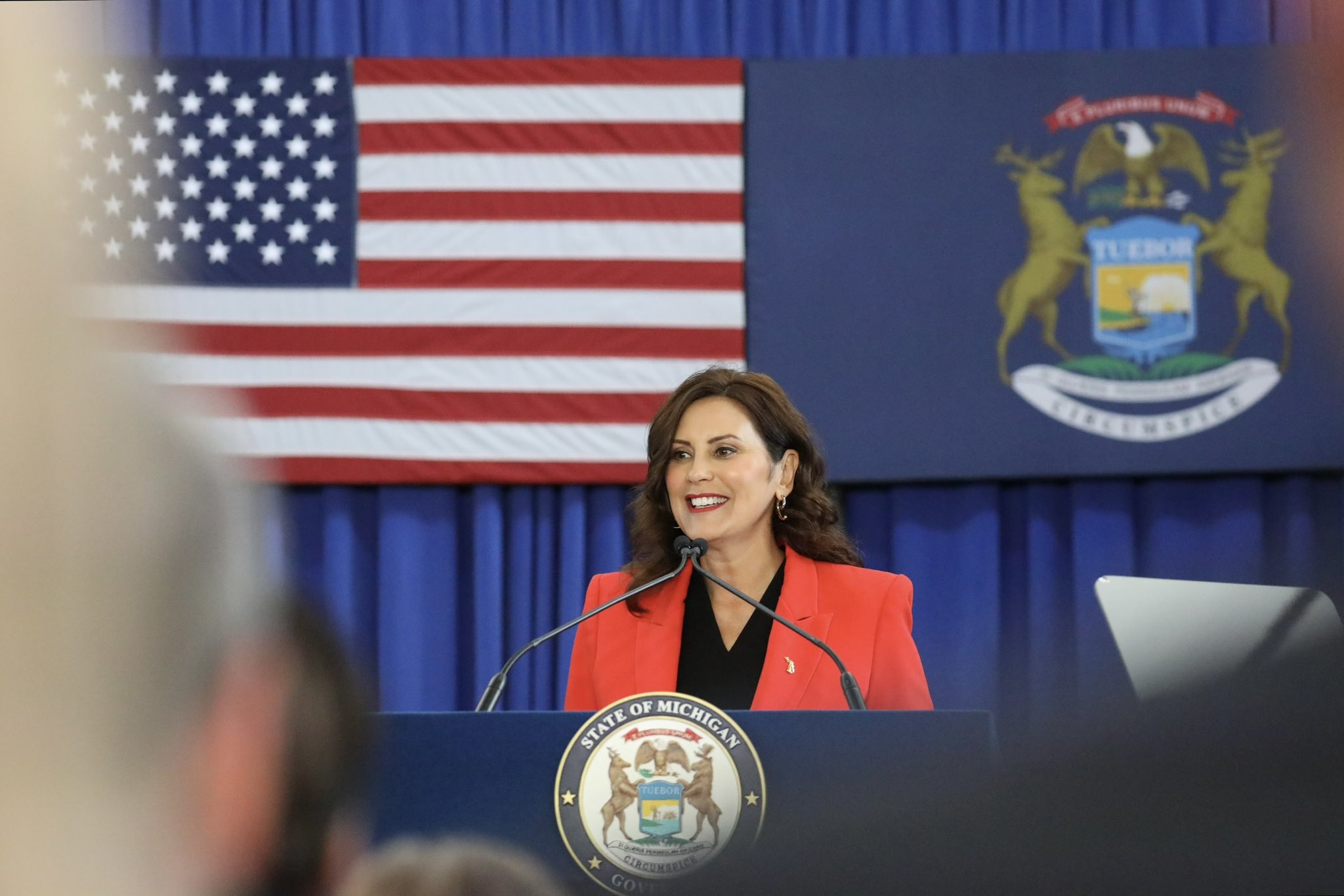
Gov. Gretchen Whitmer has met with local opposition on solar energy. Courtesy | Twitter
As Gov. Gretchen Whitmer endorses a “100% clean energy” standard for Michigan, calling it “ambitious and achievable,” local officials and policy experts are raising concerns about solar energy.
Local opposition, painful tradeoffs, and reliability concerns threaten to derail the transition to sources like wind and solar, which Whitmer called “ambitious and achievable” in the announcement.
Doug Ingles, a Hillsdale County commissioner whose district includes the City of Hillsdale, said he expects both support and backlash in response to solar projects in the region.
“One thing that does happen with solar farms of any size is if the same kind of land — flat farmland that can naturally catch the sun when they put in solar farms — it takes away from agricultural land,” Ingles said. “Potentially, in Michigan, that’s a huge problem.”
Local city and township boards review and approve solar projects. But as the projects face some local opposition to solar farms, Democratic legislators in Lansing are trying to bring these projects under the control of the Michigan Public Service Commission, which regulates public utilities in the state.
Media reports from Bridge Michigan and The Detroit News say House Majority Floor Leader Abraham Aiyash, D-Hamtramck, has been expected for weeks to introduce legislation moving oversight of “large-scale” solar projects from the local to the state level. Aiyash has yet to introduce the legislation.
State Sen. Joe Bellino, R-Monroe, said local governments in the eastern area of his district have been reluctant to approve solar projects.
“Nothing is happening in Monroe County,” Bellino said. “Mainly because all of the municipalities and townships have changed their ordinances for siting commercial solar. That’s going to be a problem with the way the Democrats want to push this new green energy deal down our throats.”
State Rep. Andrew Fink, R-Hillsdale, said he opposes efforts to centralize approval of land use for solar and wind projects.
“Overall, rushing toward these energy sources and subsidizing them in their current, underdeveloped form is a bad policy for the state,” Fink said.
Consumers Energy, a public utility company that owns a solar farm on Lake Wilson Road in Jonesville, said to The Collegian it expects solar to account for more than half of its output by 2040.
“Achieving this goal will require continued conversation and support from landowners, regulators and elected officials, and we continue to build those relationships, especially in rural and agricultural areas,” the company stated.
The company said it did not have any projects in the region “at a stage of development to discuss publicly.”
As companies such as Consumers Energy plan to advance this transition, some experts are sounding the alarm about the unreliability of newer energy alternatives.
Joshua Antonini ’22, a research analyst at the Mackinac Center, said wind and solar energy are “fundamentally intermittent,” meaning the plants are not always producing energy.
“So you need to make a lot more panels over a lot larger area to get the same amount of energy,” Antonini said. “That energy is not whenever you want it either, so that requires additional building of battery backup.”
The North American Electric Reliability Council — overseen by the Federal Energy Regulatory Commission — has warned about the reliability of the American grid two years in a row. The NERC said last year and earlier this year that two-thirds of the U.S. power grid is at risk of an “energy shortfall” when demand is high, such as during hot summer days.
“Everyone whose job it is to say ‘The grid is in danger if we continue on our path,’ is saying, ‘The grid is in danger if we continue down our path.’ I don’t see that as a wise thing to do,” Antonini said.
Energy companies must retain backup energy sources to cover solar production gaps, Antonini said. The two largest public utility companies in Michigan — DTE and Consumers Energy — don’t have sufficient battery backup to consider their wind and solar sources “non-intermittent.”
Instead, these backup sources can include coal and natural gas plants, which must be left running so that they are ready to produce if green energy sources falter.
“It’s not clear that you’re even saving on something like emissions when you’re leaving these plants idling the entire time,” Antonini said.
Bellino said there is no way the state can shut down its natural gas plants over the next 20 years while keeping the lights on.
“Nobody showed me the math yet,” Bellino said. “They don’t have the math ready. It’s a pie-in-the-sky dream to go green.”
