
For a 19th-century American, cemeteries were associated with Halloween — they were a part of everyday life, according to Bradley Birzer, the Russell Amos Kirk Chair in American Studies.
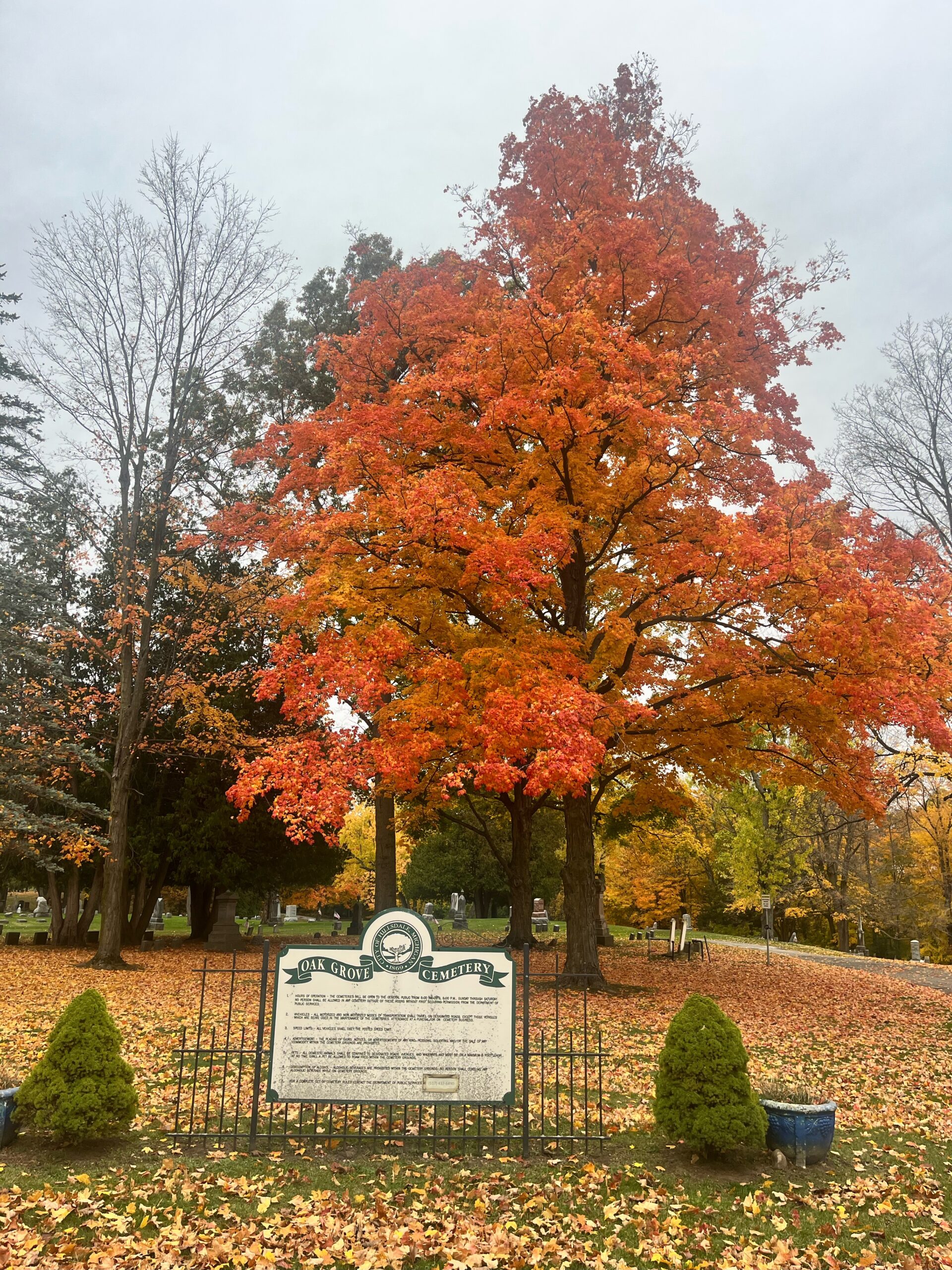
Birzer, who lives across the street from the Oak Grove Cemetery on Montgomery Street, led a tour of the cemetery on Oct. 16 in cooperation with Phi Alpha Theta, the history honorary.
“I appreciated the further history of Hillsdale that Dr. Birzer was able to provide,” said senior Lily Maciejewski, who attended the tour. “I thought it was fascinating that he was able to tell the difference between different kinds of gravestones and the different classes buried there.”
According to Birzer, cemeteries reveal a lot about the cultures that built them.
“In the 19th century, death was absolutely a part of life,” Birzer said. “Visiting the cemetery was something that you did all the time. You were meant to think about your own mortality and was very much a part of the culture.”
Cemeteries were designed as beautiful places for families to visit their loved ones and enjoy walks. One particular grave in the cemetery with Greek columns and a bench, would have been designed specifically for visitors to picnic or read a book, Birzer said.
“It was not unusual to have a family portrait taken at the grave when a family member died,” Birzer said.
Birzer has been giving a tour of the graves every fall since he and his family moved across from the cemetery in 2007. While he usually takes his classes to the cemetery, for the past two years he has given the tour with the history honorary.
Birzer said his favorite grave belongs to Robert McDougall, a corporal in the Union Army who fought with General George Armstrong Custer on the third day of Gettysburg.
“That’s probably my favorite place to go,” Birzer said. “I love going over there and thinking about that guy in that cavalry battle.”
The cemetery was founded in 1859 by the Oak Grove Cemetery Association as a resting place for soldiers and those killed in the service of the United States Army. More than 300 Civil War veterans are buried at the cemetery, as well as many residents who were involved with the college, including Hillsdale College founder Ransom Dunn and Civil War veteran and alumnus George A. Slayton, for whom the Slayton Arboretum is named.
“The most famous family buried in the cemetery would be the Robards,” Birzer said. “Jason Robards was a very famous actor in the ’60s and ’70s and his family is buried here.”
Many of the tombstones at the cemetery were provided by the Woodsman, a fraternal organization that was popular in town. Birzer said you can tell which gravestones were purchased by the Woodman since they all use the same font.
“During the 19th century, 80 percent of Americans belonged to these fraternal organizations,” Birzer said. “All of those groups would provide death benefits so when a male died, the fraternal order would pay for the funeral and they would have insurance benefits for the window.”
Although Birzer said he has always found the cemetery peaceful, a former student claims to have had a supernatural experience one night.
“I had a student — who now writes for National Review now — and he had a good friend who claimed he was walking in the cemetery when he heard a carriage go by,” Birzer said.
Earlier this fall, several students went to the cemetery to tell ghost stories after Assistant Professor of Psychology Jared Parker gave his Intro to Psychology class an unusual assignment — to listen to a scary story at night among the gravestones. Freshman McKenzie Ventrella accompanied a friend in the class to the cemetery in late September. They arrived at midnight and listened to “The Mogollon Monster,” a folk tale about a creature known as Arizona’s Bigfoot.
“I was already sketched out when we were sitting in the dark,” Ventrella said. “Then the story started and I actually became scared; I kept shining my flashlight around to make sure no one would come out from behind.”
Once the narrator started describing the smell of blood in the air, Ventrella said she had had her fill of fright and ran back to the car.
“The narrator started slowly describing blood as this metallic weird smell in the air,” Ventrella said. “I was kind of freaked out at that point and ran back to the car.”
Even though Birzer said 19-century Americans wouldn’t have been scared by a cemetery, they did have some macabre superstitions.
“One of the greatest fears was that you would be in a coma and they would just think you were dead. And so in 19th-century graves, they would often put in graves breathing tubes and also bells so if someone were to wake up, they would be able to signal,” Birzer said.
Still, Birzer said cemeteries used to be more about somber symbolism than they are today.
“We have these 19th-century people who clearly want their lives to look really prominent and nice but also their deaths. I think that is different from where we are now. We are a culture that hates death, but I think they had a very healthy understanding of death.”
