
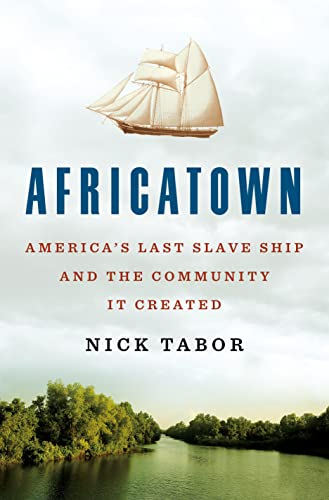
Nick Tabor ’09 examined the decline of a community founded by freedmen who entered America on the last transatlantic slave ship in a lecture Monday.
The English department and Dow Journalism Program hosted Tabor’s lecture, based on his book, “Africatown: America’s Last Slave Ship and the Community It Created.” Published earlier this year, the book explores how a Mobile, Alabama, neighborhood began, thrived, and fell into disrepair.
Tabor said Garry Lumbers, the great-great-grandson of the last survivor of the original founders of Africatown, asked the question that provoked Tabor to write his book.
“You don’t need to be writing about the descendants,” Tabor said Lumbers told him forcefully. “You should be writing about the neighborhood.”
Tabor said Lumbers noticed a stark contrast between how the neighborhood was and how it is.
With such a steep decline, Lumbers posed another question to Tabor. What happened to Africatown? How did it get to be that way?
“‘When I grew up there in the ’50s and ’60s, it was a thriving community,’” Tabor said Lumbers told him. “‘Everybody had big families. There were good jobs. There was a corridor of small businesses, and you could walk everywhere. Now when I go and visit, the place looks like a war zone. The business district has been destroyed. Half the housing stock is falling apart. There’s still a ton of heavy industry. A lot of it has just swallowed up the neighborhood.’”
Tabor said he first wondered if some form of environmental racism motivated the destruction of the neighborhood.
“It’s not a coincidence that this community established by survivors of the last slave voyage is now like the designated industrial dumping ground in southern Alabama,” Tabor said.
Some residents Tabor talked to said they used to have to go fishing to put food on the table, but the water was so polluted that some fish were blackened on the inside.
“‘We usually didn’t eat those ones,’” Tabor said they told him, “but some weeks we just didn’t catch enough so we would just fry those. It was really hard.’”
Tabor said they were haunted by those memories.
Tabor credited the decline of Africatown mostly to external economic causes, but said his economic explanation is somewhat an oversimplification.
“They didn’t put the factories next to Africatown because they wanted to give people cancer,” Tabor said. “They put the factories there because they wanted to make money and this was the path of least resistance.”
While Tabor wrote the book, Netflix came out with a movie to which he contributed, called “Descendant,” which tells the story of the descendants of those who were on that last slave ship.
“The film got a lot of attention,” Tabor said. “The book hasn’t really raised awareness to the extent that the film has, but it definitely tells the whole story, which you can’t get from the movie.”
Junior Will Gagnon said he was interested in the book’s impact and Tabor’s ability to pull together all the information.
“I found it interesting how in depth a writer like Nick had to go to get the detailed information that he had,” Gagnon said, “as well as the great importance that a project like this had to the individuals of that community.”
Associate Professor of English Dwight Lindley said he found he could resonate with Tabor’s point on economic and racial distinctions.
“What I thought was really interesting was the fine distinction between these questions of racial and economic motivation, which I found pretty compelling, having lived in Texas and Arkansas,” Lindley said. “There are a lot of cases like that where poor black people have gotten treated in the ways they’ve been treated, not just because ‘I hate you,’ but because ‘you guys are the path of least resistance.’”
Tabor said when he first visited Africatown, he felt very out of place. But when he asked residents and community leaders how they felt about him moving to their community to write about it, they all responded very positively.
“They all pretty much said that ‘we need all the help we can get. So if you’re going to do a responsible job, we’d love to have you,’” he said.
