
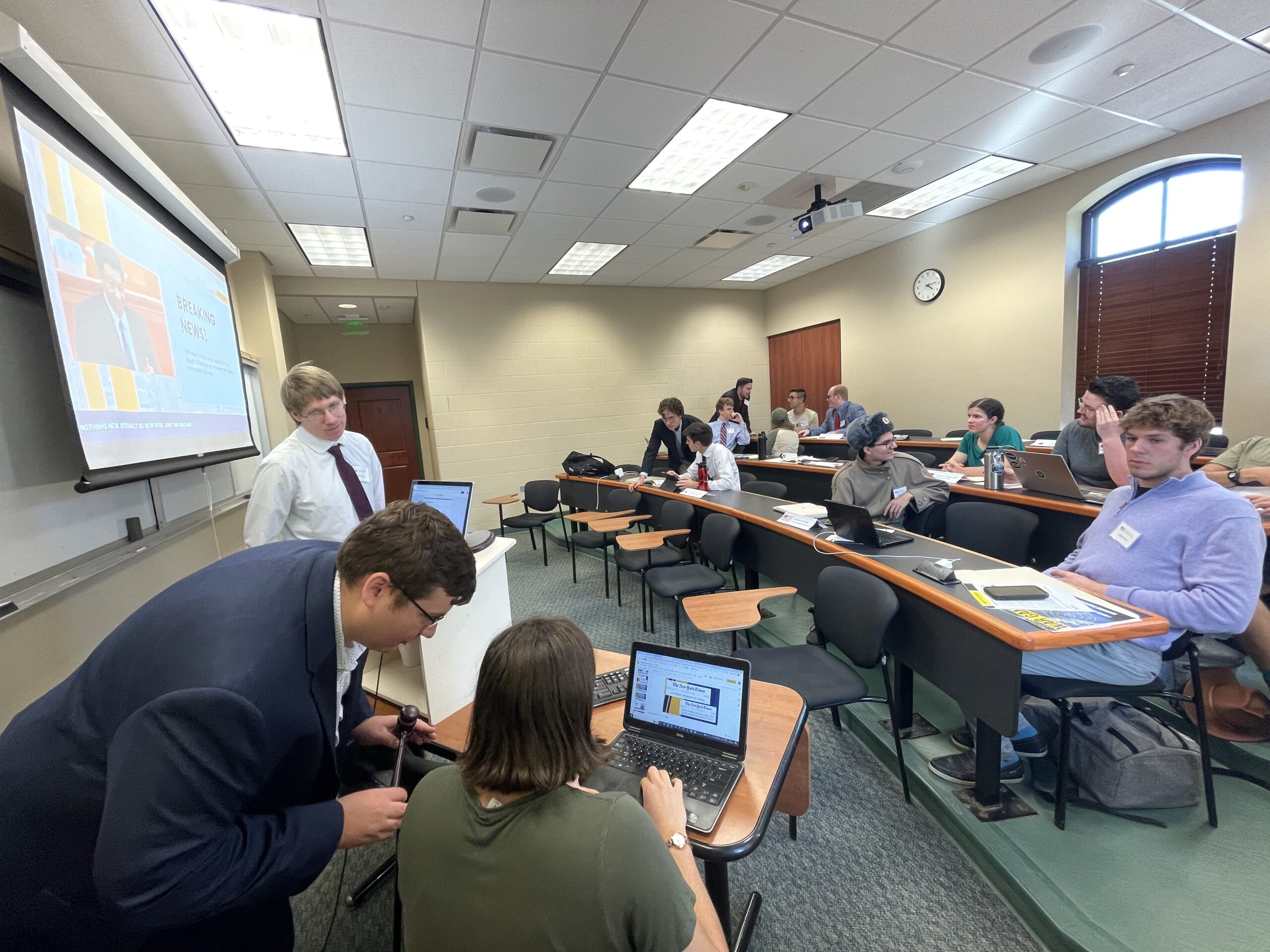
The Russia-Ukraine war ended in worldwide nuclear conflict after foreign political involvement in the war game simulation hosted by the Alexander Hamilton Society on Sept. 16.
Almost 30 people filled a classroom in Lane Hall from 12 to 5 p.m. to participate in the society’s strategic playout of the first three weeks of the war between Russia and Ukraine. The society creates diplomacy simulations which imitate the real-life decisions leaders make in war, said Erin Osborne, junior and president of the wargaming society.
“A war game, as the Wargaming Club sees it, is designed to roughly simulate being a real commander,” said senior Liam Moffat, vice president of the wargame society.
Planning for the event began during the summer so the day itself would run as smoothly as possible, club leaders said.
“Erin and I met and discussed the scenario in detail during the summer and again during the semester,” McNish said. “We talked through the details of what we wanted to simulate. Once that was hashed out, I designed the war part of the game and she designed the politics part of the game.”
Osborne said wargames teach life lessons about the importance and consequences of decisions.
“You can win a battle but lose a war,” she said. “You can sign a treaty that someone backs out of. Your character can get assassinated. The game keeps you on your toes, both as someone running the game and someone participating. You get to see your choices influence the ‘reality’ of the game in real time.”
Each player represents a real person involved in the conflict, such as military generals, government officials and diplomats. The wargame did not depend on actual historical events, but was instead a mock situation open to the decisions of those participating, according to Osborne.
“The simulation began two days prior to the actual start of the war in real life,” Osborne said. “Essentially, we gave the players the framework, and it’s up to them to decide what happens. Do they go to war at all? If so, who wins? How does everyone in the international community respond? Everything is up for debate.”
McNish said the Russians were far more successful in the simulation than the true outcomes from the past two years.
“The Russians adopted a very similar plan to the original,” McNish said. “They failed to take Kyiv in the opening days and much more quickly pivoted their focus to other areas. By the second week of the war they had overrun Ukrainian defenses in the Donbas region and were advancing on Kherson from the south. At the end of the game the Ukrainians were forced to retreat to the west side of the Dnieper River, essentially giving the Russians all of Eastern Ukraine. ”
Those behind the scenes running the game report the status of events and present situations throughout the game that players must overcome.
“Each team was given reports roughly every half hour and made tactical decisions based on those reports,” Moffat said. “Carter and I then ran these decisions simultaneously, resolved the combat, and created a new report for the players.”
As the game drew to an end, unexpected events occurred in many countries, according to Osborne.
“The last hour of a war game is always a little bit crazy,” Osborne said. “This time, Chechnya declared independence, Vladimir Putin started a ‘Putin Youth Club’ that taught children to ride bears, and Paris blew up, to name a few wildcards.”
Foreign affairs escalated to world-wide conflict before players escaped the classroom, back into the reality of Hillsdale College.
“The game ended in all-out nuclear war because of western intervention in the war,” McNish said. “That was unexpected to say the least.”
