
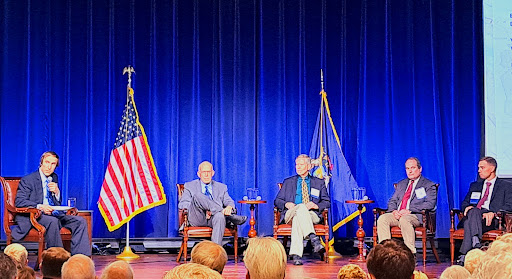
The United States needs to stop expecting other cultures to be similar to ours, according to a panel of scholars and military experts who spoke at the Center for Military History and Grand Strategy’s second annual conference on “The Afghanistan War.”
The panel, held Sept. 8 at 4 p.m. in the Searle Center, featured Assistant Professor of History Jason Gehrke, Professor of History Paul Rahe, William P. Harris Chair in Military History Mark Moyar, and Buske Distinguished Fellow in History Victor Davis Hanson. During the discussion the speakers reflected on the lessons learned and unlearned from recent foreign interventions, the complexities of international engagements, and the necessity for a more realistic approach.
“They held on to their tribalism to such a degree that any attempts to unite them under a common nationalist identity was much more difficult even to accomplish in 20 years,” Moyar said. “If there’s anything we can learn about Afghanistan, we need to be more realistic about foreign countries and not expect that their cultures are similar to ours.”
Moyar said there is a challenge in uniting tribal societies in Afghanistan under a common nationalist identity.
“We have to understand their society before we ever try to redefine their society,” junior Jonathan Popa said. “We needed to work within the system.”
Gehrke criticized the idealistic approach to nation-building.
”We thought somehow if we poured good intentions, idealism, money, power, strategic plans over time, we could remove the conditions for terrorism,” Gehrke said. “We never succeeded, even in our counter-drug operations. However, just recently, the Taliban issued an order that opium would not be produced for smuggling any more. This was met with dramatic success. Why can the Taliban do that? It goes back to historically Islamic identity.”
Rahe discussed the shift in U.S. policy toward Ukraine.
“Formerly, Trump armed Ukraine to the teeth with Javelin missiles,” Rahe said. “When Biden took over, he stopped that program only weeks after saying how he would not react if Russia made a small incursion into Ukraine. Putin thought the guy was weak. We can walk all over him, and he was right.”
Hanson highlighted the importance of understanding the thought process of Russian President Vladimir Putin.
“Putin only reacts in a cost-benefit analysis,” Hanson said. “He thinks he has a clear advantage.”
Donald Melhorn, a Toledo resident, traveled an hour and a half to Hillsdale to watch the panel.
“The program was engaging, interesting and absolutely top-notch,” Melhorn said. “The announcement that Hillsdale was launching a serious program dedicated to military strategy triggered my interest right away.”
A graduate of the U.S. Naval Academy and Yale University, Melhorn said he found the Q&A portion of the panel discussion most intriguing.
During the Q&A session, the panel addressed a lack of a clear objective in recent conflicts.
“We haven’t had a hot war since World War II,” Hanson said. “We don’t want to win a war with all of our wherewithal because we’re dealing in wars of choice — proxy wars. Especially when we run the risk of nuclear warfare.”
Rahe said that we need a clearly defined end goal.
“Fighting not to lose is not enough,” Rahe said. “We must have a defined goal so that victory can be declared. You must understand, however, that World War I and II are historical anomalies. The normality is proxy wars.”
The panel also addressed the challenge of understanding the culture of nations like Taiwan and China. Moyar acknowledged some progress in this area.
“Since the former president’s administration, we’ve become much more realistic about China,” Moyar said. “We now have numerous experts on China who understand them well, despite our current President not being particularly aware of that culture or the threat they pose.”
