
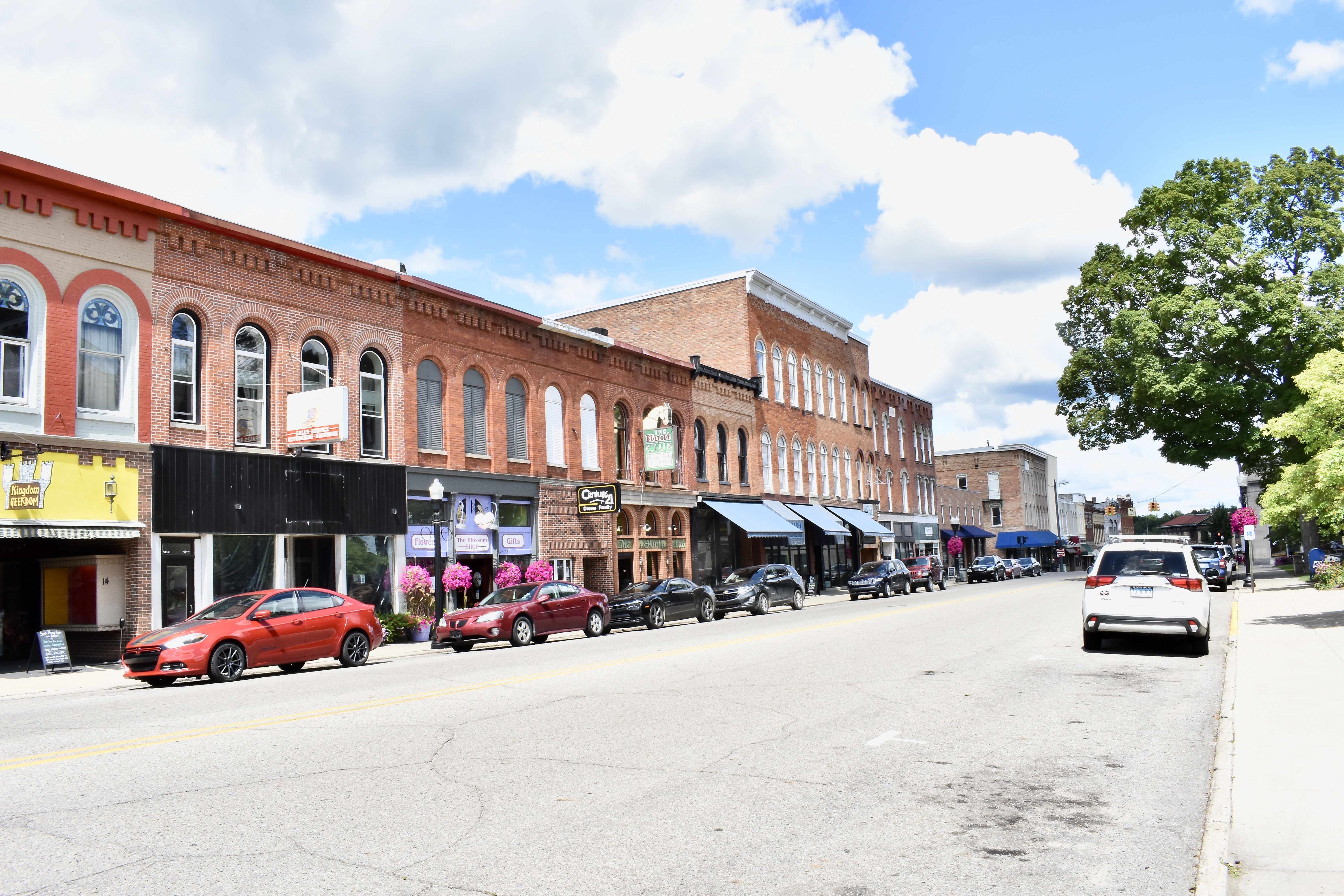
Hillsdale leads the way in urban policies. Julia Mullins | Collegian
There is a stark difference between the quaint shops and historic architecture of N. Broad Street and the sprawling parking lots along W. Carleton Road. On either side of Hillsdale College’s campus, there exists a perfect microcosm of 100 years’ worth of urban planning policies. N. Broad Street is characterized by closely packed shops, adorned with varying colorful facades and ornamentation. The street terminates at the beautiful post office and City Hall, drawing the careful observer’s eye to an attractive focal point. W. Carleton Road, on the other hand, is filled with generic, boxy stores set so far back from the road that they need large, flashy signs to catch the attention of fast-moving traffic.
The historic downtown of Hillsdale is a perfect example of traditional urban development: slow, calculated growth that maximizes land usage to reduce transportation time and infrastructure costs. Old urban policies naturally incentivized efficient development due to constrained modes of transportation, such as walking or cycling, as well as a limited municipal budget funded by local property taxes. Builders cared about ornamentation and style because those experiencing the town on a human scale would enjoy it, increasing a building’s property value. Mixed-use zoning allowed people to integrate their work with their domestic life, bringing the community together through plenty of shared spaces like neighborhood restaurants and cafes. The city itself was also incentivized to create attractive landmark buildings for its government offices by the increase in surrounding property value and subsequent tax revenue.
However, Hillsdale’s modern development, no more than a few blocks away, tells a very different story. Once Americans became dependent on cars in the 1950s, work and home no longer needed to be geographically close, assuming that there were enough parking spaces. Hillsdale expanded outward as fast as concrete could be poured and with it came big corporations brandishing trademark American consumerism. Living space segregated itself from commercial developments to escape the added noise of traffic, and ornamentation ceased as businesses changed from aesthetic designs to flashy branding to appeal to consumers. Parking lots destroy architectural beauty no matter the building and parking requirements make them mandatory. Several urban planning policies enabled this new approach to development. Parking, set-back, and greenspace requirements forced lower density than the market may have wanted. City planners also zoned much of the city as single-family residential, preventing developers from increasing density to create more affordable housing closer to Hillsdale’s central business district, the downtown.
For many U.S. cities, these mistakes were detrimental to their financial health. They became dependent on state grants to cover their large infrastructure costs and replace the depleted property values downtown. However, the City of Hillsdale avoided this mistake. For instance, a new Meijer is slated to break ground in 2023, just north of Tire Discounters on W Carleton Road. Instead of subsidizing their decentralized location, the city required Meijer to fund the expansion of the water main to their own site, while allowing them to lease out usage of that section to future businesses. This incentivizes Meijer to be frugal with its infrastructure and location choices and prevents additional liabilities for the city. According to the 2015 and 2021 City Master Plan, Hillsdale has also stated a commitment to expanding mixed use zoning in areas conducive to higher density, increasing walkability, and rerouting M-99 to decrease heavy traffic downtown.
These steps are integral to Hillsdale’s city planning strategy as it faces a unique challenge: because of Michigan state law, the would-be largest contributors to Hillsdale’s property tax base are exempt. This includes hospitals, churches, educational institutions, and government buildings. Therefore, the city must find ways to optimize its remaining tax base. They plan on increasing the connection between Hillsdale College and the downtown area, as currently many of the visitors to the college never contribute to the local economy through commerce. Additionally, both the Meijer project and the downtown revitalization efforts are an attempt at drawing the distant rural population to Hillsdale over places like Fort Wayne or Ann Arbor that might be the same distance away. Hillsdale’s downtown is also listed in the National Register of Historic Places, giving all the more reason for the city to support its vitality. Hillsdale is a small city with relatively slow growth so change will take time. However, with fiscal prudence and future plans, the City of Hillsdale will continue to be a strong, beautiful place for a long time to come.
