
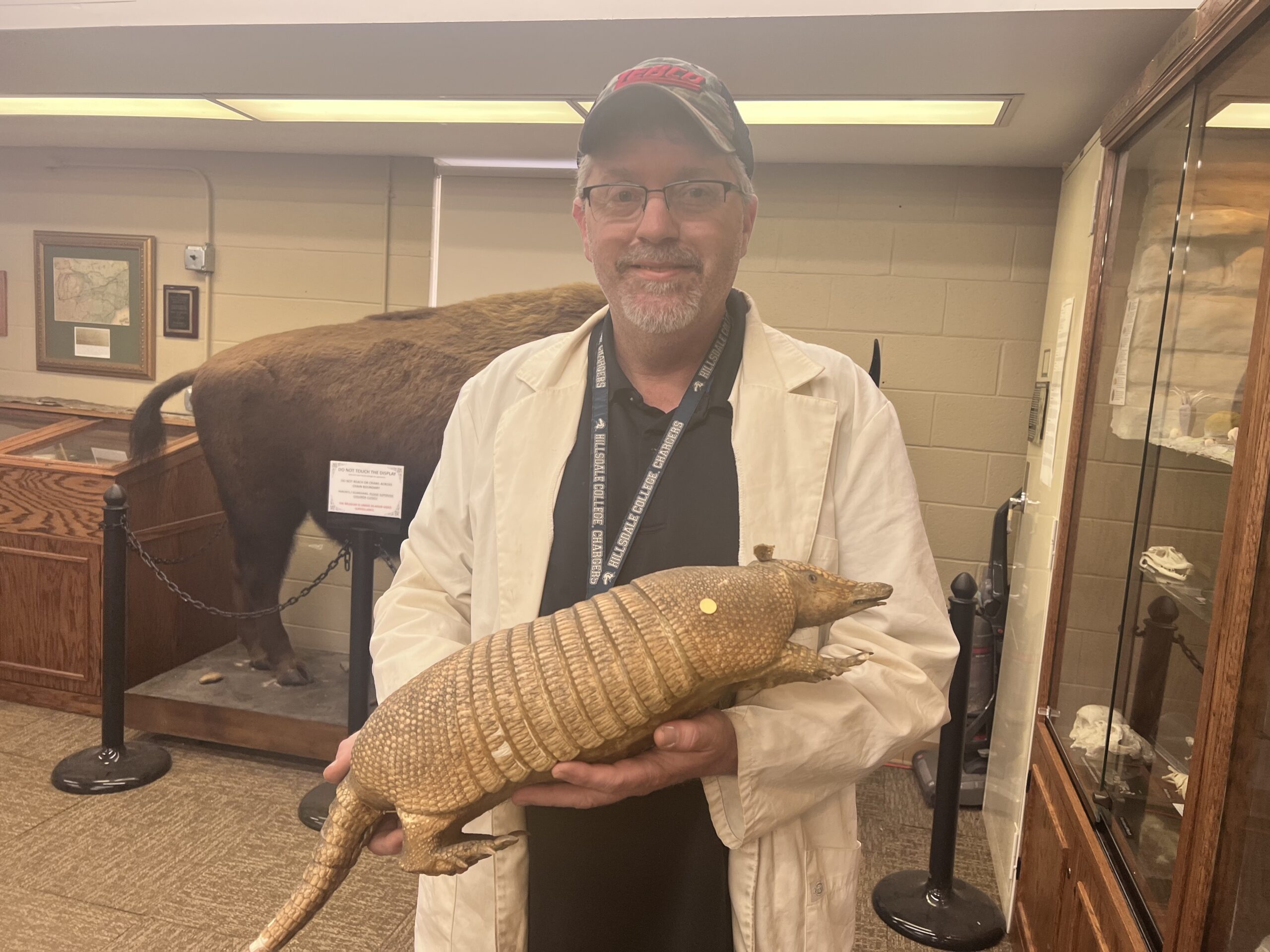
Hillsdale’s Daniel M. Fisk Museum of Natural History, created by Daniel M. Fisk in 1874 and rebuilt in 2010, hosts thousands of specimens spanning several centuries. While many students cut through the museum on their way to science classes, pausing to look through the exhibits reveals an assortment of cultural and college history. Anthony Swinehart, professor of biology and curator of the museum walks through five of his favorite specimens.
Armadillo
Originally from South America, the body of an armadillo can now be found in a museum display. The body has been preserved for more than a century.
“We think the armadillo is one of the few surviving specimens from our great expedition across the Amazon from 1880-1882,” Swinehart said. “There was one distinct record of an armadillo from that expedition.”
Swinehart said he is glad to have something tangible from the South American expedition — many of the other specimens from the trip were lost to history.
“The expedition brought back so much, and yet our allotment is lost. The Smithsonian still has its,” Swinehart said. “They publish an online record of what they have so all I have to do is look up the collector, the expedition leader’s name, and the date range between 1880-1882, and I can see what the Smithsonian has which gives us some idea of what we have because we split the findings pretty much equally down the middle with the Smithsonian.”
According to museum documents, armadillos are small mammals known for their leathery armor shells. Armadillo means “little armored one” in Spanish.
Gar Fish
The body of a toothy longnose gar is also on display in the museum. It was caught in Baw Beese Lake in 1882 and donated by Byron Archer.
“It’s a predator that eats fish and is very important in helping to maintain healthy populations of bluegill and other fish,” Swinehart said. “It’s probably still present in the lake today. I’ve never personally seen one or caught one, but I don’t use the fishing methods that would attract gar.”
The longnose gar, also known as needle nose gar, is found in shallow rivers and lakes with abundant vegetation throughout the eastern half of the U.S. according to museum documents.
Pottery
The museum has baked Native American pottery, donated by a woman whose niece was an anthropologist.
“The donor’s niece had unique access to this tribe that previously was not friendly and was even hostile to outsiders,” Swinehart said. “But she befriended them and was studying their culture and they presented her with hand painted and hand baked pottery in 1983.”
Shell collection
A collection of shells in the museum was given as a wedding gift in Tiverton, Rhode Island from the Free Will Baptist Church. The collection was donated by the estate of Rev. Franklin P. Augir, a trustee of the college, according to museum documents.
“The shells were presented as a wedding gift [by the wives] of seafaring men, and the shells were collected in the latter quarter century of the 1800s in the Indo-Pacific. It was in the collection of one of our trustees from the 1860s-1870s,” Swinehart said.
Walking stick
Though not on display, the museum holds a walking stick made from shark vertebrae and a sperm whale tooth. It was discovered in the college library a few years ago.
According to Swinehart, the walking stick likely dates back to the 1870s-1890s.
“The shaft probably has an iron or brass core and then they threaded shark vertebrae. The handle is made of a sperm whale tooth,” Swinehart said.
The museum is located in Strosacker Science Center Room 214 and is open Monday-Friday from 7:30 a.m. – 3:45 p.m.
