
The New Yorker covers Hillsdale College.
A long-anticipated profile of Hillsdale College appeared in this week’s edition of The New Yorker. It called the college “a home for smart young conservatives who wish to engage seriously with the liberal arts” and “a model that communities across the country are looking to adopt,” but also criticized it because “there is no department of women’s and gender studies, no concentrations on race and ethnicity.”
Written by Emma Green, who spent several days on campus in August, the 6,600-word article was published online Monday morning and appears in the April 10 print edition. Headlined “The Christian Liberal-Arts School at the Heart of the Culture Wars,” it quickly became a major subject of conversation on campus.
“Most of the information was pretty generic in terms of the fact that students have already heard all of this before,” said senior Alexa Robbins, whose English class discussed the article on Tuesday. “I could see how it would be more inflammatory for people who aren’t involved and don’t know the college.”
First published in 1925, the New Yorker has a weekly circulation of more than 1.2 million. Green is a staff writer at the magazine, where she focuses on “education and academia,” according to her online biography. She was previously a managing editor and writer for The Atlantic.
“We’ve read the piece,” said Emily Stack Davis, executive director of media outreach and public relations, in a statement. “In some ways, it offers a fair, if limited, view of the college. But that is all it offers. How much can a reporter learn about Hillsdale by being on campus for a few days?”
She added: “We were taken aback by how readily the reporter flattens and downplays some of the best things about Hillsdale College — the intelligence, friendship, and academic work of its students and faculty; the high regard for the Christian faith and spiritual growth among students; the liveliness of the discussion and debates; and how studying the Great Books forces students to engage in ongoing, intense study and debates.”
Green describes College President Larry Arnn as “the primary architect of Hillsdale’s rise to prominence” and quotes him extensively, from her own interview as well as the public record.
“I tend to like most of Dr. Arnn’s funny blurbs,” Assistant Professor of History Miles Smith said. “He says things in a kind of folksy way — I’m from the South, so I know the type of man who rhetorically comes at you pretty hard. When Southern men talk, they don’t sugarcoat things.”
Smith said the media often spins stories about Hillsdale.
“When he talks, I think people are likely, because he is from Hillsdale, to put the worst spin on things as possible,” Smith said. “I don’t think Green put the worst spin on things as possible, but I tend to think that a lot of the things Arnn says are self-evident, and they’re just also things people don’t want to talk about.”
Arnn has a history of speaking bluntly, Smith said. It may in part be Arnn’s “uncensored style,” Green writes, that has “complicated the school’s attempt to foster a broad revival of liberal-arts education.”
“She didn’t speak about Dr. Arnn’s principles, or what his vision is, enough. She found fair critiques of him, but then didn’t supplement them with the direct results of his efforts and his philosophy,” junior Michael Hoggatt, who was quoted in Green’s article, said. “The negative things that she wrote, I think, are fair parts of his history. But they weren’t supplemented with fair positive things.”
Green mentioned the success of Hillsdale’s K-12 initiative, its 1776 curriculum, and its new graduate school in classical education, adding that some classical-school leaders are wary of Hillsdale’s “more distinct political identity.” Robbins said Green’s analysis of Hillsdale’s success in the classical education world seems slanted.
“She had a beautiful narrative about graduate students reading a great poem and art for art’s sake. But then she ends with, ‘The classroom felt a bit like a cathedral,’” Robbins said. “I don’t know if she’s being fair or if she assumes that a modern reader is automatically going to think that there is no separation between faith and education — which is for many a bad thing. Green relies on the modern political correctness that’s been assigned to words like cathedral to carry an insult.”
Green used soon-to-be Catholic convert Hoggatt as an example of the debate on campus between Protestantism and Catholicism. Hoggatt said Green asked informed questions about campus life and religion, with no tone of attack.
“She was curious about the dynamics of what the demographics are on campus and then how they interact,” Hoggatt said. “The New Yorker fan base, which is New England educated elites and everyone else who subscribes, are people who might not favor the strong conservatism of Hillsdale. It seems like Green was genuinely curious about the liberal arts, and I think it’s fitting in the chronology of events in America because Hillsdale is the icon or symbol of the conservative movement in education.”
The article mentions Hillsdale’s political connections, from Florida governor Ron DeSantis, who is scheduled to speak on campus tonight, to former Vice President Mike Pence, who spoke in the chapel last month. It also includes many references to Hillsdale’s involvement in former President Donald Trump’s administration.
Although the article focused on the college’s political ideology, Smith said, students shouldn’t be reduced to one subject.
“What I don’t think Green understood is that students are not that interested in politics. Her piece was very much trying to figure out the politics of Hillsdale,” Smith said. “And so she came away thinking, ‘maybe this place isn’t as Trump as possible.’ But what she misses is our music or arts or all of the stuff that our students do. The religious life of our students is even reduced to a kind of traditionalist journey.”
Smith said the magazine’s audience might have a more favorable view of Hillsdale after reading the article.
“I think the intended audience is, I assume, for people who aren’t in the Hillsdale orbit already. If that’s the case, I think Green gave them what is probably a more charitable picture than what a lot of them think,” he said. “People have this idea that we’re all knuckle dragging Republicans and that we all love Trump.”
College Democrats President and junior Avery Noel said the article described Hillsdale’s politics fairly and could have expounded on college policies he finds damaging to political discourse, such as the one that strongly discourages protesting on campus.
“Students on campus have a very limited range of beliefs that I think was captured by the piece. It also represented that there are a number of students who don’t feel the need to engage politically, which I felt was accurate to my experience of the college,” Noel said. “In spite of this, the focus of the piece on the outward persona of Hillsdale as a strong conservative bulwark of education I felt was very accurate. Hillsdale has, in my opinion, become the shining star of education for the right, as a college that refuses to address gender identity or other ‘woke’ values, and I felt that was represented well in the piece.”
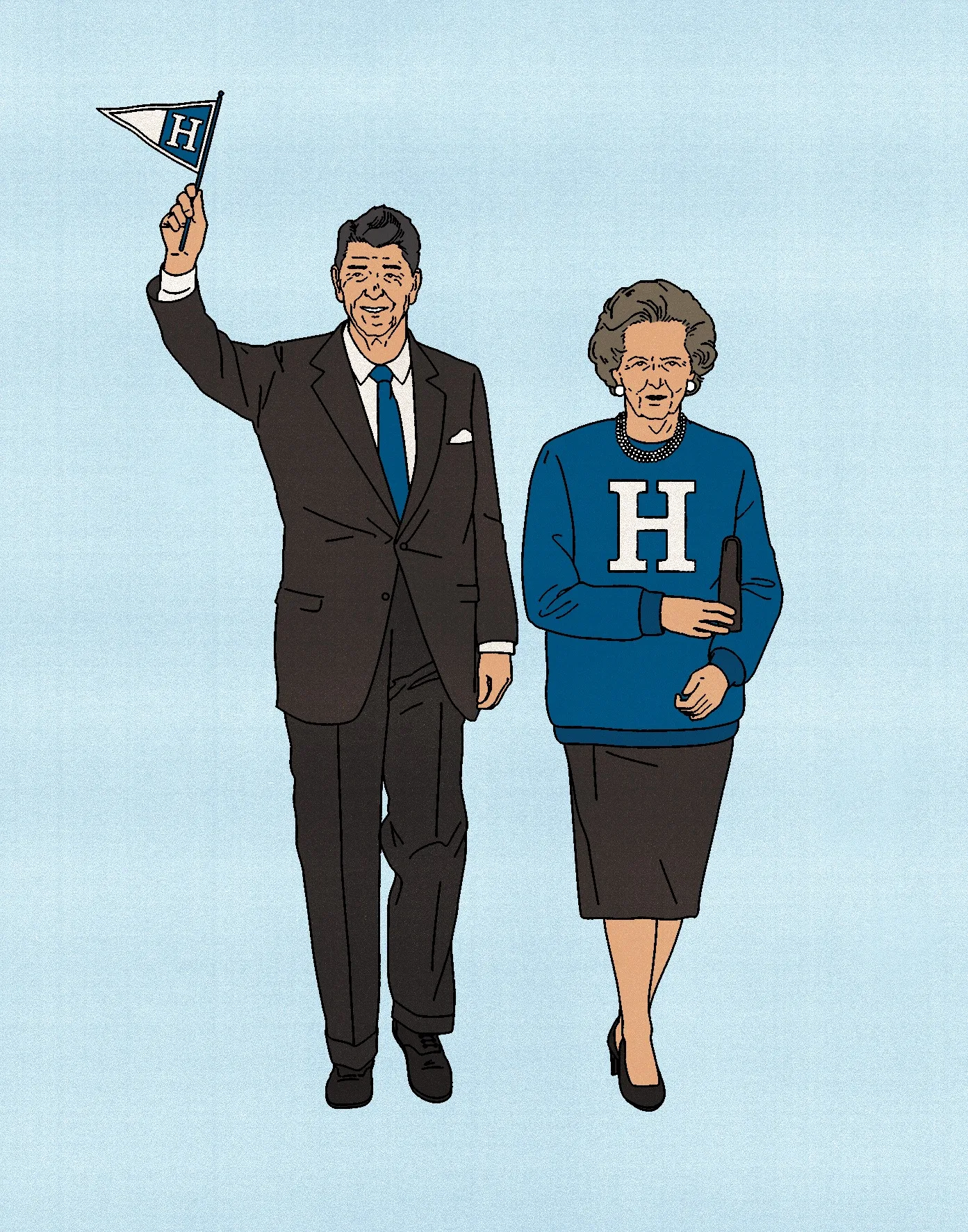
Some students appreciated the article for the art published with it. An illustration by Álvaro Bernis shows Ronald Reagan waving a Hillsdale banner and Margaret Thatcher wearing an oversized Hillsdale sweater.
“I really liked the picture and think the artist adequately depicted both the culture of Hillsdale as well as some of the most prominent, looked up to historical figures of many of the students,” sophomore Sarah Trimbath said.
Alumni on social media have called for stickers of the drawing. Mike Morrison ’12 wrote on Twitter that he “would not be surprised if students blow this up to poster size and hang it in their dorm rooms.”
