
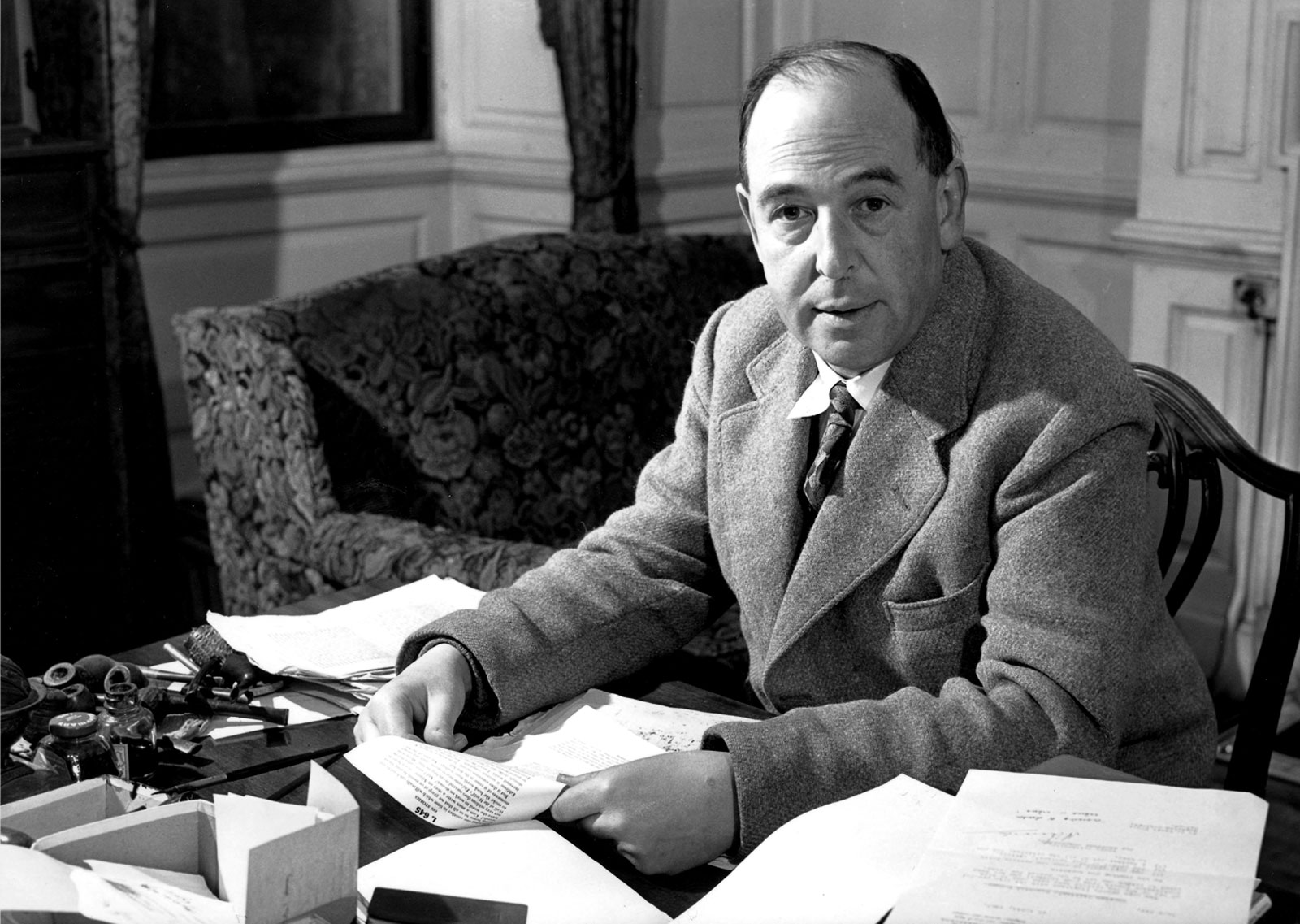
Add C.S. Lewis to the Liberty Walk. Courtesy | Wikimedia Commons
Designed to commemorate the moral visionaries who transformed the hearts and minds of others, Hillsdale’s Liberty Walk has yet to honor a religious figure in its bronze collection of historical statues.
C.S. Lewis remains the foremost Christian apologist of the 20th century to defend faith and freedom. Whether you first encountered C.S. Lewis’ work as a child in the lands of Narnia, a religious skeptic on a spiritual journey, or a Christian interested in developing a more robust understanding of the faith,
Not only did Lewis devote himself to the defense and exposition of Christianity, but he did so in a way that inspired the imagination of man for years to come. To this day, Lewis is revered as a religious figure whose writings continue to transcend denominational divide.
He has both impacted Catholic and Protestant Christians alike, young children, and stubborn atheists through his books on love and Christianity, distant planets and a magical wardrobe.
In “The Problem of Pain,” Lewis figures the primary conviction which motivated him to defend the Christian faith. According to Lewis, “A man can no more diminish God’s glory by refusing to worship him than a lunatic can put out the sun by scribbling the word ‘darkness’ on the walls of his cell.”
At a college that strives to maintain “by precept and example the immemorial teachings and practices of the Christian faith,” C.S. Lewis ought to be added to the Liberty Walk for his life’s embodiment of Christian virtue.
In many ways, Lewis’ traumatizing life experiences should have led him to despair. As a child, he suffered the death of his mother only to endure the nightmares of boarding school and the burden of a strained relationship with his father. Later, when he served in the First World War, he saw the horrors of the battlefield and was badly wounded.
Forged in an unhappy childhood, Lewis’s atheism was fueled by earthly experiences which tried to rob him of his hope. If it weren’t for his friendship with J.R.R. Tolkien, Lewis would never have come to the conclusion that “Atheism turns out to be too simple. If the whole universe has no meaning, we should never have found out that it has no meaning.”
In 1933, Lewis had a conversation with Tolkien and Hugo Dyson which marked a turning point in his journey from atheism to theism. Lewis’s doubts about the divinity of Jesus Christ diminished a year later when he felt a sense of “relief and weightlessness” prompting his conversion to Christianity.
Lewis’ faith was the catalyst for his reputation as a beloved literary scholar, Christian apologist, and children’s book author. After his conversion, Lewis wrote more than 30 books on the Christian faith alone.
In a 1944 paper for Oxford Socratic Club, Lewis wrote: “I believe in Christianity as I believe that the sun has risen: not only because I see it, but because by it I see everything else.”
Lewis characterized his spiritual pilgrimage by joy. Despite the haunting experiences of his past, joy sustained Lewis in times that seemed absent of comfort and happiness.
Because of the presence of joy in his life, Lewis restored hope to a world that had lost it. “No soul that seriously and constantly desires joy will ever miss it. Those who seek find. To those who knock it is opened,” wrote Lewis in “The Great Divorce.”
Through his many books, BBC radio broadcasts, and teachings at Oxford and Cambridge universities, Lewis hoped to free those who had not yet experienced the joys of love.
By giving readers a vision of the joy set before them and an image of things to come, Lewis played a profound role in focusing readers’ minds on something other than themselves, a story greater than their own.
None of this would matter much if it weren’t for Narnia. In a land where beavers speak and a lion rules, readers are drawn to a mythical story which will help them accept the supernatural magic of the Incarnation.
The only man to take a homeric approach to apologetics, Lewis gave his readers a mythology before introducing the true myth of Christianity. In order to develop his audience’s moral imagination, Lewis had readers encounter the real and concrete in stories like “The Chronicles of Narnia” and “Out of The Silent Planet” before moving to the more abstract narrative arches of “The Abolition of Man” or “The Problem of Pain.”
Lewis helped readers understand that the life of the redeemed hero was better than the life of the vanquished villain, and then he presented them with the life of Christ and the harrowing of Hades.
Motivated by the effectiveness of storytelling and the power of the imagination, Lewis married the worlds of truth and fantasy in such a way that developed readers’ hearts and minds.
If Lewis is featured in Hillsdale’s Liberty Walk, he will not only represent the college’s preservation of the Western Theological Tradition, but he will also honor all denominations on campus with his presence.
