
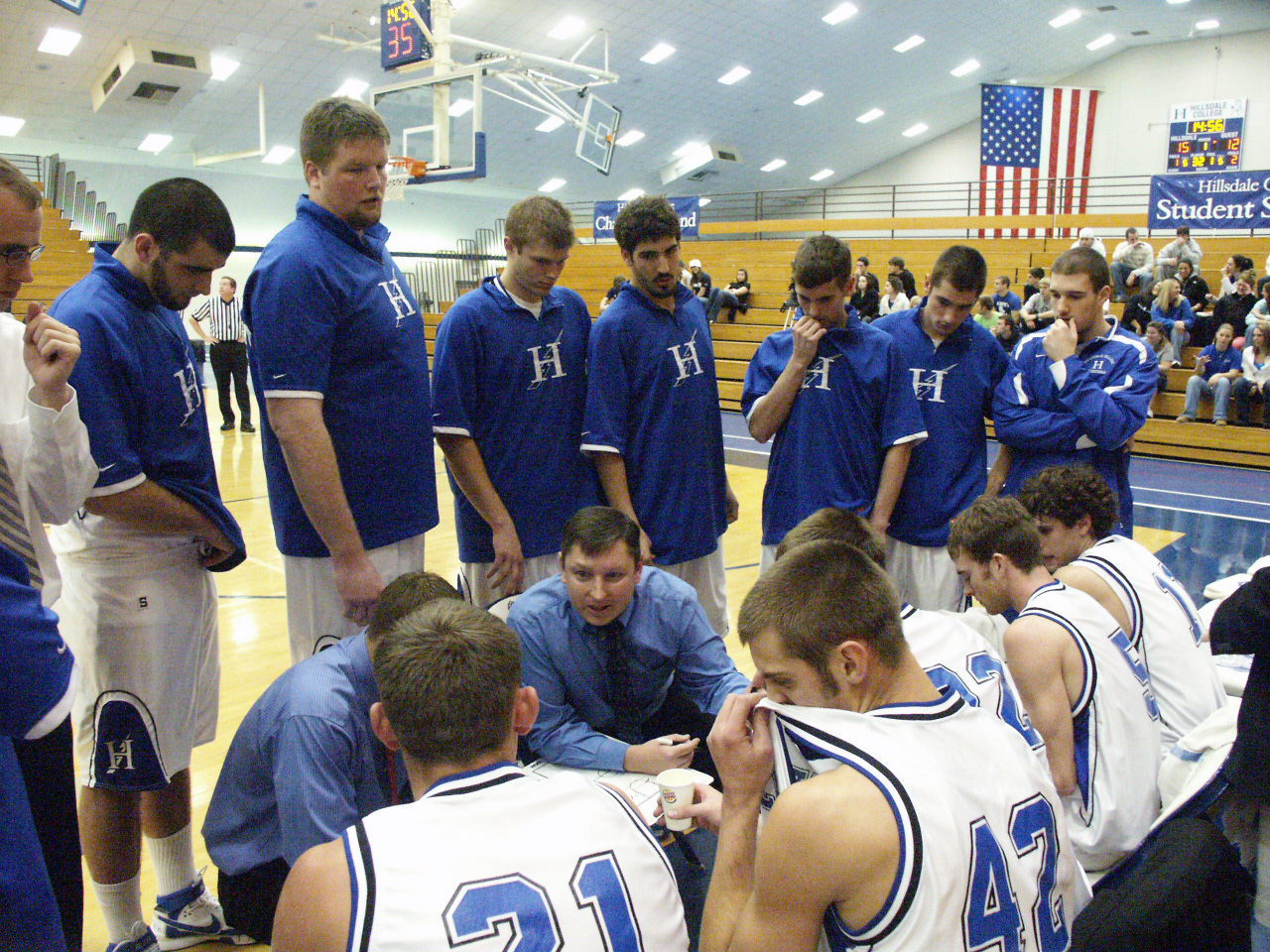
Head coach John Tharp has led the Hillsdale men’s basketball team for 16 years. Courtesy | James Gensterblum
How John Tharp built the men’s basketball program with the highest winning percentage in the state
In the final game of the 2019-20 season, the Charger men’s basketball team took down its long-time rival, the University of Findlay, in a last-second battle to secure their first ever regular season conference title since switching to the G-MAC.
“During the locker room celebration when we beat Findlay to clinch the regular season title, Tharp came up to me and hugged me while I was in the shower,” former two-time all-conference Charger Dylan Lowry said. “It was one of the most incredible moments of my entire life. He had a full suit on.”
Since the 2017-18 season, teams from the University of Michigan and Michigan State University have made multiple trips to the Final Four and even a run to the NCAA Championship, but the NCAA men’s basketball program with the highest winning percentage in the state is from Hillsdale College.
Over the five-year stretch, the team has won 73.94% of its games, going 105-37, which is more than 5% better than any other program in Michigan. Behind them are Ferris St. with 68.46%, MSU with 67.26%, and U of M with 66.46%.
“When you go to the YMCA growing up and there’d be five old guys at the end of the court, and you lost to them 10 to eight, and it’s like ‘how did I lose to those guys?’” head coach John Tharp said. “Well, they pass, they catch, they play together, they’re skilled. In our own way, that’s kind of what we are.”
Despite playing fewer games than its DI counterparts, Hillsdale was the only one of 25 programs in the state to win at least 19 games in each year since 2017.
The past three years have been especially fruitful for the team. A pair of NCAA Tournament Sweet Sixteen runs and a bid to the Elite Eight — both the first such runs in program history — cemented the team in the record books of both the team and the nation.
“The last two or three years, it’s been pretty absurd, the winning they’re doing, it’s shocking,” Lowry said.
The key to the program’s historic success, according to current and former players, is simple: the team’s 16-year head coach, Tharp.
“You’ve got turnover in college basketball, guys leave,” Lowry said. “Every year you graduate four, sometimes up to seven guys. Even our staff, none of the current assistants were on staff when I played. Even while I was there, I had probably six or seven different assistants in my five years. There’s one common variable, and that’s coach Tharp. It all goes back to him.”
Tharp has recently topped 500 career wins, and holds the program record for wins as a head coach with 297, 125 more than any other coach.
According to former three-time all-conference Charger Davis Larson, Tharp is someone you both love and fear at the same time, saying there simply aren’t many coaches like him anymore.
“It’s such an interesting combination for a coach, I feel like it’s so rare with all the other coaches I’ve seen and had,” Larson said. “He’s someone you truly, truly want to play for, you always do what he says and respect what he says, yet you love him as a father, and he loves you as a son.”
After the team’s final practice before leaving for Evansville and the Elite Eight in 2022, Tharp shared a message with the team.
“He calls us into the old locker room in the back corner of the gym, where everything started for him and his teams 16 years ago,” fifth-year senior guard Jack Gohlke said. “He talked to us about how he started at the program from those days where he only had a couple guys returning when he was the new coach coming in and he had to build the program on toughness and those guys going to battle every day. He talked to us about how we were the next step in the revolution.”
In April 2007, Tharp took over as the Charger head coach following 13 seasons leading DIII Lawrence University in Appleton, Wisconsin, to a program record 204 wins.
With a losing conference record in four of its previous five seasons, however, the program Tharp took over had been treading water. Hillsdale had yet to find any consistent success since joining the NCAA in 1990, with only three tournament appearances and no tournament wins in the program’s history.
“When I interviewed here, I came back for the second interview and I had my wife in the car,” Tharp said. “We’re driving and it was late at night. We’re pulling in and she’s like ‘where are we?’ and I said ‘honey, I’m not quite sure to be honest with you.’”
The little-known DII school in rural Michigan was recognized far more for its academics than for its athletics.
“He was interviewing at Hillsdale and he was told that a different candidate that now coaches a different team pretty much told Dr. Arnn that you can’t win with smart players,” Lowry said. “And I think Tharp took that very personally.”
To make matters worse, only four players from the previous year stayed with the program once Tharp took over. Tharp still remembers each of their names.
“Those four guys I owe a great deal to,” Tharp said. “We put together just a great collection of people and we went to battle. We went .500 our first year, went eighth seed in the GLIAC tournament and lost to Grand Valley.”
It was after that year that Tharp’s vision for the program began to take shape.
“The next year was the revolution,” Tharp said. “The revolution was we needed to just claw our way to the top of the GLIAC. My first year Grand Valley beat Michigan State and Findlay beat Ohio State in exhibition basketball and I walked in like ‘what the heck did I just get myself into?’ So we started the revolution.”
Now, 15 years later, Tharp has revolutionized Hillsdale ball. During his time the team has appeared in five NCAA Tournaments, and produced four all-Americans, and won the conference three times.
In an age of college athletics characterized by NIL deals, the transfer portal, and social media, Tharp has built a basketball powerhouse on tradition.
“He recruits these guys that understand that tradition, that understand the reason they’re playing for,” Larson said. “Our team’s had a lot of success but we learned that success from previous teams we played on and from previous players. Even the players that didn’t have as much success on those teams, we learned all of that from them. I think when you put on a Hillsdale jersey, you’re not just representing the school, you’re representing previous players – either teammates or not — that put on that jersey.”
Slow, methodical pace of play offensively, and a grit-and-grind, physical approach defensively are usually descriptions reserved for the old-school basketball teams of the ’80s and ’90s. For the Chargers, however, it has become the norm.
“I would say it’s a traditional, beautiful way of playing basketball, the best way of playing basketball,” fifth-year senior Peter Kalthoff said.
The team emphasizes hard work and selfless play on both ends of the floor, with a rallying cry of “one fist” underscoring the Chargers’ goal of winning.
The team’s traditions and togetherness show off the court as well, as the team claims to be the greatest basketball family in the world.
“I think that’s true,” former two-time all-American Charger Patrick Cartier said. “Obviously it results in wins on the court, but it’s a very process oriented way of looking at things. Come in every day, love each other, work hard, and be there for one-another on and off the court.”
For Cartier, that culture of family was clear to him before he was even on the team, and it’s what he says convinced him to join the program.
“Once I came on my visit, it was literally while I was driving home I was like ‘that’s it, that’s where I’m going,’” Cartier said. “I was hanging out with the team and I remember I was laughing my butt off the whole time. I was like ‘wow, this is so cool, the whole team all went out to dinner, every single guy. It wasn’t just little cliques, the whole team came out, and those are the type of guys I want to be around, the type of culture I want to be a part of.’”
This was not an experience unique to Cartier. According to Larson, he knew he was going to be a Hillsdale Charger as soon as he stepped on campus.
“The people on campus and around the team, they speak for themselves,” Larson said. “I remember the first day when I went on my visit, I was hanging out with Dylan Lowry and Nate Neveau and I was like ‘these guys could easily be my best friends.’”
Tharp is the fountainhead of this culture, according to Kalthoff, and it trickles down to the staff and players. For Tharp, these relationships with and between the other members of the program are intentional parts of his vision for the team.
“This program is a family, this is a lifetime commitment that you’re giving and in return you’re gonna get a lifetime of friendships,” Tharp said.
Recently, however, the transfer portal’s rise to prominence in college sports has challenged the program. The team lost Cartier to Colorado State as a graduate transfer following last year’s Elite Eight run. According to Tharp, more than 1,800 basketball players are currently in the transfer portal between DI and DII.
At a four-year institution with Hillsdale’s academic standards and only two graduate degrees as options, the Chargers stand in contrast to many other NCAA programs. Every player currently on the roster was recruited by Tharp in high school.
“What I’m most concerned about is developing guys and losing them,” Tharp said. “We’ve had some success with redshirting some guys here and having them their fifth year, which has been our way of neutralizing some of the transfer portal or maybe not being quite as athletic; having a fifth-year, experienced man on the roster.”
This strategy has proved consistently successful for the team, with 10 of the 16 all-conference appearances by a Charger over the last five years being by a fourth- or fifth-year player.
Throughout this run, Tharp has always kept his former players, the original revolutionaries, on his mind.
“It’s been a reflection of the start of the four guys that were here,” Tharp said. “It’s a reflection of the players over the years, it’s been a reflection of the assistant coaches that we’ve had over the years. We’ve set a precedent for us, and we’ve got to keep on honoring those guys and try to keep playing at that level.”
