
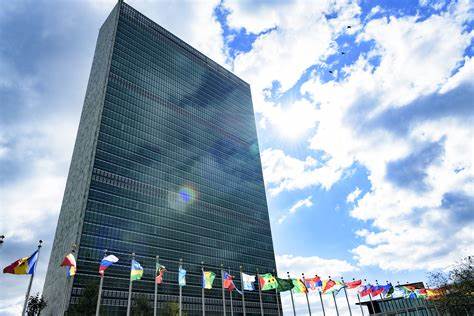
United Nations Headquarters, New York City.
Despite the opposition, conservative voices need to be heard at the United Nations, said sophomore Mark Den Hollander who attended the U.N.’s annual Commission on the Status of Women last week.
The Commission on the Status of Women was established in 1949 and is the largest intergovernmental body dedicated to gender equality, according to the U.N.’s website. Since its founding, the commision has hosted a two-week session every year.
Den Hollander lobbied with the Christian Council International, a global nonprofit, at the conference, hosted at the U.N. Headquarters in New York City from March 6 to 17. The conference discussed education in the digital age for achieving gender equality.
“It was my first time at the U.N.,” Den Hollander said, who has worked with CCI since 2021. “I was lobbying, but I was also trying to get a better understanding of how the U.N. works.”
The CCI is an international nonprofit that promotes a Christian worldview among global organizations such as the U.N. and European Union. It was founded in 2013 by Henk Van Schothorts and has attended the Commision of the Status of Women since 2017.
“Our goal at the conference is to try to achieve a favored position of the natural family and to prevent all kinds of progressive language such as gender identity and comprehensive sexual education,” Schothorts said.
During the conference, CCI focused on fighting the ECP/EU, a proposed agreement between the EU and Caribbean, African, and Pacific nations. Among other things, the agreement is attempting to codify abortion as an international, fundamental right, according to Schothoths.
Den Hollander said the agreement is a form of cultural imperialism.
“It’s a 20-year bidding contract between the European Union and African countries,” Den Hollander said. “Specifically, our organization is trying to fight against the cultural imperialism that Europe is trying to foist on these countries as they enforce their standard of cohesive sex education, abortion, and other things on these countries.”
During the conference, Den Hollander said he noticed a divide between European and non-European countries as they approached women’s issues. While Western countries largely focused on social issues, he said non-Western countries often fight for more serious issues such as access to basic healthcare.
He cited a side conference hosted by the Democratic Republic of the Congo as an example.
“They highlighted how recently there is a lack of equality for women because of ongoing violence in the region,” Den Hollander said. “In order to improve the lives of women, they need to first establish peace. Part of the reason why there isn’t peace is that different countries, especially France, have been destabilizing the region by sending weapons in.”
According to Craig-Austin Rose, associate director of governmental relations at the Center for Family and Human Rights, each U.N. conference ends with an agreed conclusion: a contract that U.N. agencies are bound to execute and promote.
This year’s agreed conclusion includes 89 clauses that reaffirm many of the U.N.’s past resolutions such as the Universal Declaration of Human Rights and the Convention on the Elimination of All Forms of Discrimination against Women.
The resolution contains language that Rose termed “U.N. speak.”
“The language is very hifalutin but ultimately very shallow,” Rose said. “For example, the resolution condemns all forms of violence, including sexual and gender based. But what exactly is gender based violence? It is a very vague term.”
Rose said vague language such as “gender based violence” is used to condemn pro-life laws and opposition to gender ideology. He also said U.N. agencies can use vague language to allow for more progressive interpretations of their resolutions.
“The language seems innocuous to the public,” Austin said. “Things may not explicitly mention abortion, but it doesn’t have to because bureaucracies know exactly what it means. The language makes it more palatable and opens it up to greater interpretation. It even allows it to get around the law in some countries.”
Den Hollander said while the U.N. is hostile to conservative perspectives, he still felt the conference was a success.
“As an organization, when we walk into a conference, it is really our goal to develop connections and build a network,” Den Hollander said.
As well as meeting with representatives from the Center for Family and Human Rights and the Christian Embassy, Den Hallander also got breakfast with a South Korean and Indian Diplomat.
According to Rose, the greatest advantage of these conferences is using them to remind countries of their sovereignty. Even if U.N. agencies are bound to follow resolutions, countries are not, he said.
“Our best hope, which is quite good, is to constantly remind delegates that they have national sovereignty,” Rose said. “That they should not be pushed around by these agencies or powerful western donor countries.”
Den Hollander said he was also hopeful after hearing diplomats and lobbyists from around the world who supported CCI’s mission.
“I went to an event sponsored by Brazil and they shared with me that they do not have access to abortion,” Den Hollander said. “It was refreshing to talk with other people who supported family rights and seeing that there are people with similar beliefs all around the world.”
