
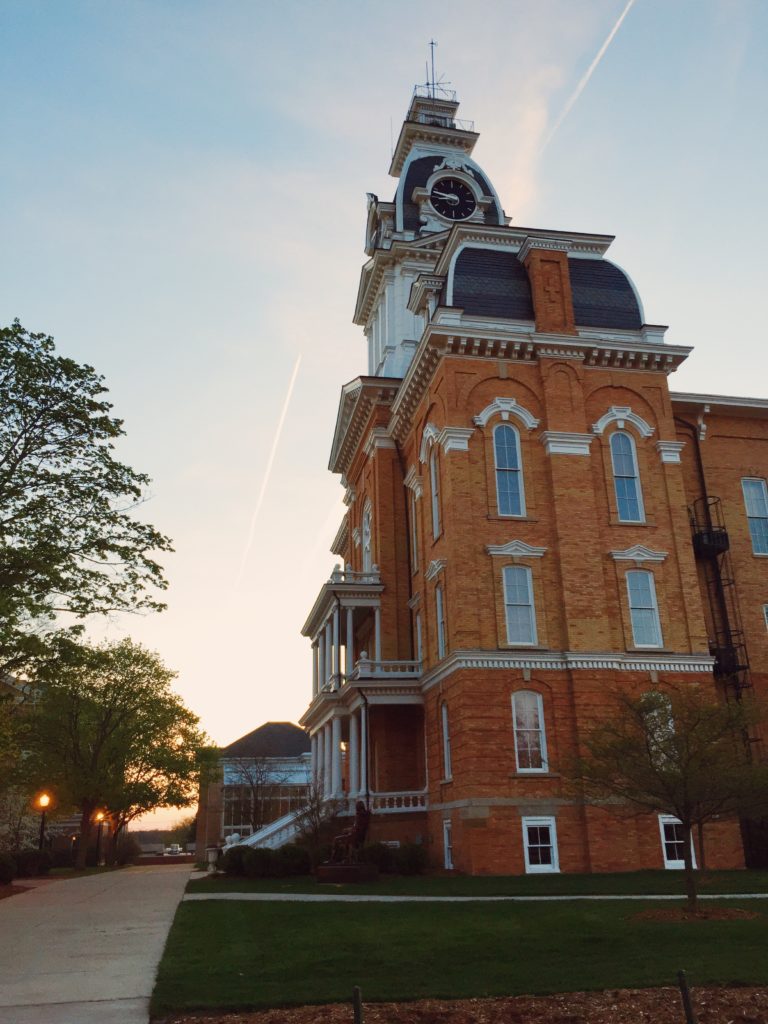
Security hosts staff training session for campus safety.
Hillsdale College Security offered staff training after the Michigan State University shooting that left three students dead last month.
“We are always looking for ways to increase our readiness for any emergency and working with staff and faculty to address their concerns,” said Associate Director of Security and Emergency Management Joe Kellam.
Security hosted a training for staff on Monday, Feb. 27 at 1 p.m., according to Kellam. He said three years ago, he started security briefings for all new students, and all new hires cover the FBI’s “run, hide, fight” standards in a one-hour briefing.
“The training that’s coming forth now is potentially for ones that have missed it, that have been here longer than the 10 years of the current staff plan for security, or those who just want a refresher,” he said. “There are a lot of people hired eight years ago that don’t remember all that, so we’ve put together a presentation.”
Kellam said security would record the training and post it online for faculty and staff. Chief Administrative Officer Rich Péwé said the college will have college employees review the training annually and continue training programs.
Sophomore Esdras Blackwell said security does a good job, but he thinks it would be helpful to hold trainings more often.
“That probably could be something that you reiterate at the beginning of every semester,” Blackwell said. “I think because Hillsdale is the way it is, I don’t feel unsafe.”
Senior Stephen Mulcahey said he is unsure the trainings will be effective.
“In the heat of the moment, will it actually make a difference?” Mulcahey said. “I think it’s kind of hard to say if the trainings are adequate or not since they’ve never been put to the test.”
Kellam said during a campus-wide threat, the security office would notify students with the app Alertus, and students could send information to security with the Rave Guardian app.
The school sent several test alerts just before noon on Monday, March 6, reaching students through email and by phone. Péwé said the college was testing Alertus and another notification system through Blackboard.
“We had a scheduled test of the emergency communications systems,” Péwé said. “Anyone who has given us their emergency contact should have received a text or e-mail and we can see what our send success rate was.”
Alertus should display notifications on any phone connected to the app, and any computers on the college’s network should flash the emergency message. According to security handouts, students and staff can sign up for Alertus with facility code “Hilcol,” and log in with their college credentials.
Péwé said the college can use Alertus and Blackboard to reach students, parents, and staff in an emergency if email is not working, or even if cell towers stop working, like they did on Feb. 21.
“There are tiers of emergencies. Typically something like a power disruption would not utilize Alertus unless internet was down. We would for a tornado or active shooter,” Péwé said. “If we wanted to notify all students, their parents, and all the employees during an emergency, we have the ability to do that.”
He reminded students to update their contact information at https://apps.hillsdale.edu/ContactInfo/ so they can receive emergency alerts.
When students report a threat on campus, Kellam said, security immediately responds to investigate.
“Once we get notified, our staff is going direct to the location to determine the actual threat,” Kellam said. “From there, we determine if the threat is active, and we address it. We go into a lockdown.”
Kellam said the school will enter either a “hard” or “soft” lockdown after a threat is reported. A “hard lockdown” requires the school to shut down during an on-campus threat, and a “soft lockdown” responds to a possible threat in the area while classes may continue. Security will notify staff and faculty, who should use the Nightlock door stops to lock classroom doors.
“Once we push the lock buttons, anything with card access locks immediately, and any interior classroom gets locked with Nightlock,” Kellam said. “Anyone that’s outside and can get away, the first thing in ‘run, hide, fight’ is run, right? So we say to get at least three to four blocks away.”
After the threat is gone, Kellam said, the deans will contact RAs and house directors to ask them to account for their students. He said the deans will reach out to parents and notify them of the situation.
“I know parents are always worried about things, but we have to handle the situation first before we can really brief them on it,” he said. “There’s no direct threat here, it’s just that we want to be the best that we can be.”
Kellam encouraged students to act as observers and report anything suspicious to security.
“Even with several of us throughout the day shift, we can’t be everywhere,” Kellam said. “The biggest advantage we have is 2,000 eyes out there.”
Students can call 517-398-1522 or use Rave Guardian to report suspicious activity to security, Kellam said.
“We want to be welcoming to students, to people,” Kellam said. “We are as prepared as we can realistically be, and still have it be an institution of learning, not a prison.”
