
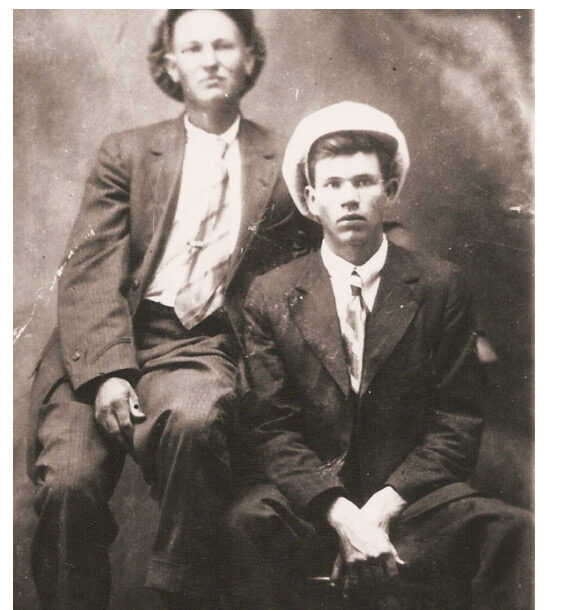
Brothers Robert and Benjamin Philips were teenagers during WWI. Courtesy | Tracy Wilson
When I found my 92-year-old grandmother’s high school yearbook picture online, she was taken aback—she said she thought it was one of the worst pictures ever taken of her. As it turns out, Hillsdale students have full access to records on Ancestry.com— including parents’ and grandparents’ awkward yearbook photos—through the library website.
Fortunately, that yearbook picture doesn’t tell the full story of who my grandmother is. I have seen scrapbooks full of other great pictures of her, and have heard her life’s stories. But I might have a different impression of her if all I had was that single picture.
Using genealogy websites can give you a false feeling of being close to your relatives and to your heritage. When using websites like Ancestry.com to build a picture of your heritage, approach your findings with mild skepticism— the little information that is available online does not tell you everything about who your ancestors were, let alone who you are.
Journalist Rob Brooks, in a 2021 article in The Guardian, explains that the more information you have about someone else, the closer you feel to that person. This is due to the fact that, psychologically, you are beginning to incorporate that information into the context of your own identity. He claims that this feeling can be synthetic.
“According to psychologists, as we grow closer to another person, we expand our sense of self to include them. The closer we become to them, the more we tend to think of their identity as our identity, of our views as their views,” Brooks said. “Just as celebrities share small disclosures to build the illusion of intimacy with a fan, the processes that build friendship and love can be emulated by algorithmic processes too.”
Just as social media and online messaging can make users feel close to people they don’t know in real life, technology used to research and verify your heritage can produce a similar false feeling of connection and identity.
Ancestry.com, one of the most popular ancestry websites, is often used for two things: DNA testing and historical record-keeping.
Many people turn to DNA testing to learn not only about their genetic makeup and what illnesses they may be predisposed to, but also to gain a richer understanding of their identity. Some DNA testing companies even offer the chance to connect with previously unknown relatives.
“Make personal discoveries with AncestryDNA,” Ancestry’s tagline says. “It’s… the most comprehensive portrait of you yet,” says 23andMe’s website. “Your DNA test offers you the powerful experience of discovering what makes you unique and learning where you really come from,” touts the MyHeritage webpage.
These advertisements are worded in a way that appeals to the personal. It is presented not just as scientific and medical information, but information that offers the key to understanding who you are.
Ancestry.com offers customers what they call an “ethnicity estimate,” which is the breakdown of how a customer’s DNA compares to DNA taken from other living people. The DNA in Ancestry’s system comes from living people who have verified “deep ancestry” in a particular region, such as Spain or Wales. People with ancestors from the same region are put in a reference panel, or a set of data which customers’ DNA can then be compared with.
“When asked to trace familial origins, most people can only reliably go back one to five generations, making it difficult to find individuals with knowledge about more distant ancestry,” according to Ancestry’s ethnicity 2022 white paper. “Fortunately, knowing where someone’s recent ancestors were born is often a sufficient proxy for much deeper ancestry. In the recent past, it was much more difficult and thus less common for people to migrate long distances. Because of this, the birthplace of a person’s recent ancestors often represents the location of that person’s deeper ancestral DNA.”
In other words, if 25% of a customer’s DNA shows as Irish, it’s not because their DNA has an “Irish” gene — it’s because 25% of the customer’s DNA is most similar to the DNA in that company’s “Irish” reference data set, which was taken from recently living people.
Because each company uses a different pool of DNA to compare with customers’ DNA, customers may get different ethnicity profiles based on which company they use, Ruth Padawer finds in a 2018 New York Times Magazine article.
“Customers’ results are based on inferences and are merely an estimate, often a very rough one — something many test takers don’t realize and testing companies play down,” Padawer said.
Even if an ethnicity estimate is highly accurate based on a given company’s data pool, it is still a best guess — it is not scientific verification of your family history, as some people seem to think it is.
Padawer’s article followed then 62-year-old Sigrid Johnson, who used DNA testing to confirm her theory that she was partially Black. As it turned out, her ethnicity breakdowns differed greatly from company to company.
“In a matter of weeks, Johnson’s African roots had bounced from 27 percent to 45 percent African — and her Italian roots had been reported as 0 percent, 49 percent and 20 percent,” Padawer wrote. “Through it all, of course, Johnson’s true ancestry, whatever it actually is, never changed.”
The other side of genealogy companies, which consists of record-keeping and lineage tracking, also often lacks details surrounding your familial background. Ancestry offers digital access to birth and death certificates, draft cards, and census records.
When I logged into the Ancestry database from the library, I was excited to find more information about my great-grandfather Benjamin, who died in 1928 at the age of 32. He died when my grandfather was only a boy, and so much of his life story has always been a mystery. Family legend has it that Benjamin was an electric lineman, and I always had believed he died in a work-related incident.
His official death certificate, which I found on Ancestry, told another story: he died from spinal cancer.
Although it was initially shocking, the little information I found doesn’t really tell me much about Benjamin. It doesn’t tell me what he was like as a son, a husband, and a father; it doesn’t tell me what kept him up at night, or what motivated him. I am grateful that I now know a little bit more about my family, but I’m not much closer to Benjamin’s memory than I was when I started my search.
The Ancestry library website also has a function called StoryScout, which uses information about your great-grandparents to generate a “story” about them. For example, using my great-grandfather’s World War I draft card, StoryScout says, “Millions of young men like your great-grandfather saw their lives change instantly. One veteran many years later remembered, ‘We saw this note under the door… for me to report [at] 6:00 a.m. in the morning. That was the next morning.’”
The program used to generate this text made me feel like I was reading a personal story. But it isn’t a personal story — thousands of other users have likely read the exact same StoryScout text about their great-grandfathers who entered the World War I draft. Like an ethnicity estimate, StoryScout offers only a best guess as to how a person’s ancestors might have lived.
Genealogical databases can seem like a way to prove our heritage and family history. In reality, these websites provide a picture that can be just as vague as the stories and records passed down through family legend.
We shouldn’t stake our identities on our findings, because we will never know our long-gone ancestors personally, no matter how many government records we find or how much DNA we process.
