
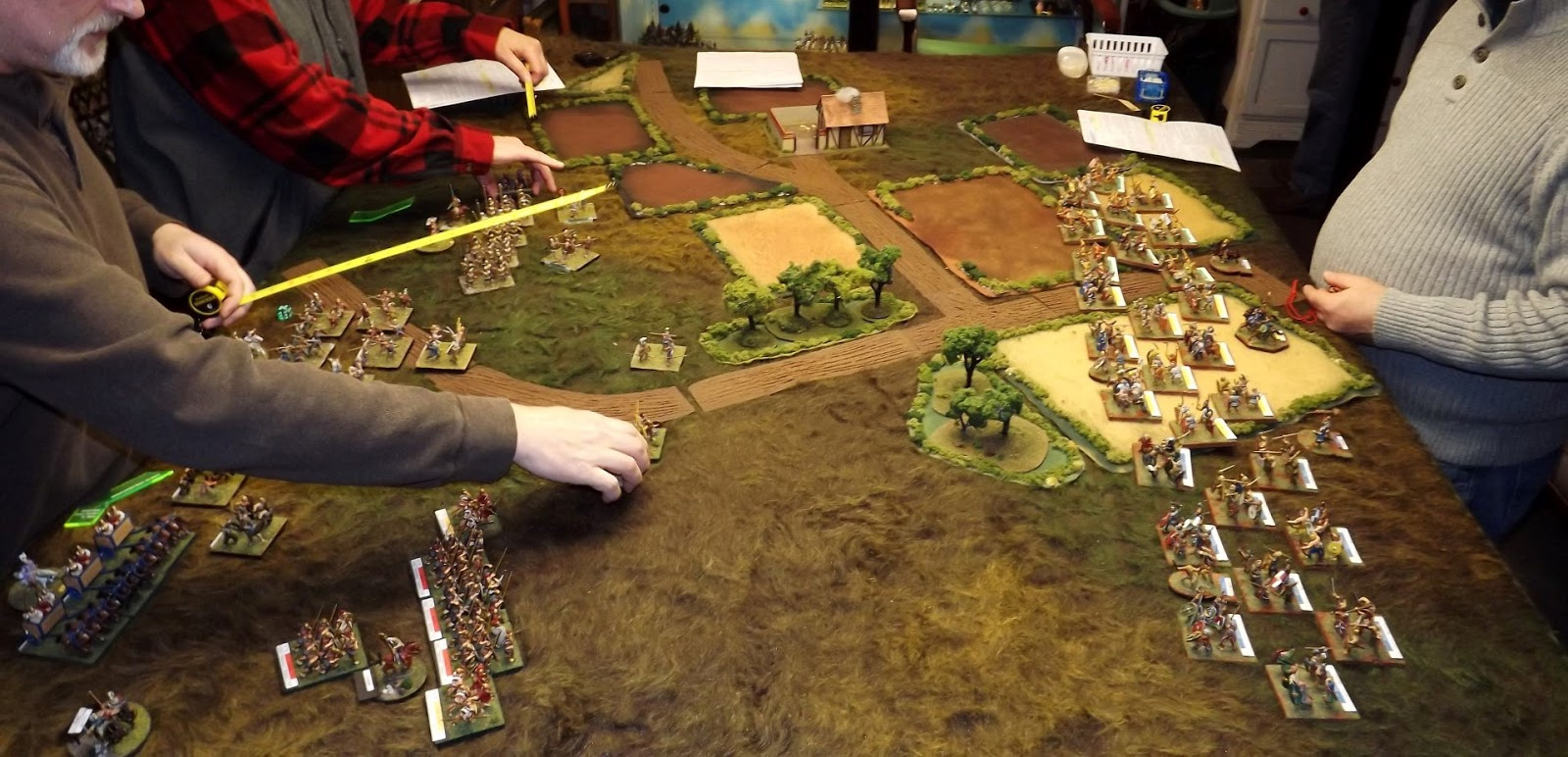
Play a wargame. Courtesy | Wikimedia Commons
North Korea recently came within an inch of completing a nuclear program and dominating the Korean peninsula.
At least that’s what happened in the wargame I played last summer.
Wargames are simulated military conflicts used by foreign policy experts to test the effectiveness of different strategies and tactics. They also provide invaluable insight into how well people think under pressure and cooperate with others. There’s also an opportunity to participate in one this Saturday from 1 to 6 PM in Lane 125.
Wargames are an essential tool to formulating a deeper understanding of statecraft and strategy in a fun, hands-on environment. There’s also an opportunity to experience a wargame for yourself on Saturday during a simulation of the Chinese Civil War hosted by the Alexander Hamilton Society.
Over the summer, I played the game “Hegemony,” a wargame where two teams compete for political prestige through military and diplomatic operations in various regions of the world. There are six countries and organizations: The United States, NATO, China, Iran, North Korea, and Russia. Of those six, the United States and NATO are on the blue team, and the rest are on the red. While one might assume the red team can quickly gang up against the U.S. and NATO, different win conditions make cooperation difficult.
The creators of “Hegemony” intended to use the game to teach United States Department of Defense officials how different strategies impact trade, technological development, arms procurement, and force management. Yet it also provides an invaluable tool for personal development by exposing an individual’s preconceptions before the game even begins.
How someone approaches conflict and negotiation with others ultimately will determine how successful they will be in achieving their objectives. Through my personal observations, I also discovered that how the game is set up influenced how I strategized.
When the game began, my partner and I quickly realized the deck was stacked against North Korea. We started with minimal industry to make new weaponry and almost no research capacity to improve our nuclear program. Meanwhile, our enemies (the U.S. and NATO) possessed large amounts of resources that enabled them to counter any aggressive maneuver we mustered.
In the face of these odds, our fellow red team comrades vowed unity, urging us to take erratic and provocative actions against the decadent westerners to slow down their modernization. Yet there was little cohesion in this alliance. Our so-called “ally,” China, would automatically lose if we achieved our victory conditions, so we discounted any assistance from them. Meanwhile, Russia and Iran never followed through on any aggressive military operations on their part.
On the other hand, the blue team organized an effective alliance based on clear divisions of responsibility and achievable objectives. NATO mainly constrained itself to counter Russian incursions in Europe while modernizing its intelligence capabilities and equipment to support the U.S. in global endeavors. Meanwhile, the U.S. mobilized its forces to counter the aggressive actions made by the “rogue” dictatorships of Iran and North Korea while balancing a strategic competition for prestige points against China.
China proved to be the West’s greatest asset. China was uniquely positioned among the red team because it could win by pursuing an economic victory. It was in China’s interest to reign in its red team allies to get the U.S. to the bargaining table to win extra prestige points during negotiations.
This strategy proved to be foolish for the red team. As China sought a peaceful solution, the rest of the red team faced a fully modernized Western alliance. This meant the U.S. and NATO pounded the red team relentlessly and destroyed its capacity to mobilize any troops. As a result, the West was close to victory.
Abandoned by our allies, we sought our own solution. Rather than fight the unwinnable battle of unifying the Korean peninsula, we used diplomacy to bolster our position while simultaneously developing our nuclear program to push us over the threshold to victory. We managed to get the U.S. to agree to several diplomatic conferences, pushing us to within one point of victory.
Our final challenge was getting that last point. China and the West tried everything within their power to oppose us. We arranged diplomatic conferences with Iran that failed, tested missiles that failed, and even attempted to hack the U.S. stock exchange, which failed. In the end, the West resoundingly defeated us.
Wargames are a glimpse into how we as individuals address conflict. Do we approach it hubristically and with malice? Or do we cooperate with others and pursue a common objective? As much as the simulated tanks and units slide across the board, Wargames are really about understanding the mindset of how specific policymakers rationalize the decisions they make.
