
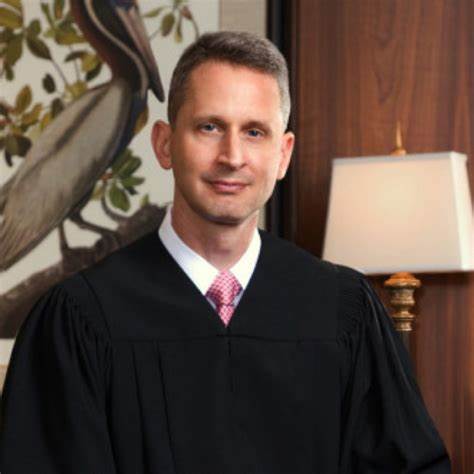
Judge Stuart Kyle Duncan serves on the U.S. Court of Appeals for the Fifth Circuit. He visited Hillsdale College on March 2 to speak on a Federalist Society panel with attorney Marc Ayers. On March 9, Duncan traveled to Stanford University’s Law School to speak on “Covid, Guns, and Twitter.” His speech was interrupted by protestors and Stanford’s associate dean of diversity, equity, and inclusion, Tirien Steinbach, delivered remarks criticizing Duncan. The following has been edited for length and clarity.
You were in Hillsdale just a few days before your lecture at Stanford. How did those visits compare?
It’s not difficult to contrast the experiences. First of all, Hillsdale is a wonderful place where my oldest son is a freshman, and we are delighted with the education and the formation he’s receiving there. I was happy to come and speak along with a lawyer and friend of mine, Marc Ayers.
We just had a conversation with the students. It was great, and I thought that the students’ questions were really incisive and well-informed, especially for people who are not in law school.
I was planning to go to Stanford the week after that. I thought, well, this is a good warm up for that because at that point, I was still trying to figure out what exactly I might address with Stanford.
What happened at Stanford law school a week later?
I was invited to speak by the student chapter of the Federalist Society on some current jurisprudence from our court. I’ve spoken to countless law schools over the past several years, and I’ve spoken at Stanford within the last few years with no protests. I was informed a couple days ahead of time that there would be a protest by one or two student groups, and I tried to inform myself about what the protests might look like. I couldn’t really figure out what they would do. I reached out to the administration through a professor there who I know and the administration assured him that there would be no disruptions because that would be against school policy.
When I got there, though, it was a different story. There was a loud rally outside the classroom and lots of posters of me and the students who invited me. It seemed the purpose here was to intimidate me or the students.
When I went into the classroom, the protesters came in and began heckling the student president of the Federalist Society, and then continued by heckling me during my speech. It was, obviously, very unpleasant. I was not told that there were administrators present, but evidently, there were. After a few minutes, I stopped speaking because it was really impossible to continue under those circumstances. An associate dean of diversity, equity, and inclusion came up to the front and had a prepared speech to give, which I found confusing, since I wasn’t told ahead of time that this would happen and I didn’t know what to expect. The associate dean criticized me, criticized my rulings, criticized my views on various matters, and empathized with the students’ pain that my visit was causing.
It went on for several minutes and then she welcomed me to speak and invited students to leave if they wanted to. Of course, they didn’t have to come in the first place, but she invited them to leave.
Under those circumstances, I didn’t think it was wise to really continue speaking. The vast majority of people there outnumbered the students who invited me like 10-to-1 and were obviously there to criticize and heckle me and, I guess, shame me. So I opened it up to Q&A, to, as you might expect, very hostile questions. I tried to engage with some of the students but I was disturbed and annoyed by the whole spectacle, which I thought was totally contrary to any sense of free expression, any sense of civility.
It was a disturbing, unfortunate event, unlike anything that’s ever happened to me and my fairly lengthy legal career, both as a lawyer and a judge.
A Stanford memo reviewed by the Washington Free Beacon this week states the school will not discipline any of the students who disrupted Duncan’s speech. Any comment?
My first reaction is gratitude, because at least the letter seems to recognize that what happened during my talk is inconsistent with the university’s policies. I’m grateful that some measures are evidently being taken to reinforce the university’s judgement that this was not an appropriate response to my presence on campus. I’m grateful that the university appears to be taking this very seriously which they should and that they recognize that they need to do better.
The incident has earned you lots of positive and negative media coverage. What has that been like?
It’s distracting, because judges do not communicate with the public in this way. We communicate through our opinions in a very careful and structured way. What goes on in court, of course, is nothing like what went on in that law school, even though we have sort of very spirited arguments in court. Nothing even remotely approaches that kind of disdain and disrespect and hostility that was experienced there.
I did feel an obligation to speak about this because I was at the center of it, even though I have no plans to be, and I’m sorry to be the center of this. Hopefully, everyone can draw the right conclusions about what this means for legal education for civil discourse.
You’ve received some criticism in the media for how you responded to the protestors. Do you regret anything about how you reacted?
No, because although other judges may have reacted differently, I reacted with what I thought was a reasonable amount of anger and disdain for what was happening because it was obviously directed personally at me. I was relentlessly shouted down, hounded, jeered at, and mocked. Did it hurt my feelings? Not really. I was just outraged at the whole spectacle of it. It’s totally unbecoming of any law school. Nobody should treat an invited guest on the campus that way.
I was particularly upset about the way that the students who invited me were being treated, which is reprehensible. I cannot imagine trying to put myself in the position of those students.
I thought it was despicable. So yeah, that made me angry and no, I don’t regret how I reacted to it.
Do you expect similar protests at your upcoming talks?
I don’t expect it. I sure hope not. I thought it was completely inappropriate. People are free to protest. People are free to have signs and say “Down with Duncan” or whatever. People can do that, but there’s a time and a place and a way of doing that that is consistent with free society and with a respect for other people, even those you disagree with, and public order. Free speech does not mean mob action.
