
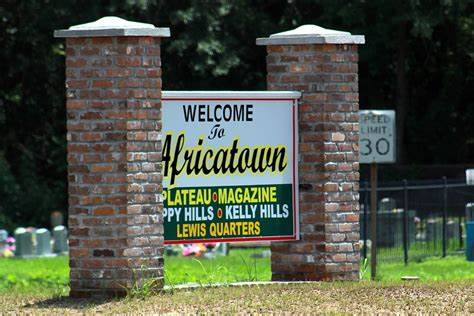
A town in Alabama, inhabited by descendants of the last slave ship to arrive in America, is poor, polluted, and an example of “environmental racism,” writes alumnus Nick Tabor ’09 in a new book.
“This story gives us an opportunity to see how one thing has led to another, how the legacy of not just slavery and the slave trade, but the legacy of Reconstruction, the legacy of the Jim Crow era, how they’re still with us, often in physical ways,” Tabor said.
Tabor’s first book, “Africatown: America’s Last Slave Ship and the Community it Created,” came out through St. Martin’s Press Feb. 21. In its earlier days, Tabor said, Africatown had been a thriving industrial community, but today, it’s poor and riddled with pollution, which Tabor said appears to have led to a cancer epidemic.
Tabor was the news editor of The Collegian and has worked in journalism since he graduated, writing for publications including the Oxford American and New York Magazine. In 2019, he left New York Magazine and temporarily moved to Mobile, Alabama, to research and write his first book, a journalistic look into the history and environment of Africatown, a neighborhood near Mobile.
He became fascinated with the town and its history after being assigned to write about it for New York Magazine in 2018.
“There was this book coming out called ‘Barracoon’ by Zora Neale Hurston that she had written in 1928, maybe ’29, thereabouts,” Tabor said. “It did not get published in her lifetime, it was published five years ago. We were running an excerpt of it in New York mag, and my editor said, ‘you know, it’d be really nice if we could have a story alongside the excerpt about what happened to the descendants of Cudjo Lewis,’ who was the last survivor of the last slave ship that ever came to the U.S.”
He said it was difficult to track down the descendants and talk to them.
“The descendants had never really made themselves known,” Tabor said. “But I eventually did get one of them on the phone and he said, ‘you don’t need to be writing about the descendants. You need to be writing about the neighborhood. When I was a kid, it was this thriving place. But now it looks like a war zone.’”
After he wrote that story, Tabor became fascinated with Africatown, which was founded by the people brought to America in 1860 on the Clotilda, the last ship to transport slaves to America. Descendants of people on that ship still live there today.
According to Tabor, the town is an example of environmental racism. While there are digestible books on other topics of America’s racial history, Tabor said, he noticed a gap in the same on environmental racism.
“There are some academic books that lay it out in a pretty comprehensive way, but I felt like there wasn’t anything out there for the general public that explained how this had developed and how it continues to plague a lot of communities today,” Tabor said. “It’s an element of American history that I think had not been, and maybe still has not really been, examined to the extent that it needs to be. This book is an attempt to remedy that.”
Kirkus Reviews praised “Africatown” as “a sharp portrait of a unique American town.”
“I wanted to explain in a way that was not polarizing but in a way that was utterly convincing, if not irrefutable, how racism still plays a role in people’s lives today,” Tabor said. “Because it’s not just a question of people’s attitudes and what’s in their hearts. It’s a question of, in this case, how cities are built — what goes where, how the geography has been shaped, and who owns what and who has power.”
Chair and Professor of English Justin Jackson, who taught Tabor during his time at Hillsdale, said he is looking forward to reading the book.
“I read his article on Africatown a few years ago in New York Magazine, and it made me want to learn more. That’s a sign of good journalism,” Jackson said. “I’ve talked to him about his project several times now, and I’m excited to see how his living in the South for a couple of years helped him to develop and craft the story.”
Dean of Humanities and Professor of English Stephen Smith also taught Tabor and said he is a skillful writer.
“Nick is insightful and thorough,” Smith said. “He has a fine eye for truly telling details about his subject and human character. I look forward to reading his new book. Knowing Nick, it will be the first of many.”
Despite its heavy subject matter, Tabor said “Africatown” is not wholly a sad story.
“I will say, it’s also a hopeful story,” Tabor said. “There are elements of this story that bring out some of the better, some of the best aspects of American culture, too, and I think it enriches our understanding of our country.”
