
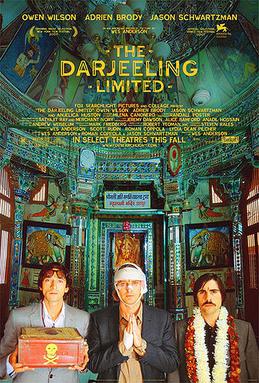
Jason Schwartzman, Adrien Brody, and Owen Wilson appear on the poster for Wes Anderson’s “The Darjeeling Limited.”
If there’s one lesson I learn every holiday season, it’s that it’s nearly impossible to get along with my older sisters. No matter my resolve against it, we always get into some sort of conflict, and by the end of the holidays, I’m more than ready to say my goodbyes.
I know that I’m not alone in feeling this, though– every sibling has faced this uniquely familial struggle at some point. Wes Anderson explores this complexity in his pastel-drenched, 2007 indie comedy “The Darjeeling Limited.”
The movie follows the three Whitman brothers as they embark on a train trip across India. The vacation, organized by the eldest brother, Francis, is disguised as a journey of “spiritual discovery,” but it’s really a last-ditch effort to reconcile the brothers after their father’s death. The brothers haven’t spoken since this tragedy, and they live estranged from any familial connection.
Jack, the youngest, has been traveling around Europe and pining over a lost lover, who has just abandoned him for the final time.
Peter, the middle brother, is overwhelmed by his wife’s pregnancy, worries over the thought of divorce, and lives in constant memory of his father– carrying his car keys and wearing his sunglasses, even though the prescription gives him a migraine.
Francis, the eldest, decides to repair his relationship with his brothers after he has a near-fatal motorcycle accident, which is later revealed to be a suicide attempt. In contacting his brothers, he hopes to restore their bond, find spiritual clarity, and heal from the trauma that still plagues them.
“The Darjeeling Limited,” named after the railway that snakes throughout the lush Indian terrain, paints a unique portrait of grief that epitomizes Anderson’s beloved filmography.
His movies are notorious for their colorful settings, idiosyncratic characters, quick cuts, and witty dialogue. Anderson is also hailed, or criticized, for his maneuvering of difficult subject matters. His protagonists often suffer losses, grieve broken families, and battle depression– struggles which are all on full display in “The Darjeeling Limited.” Some argue that he handles these subjects nimbly, while others think his commentaries fall flat.
This film could be subject to either criticism. Anderson introduces weighty subjects but handles them with levity. The characters are painfully human, with flawed struggles and flawed solutions. Each brother handles grief differently – Francis resorts to painkillers, Jack attempts a romantic rendezvous, and Peter isolates himself.
Once reunited, they fall back into their old, petty behaviors. Francis is bossy and controlling, while Jack and Peter have trust issues and hold on to frivolous things, as only younger siblings can. Wes Anderson is illustrating universal experiences that families share, which only appear under the backdrop of a larger issue like shared trauma.
In this film, though, his commentary stops at the surface. Though aesthetically pleasing, Anderson’s filmmaking can come across as shallow, and this movie is no exception. The director bites off more than he can chew, and when he creates characters with such complex backstories, he can’t fully bring them to resolution in a 90-minute runtime. Further, the tone of this movie prevents any message from having a lasting impact. It’s easier, as the viewer, to laugh at jokes and quirky characters instead of considering what exactly drives their actions.
In this film, Anderson continues collaborations with his favorite iconic faces, including Jason Schwartzman as Jack, Adrien Brody as Peter, and Owen Wilson as the bruised and bandaged Francis. Angelica Houston plays a small role as Patricia, their mother, and even Bill Murray has a brief cameo in the opening scene.
Anderson’s stylized filmmaking thrives in this movie: the tight train compartments organize the frames into symmetrical lines, and the cinematography is based on primary colors, which contrast with the rich hues of the Indian landscape.
Anderson is at his best here, with punchy one-liners, monochromatic bathrobes, montages soundtracked by the Rolling Stones, and depictions of grief that hit a little too close to home.
There’s always more than meets the eye in Wes Anderson’s works, and though this particular film only stays surface-level, it’s still relatable for anyone who’s experienced loss, trauma, or a strained relationship with siblings– even if it hasn’t driven them to spend a summer on a train in India together.
