
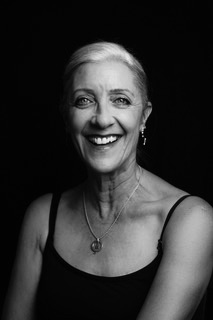
Carla Lippert taught the Hillsdale Tower Dancers.
Courtesy | Holly Hobbs
Carla Lippert is a professional ballerina and teacher. Performing as a soloist for the American Ballet Theatre and a principal ballerina at the Boston Ballet, Lippert now teaches ballet. Lippert traveled to Hillsdale College as a répétiteur for the “Pas de Quatre” ballet, which the Tower Dancers will perform at their Spring concert in April.
You’ve traveled and worked in so many places. What have been your favorites?
There’s so many. As I matured as an artist, I really wanted to do something other than the classics, so to be choreographed on was really exciting for me, and I got very little of that with the American Ballet Theatre. I got a contract with Boston Ballet as principal and there I got to be choreographed on. It was the creative process that I really, really enjoyed. I didn’t want to choreograph myself — never really had that burning desire — but it was really amazing to be in that process.
As you’ve transitioned from dancing to teaching, what have you enjoyed and what have you struggled with?
Well, motherhood came in between there and learning to balance everything. Teaching young dancers comes at dinnertime, when your kids are also home from school. So that was a challenge. But what I have enjoyed as a teacher is watching my students grow. It’s also very difficult, because as they grow, they also realize this is not for them. They grow as people, not as dancers, when they’re between the ages of 10 and 16.
Very few dancers make it into major schools. Maybe 2% of them get into great schools and then maybe 1% of them actually get into a company. It’s really very sad. But that’s what we strive for, you know?
How was your experience working with the Tower Dancers on “Pas de Quatre”?
It’s been rough, because you don’t have a dance major here — it’s a minor. The emphasis is not put on training so much, so it was very difficult for them to find time to prepare for this. But to do a classical piece like this, you have to be in a certain shape. They weren’t quite ready for that, so they were a mass of sore muscles and blisters on Saturday morning after our first rehearsal. That was hard, but they have grown so much.
My students are usually quite a bit younger. Their heads are constantly turning. These women are focused, and that has been wonderful. They have their studies, their majors that they have to look out for, but when I have them in the studio, and they know now that they have to train to be able to do this at a standard they’ll be comfortable with– it’s the maturity of accepting that and putting the nose to the grindstone that’s really refreshing and wonderful. It’s rare.
How do you like to teach?
The more I taught, the more I realized there are so many teachers that don’t know what they’re doing. It disturbed me greatly more and more because I would see beautiful, talented dancers that have the body and everything who were poorly trained, and it’s really hard to untrain that once it’s there. Nobody needs to be certified to open a studio in America. In France, Russia, Italy, I believe you have to be certified to open a studio or to teach. I think it’s pretty loose, but the system is there.
Then I heard about ABT coming up with a curriculum. So I jumped right on and I was very, very, very blessed to be able to – being an alumna – go in and train with it for free. I go back periodically, just to audit some of those trainings. But that is a beautiful thing that America is just now starting, in the last 15 years, to certify teachers and it’s growing and growing. That’s probably one of the most beautiful things that I’ve seen happen in America.
I can usually spot a dancer that has had the ABT curriculum because they are so grounded, it’s like a clean slate. That’s what they wanted to do: present a dancer that was trained with nothing extra, just so you could tell them to do it with this style and they could do it, because they had the basic foundation.
Did you always want to be a dancer? What do you love about it?
At 3 years old, my parents put me in gymnastics because I couldn’t sit still. Then they decided, let’s try ballet. It was good, sound training, and my teacher knew her limitations. She knew to get other teachers in there. She produced six dancers that went on to major companies.
Once I learned what ballet was, I loved it. There was no turning back.
My parents were supportive; my teacher was supportive. She put me in areas where I could go further, and I got a scholarship to the School of American Ballet and American Ballet Theatre. I was in New York at the age of 16 for five weeks in the summertime. My parents did not let me go at 13, when I had a full scholarship to go to the North Carolina School of Arts. They knew they didn’t want to lose their daughter at that point. I wasn’t ready. I don’t remember discussions about it or anything, but I’m very grateful.
I just kept putting one foot in front of the other. I never thought in a million years I would go to ABT.
I’m a spiritual person, too. I pray, “Lord, is this where you want me to go?” And doors opened. “Lord, tell me if this isn’t it.” Some things were, you know, “Lord, come on, that made me question what I was doing,” but it just made me stronger, all those things. I had to really want what I was doing. I never took it for granted.
