
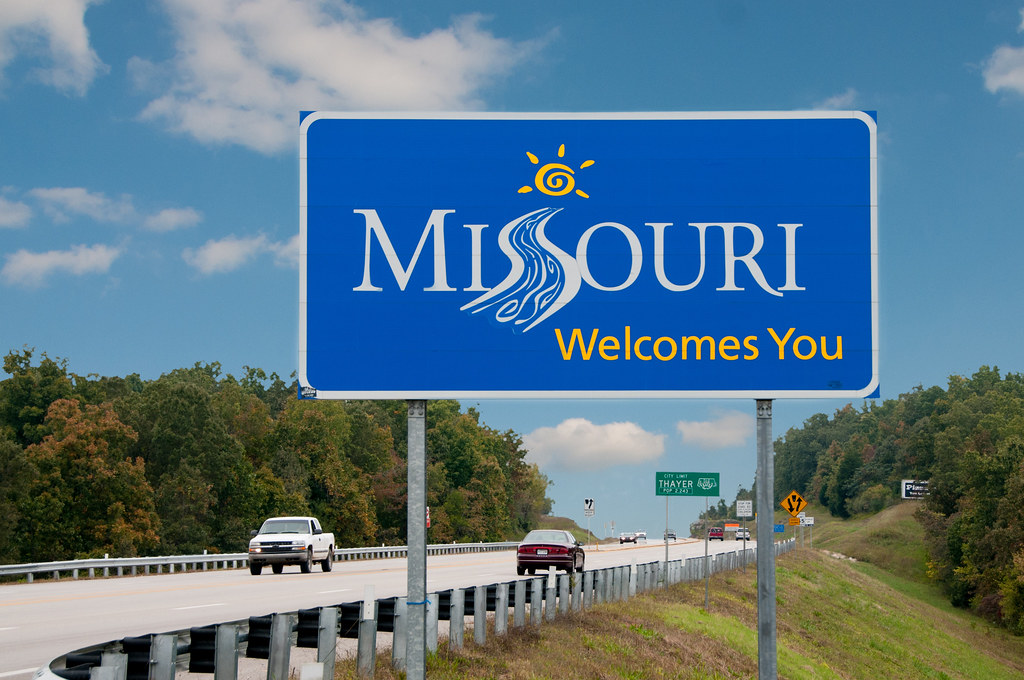
Missouri is a part of the Midwest. Courtesy | Flickr
My home state of Missouri is a weird state, one historically caught in the margins. Because of this, there’s debate over how it should be considered culturally – part of the Midwest or part of the South? At Hillsdale, I’ve found that a handful of friends, mostly from the Eastern Midwest, do not believe Missouri can be considered Midwestern. An Instagram poll I conducted confirmed the popularity of this belief. While much of Missouri’s heritage and culture stems from the South, to deny its Midwestern roots is incorrect.
Culturally, most of Missouri fits in with the Midwest. Consider vocabulary. One of the defining cultural traits of the South is usage of the word “y’all” to refer to a group of people. A 2013 study by Joshua Katz of North Carolina State University revealed that throughout Alabama, Georgia, and the rest of the Deep South, y’all is a common word. The farther away from Jackson, Mississippi one gets, the more usage declines. In Missouri, y’all is commonly said only in the Bootheel, that awkward bit in the southeast that we took from Arkansas. Anywhere farther north, people refer to “you guys.” One phrase Missourians do use a lot is “ope,” one of the defining phrases of the Midwest. It’s a term used to apologize for minor inconveniences. Whether these perceived inconveniences actually occurred or not is irrelevant.
Beyond vocabulary, ope can be seen as an example of “Midwest Nice,” a buttoned-up form of courtesy that sometimes edges into passive-aggressiveness. While Minnesota will always be the king of Midwest Nice, Missouri has also mastered this method. I’ve lost count of the number of four-way stops I’ve been waved through in Missouri. Additionally, we have Culver’s, John Deere, and Casey’s, serve pulled pork at every high school graduation, and wear shorts in 40 degree weather. Salt, pepper and ranch are often as spicy as food gets.
Geographically, Missouri also fits in better with the Midwest than the South. My hometown of Brookfield is an hour’s drive from Iowa. While Brookfield is fairly far to the north, the entire state is largely parallel with the Midwest. Even as far south as Springfield, for instance, driving west brings you to Kansas and driving east brings you to Illinois. It also has similar terrain to these neighbors. Driving through Missouri means seeing a lot of corn and soy, followed by even more corn and soy. As a prospective Hillsdale student, I couldn’t help but note how similar the landscapes of even Missouri and Michigan were, particularly in the undeveloped countryside. At most, the Ozarks can be considered part of the South, since it’s a shared geography with Arkansas. Even then, the top half of the Ozarks is a gray area, and to strip anything north of them from the Midwest is ludicrous.
The most common argument for Missouri being part of the South is that it was a slave-holding state prior to the Civil War. But consider the historical context. The idea of slavery being legal in a state that far to the north was so strange that following vigorous debate, Congress had to make the Missouri Compromise to allow its practice. During the Civil War, while a significant number of Missourians supported the South, it never joined the Confederacy. Nearly three times as many men from Missouri became soldiers for the North than for the South. Thus, while Missouri certainly has some historical Southern influence, this history is too complex to just lump it in entirely with the South.
I consider Missouri a Midwestern state with Southern trappings. Its very identity is kind of an awkward combination, something God thought would be funny, like the platypus’ makeup of mammal body and duck bill. But just as the platypus is identified as a mammal despite its duck bill, so Missouri should be considered first and foremost a Midwestern state in spite of Mizzou’s presence in the SEC.
