
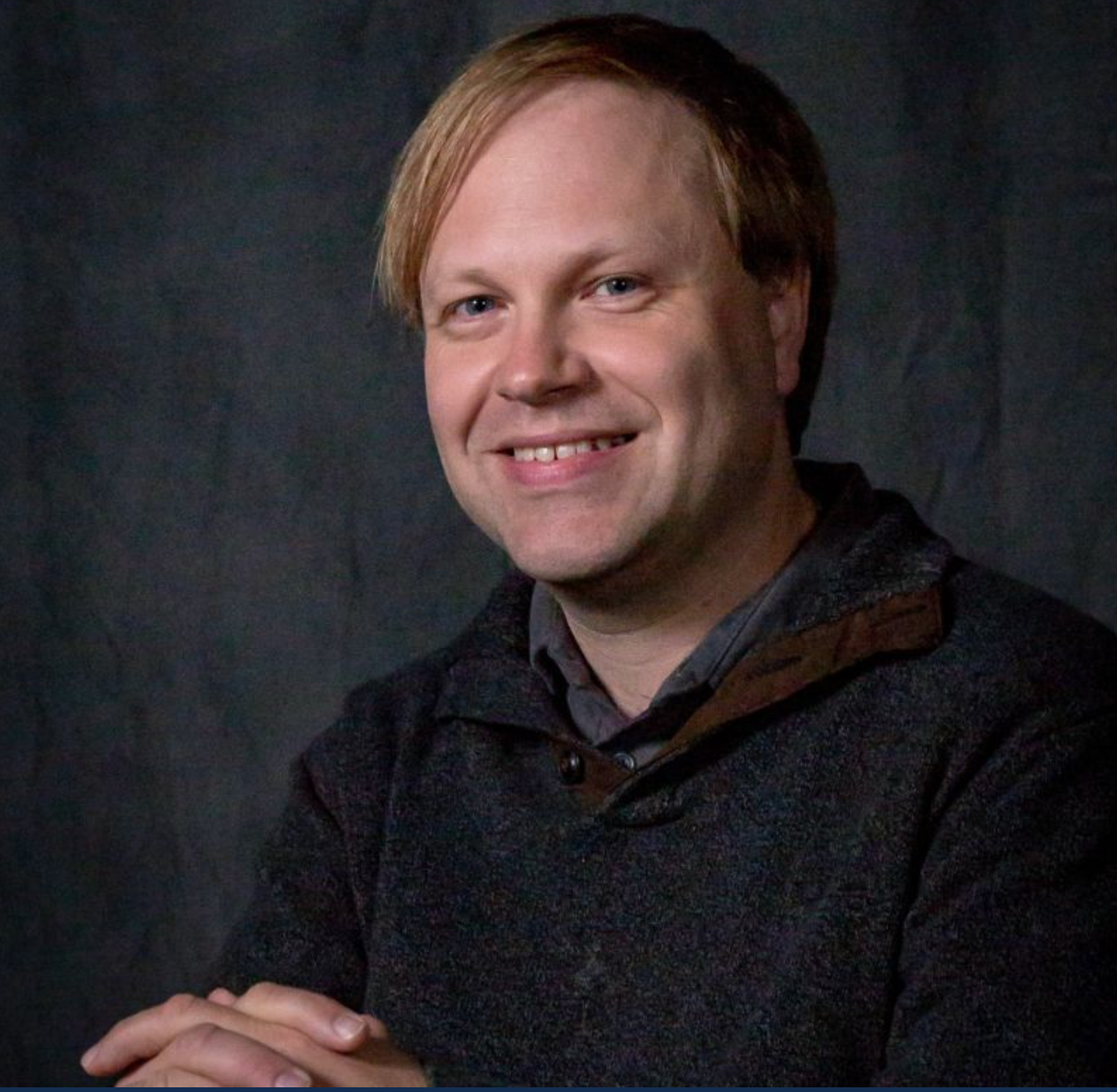
Hillsdale Professor of Physics Tim Dolch | Courtesy Hillsdale College
Associate Professor of Physics Timothy Dolch co-wrote three astrophysics papers, which span topics from the solar wind to neutron stars.
The first paper was submitted to the Heliophysics 2024 Decadal Survey in August. It is a white paper describing the sun’s influence on the Very Local Interstellar Medium — the area around the sun filled with partially ionized, warm, and magnetized plasma.
“What we’re finding is that the sun has a significant influence on the local interstellar medium,” Dolch said. “There’s not a sharp transition between where the solar processes end and the interstellar medium begins.”
In September, Dolch co-wrote another paper titled “Snowmass 2021 Cosmic Frontier White Paper: The Dense Matter Equation of State and QCD Phase Transitions.” The paper features research on pulsars — dense, rotating neutron stars — and describes how the extreme conditions inside pulsars reveal information about atypical states of matter.
Dolch said this paper was partially based on research done through Hillsdale’s radio telescope control room, which is linked to the Green Bank telescope in West Virginia.
“One of the pulsars students and I were looking at could be the most massive pulsar ever observed — 2.2 times the mass of the sun,” Dolch said. “The states of matter that exist inside a pulsar this massive probably don’t exist anywhere else, so observations like these help narrow down theories on what’s going on inside neutron stars.”
Dolch compared pulsars to “cosmic clocks” because they rotate regularly and emit an oscillating energy pattern.
“There are about 3,300 known pulsars,” he said, “but we only observe 77 of them because we want the most accurate clocks.”
One of the 77, known as J1713+0747, experienced a sudden, transient fluctuation in its normally regular pulse shape. The most recent paper Dolch worked on explored possible explanations for this irregularity.
Paul Hosmer, chairman and associate professor of physics, said these papers are fascinating because they demonstrate the “flexibility and power of pulsar studies.” Hosmer’s field, nuclear astrophysics, focuses on interactions between particles so small they fit inside the atomic nucleus, but he said pulsar studies still inform his research. Like particle accelerators on earth, they offer insight into how nuclear forces operate in extreme conditions.
“That’s a really cool aspect of physics,” Hosmer said. “It can relate interesting things both on a very small and very large scale.”
Freshman Eleanor Whitaker is a member of Dolch’s student pulsar research group, the Hillsdale College Student Teams of Astrophysical Researchers.
“One of the coolest things our group did was go out to see the low-frequency radio telescope that Dr. Dolch and his students built a few summers ago,” Whitaker said. “We can take our own data and answer our own questions right here on campus. The glory and honor of discovering a real pulsar like Hillsdale students have in the past is always a possibility.”
