
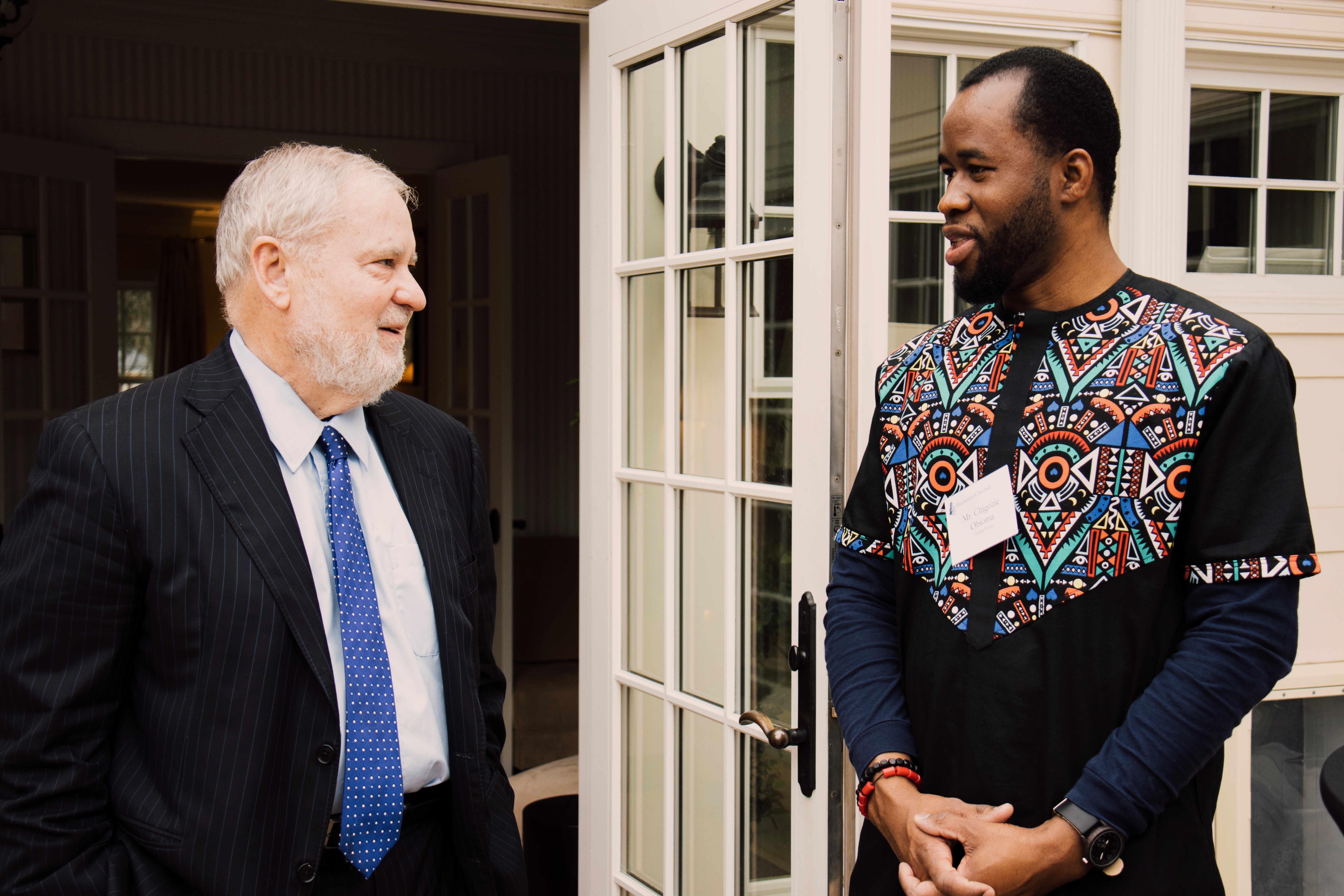
Author Chigozie Obioma said he tells the story of Nigeria’s civil war through the voices of both the living and the dead in his newest novel, “The Road to the Country.”
The President’s Office and the Hillsdale College Creative Writing Honors Program hosted Obioma Nov. 7 for a lecture on mystical realism, an ongoing theme which he said characterizes his work.
Obioma said an email from a professor at the University of Toronto prompted him to define his work.
“I got this very lengthy email one day that I paid a lot of attention to because it was from a University of Toronto professor,” Obioma said. “She said that magical realism would not be a fitting genre for my novel because there isn’t any magical happenstance. She said that the novel does not contain magic but rather the spirit of magic.”
This “spirit of magic” captured Obioma’s imagination and helped him to define mystical realism as the border between the realistic and the spiritual, Obioma said.
“When we write fiction, whether it’s Raskolnikov from ‘Crime and Punishment’ or Ishmael from ‘Moby Dick,’ we are never writing about real people,” Obioma said. “The act of creation itself is extracting the spirit of something and then putting it in the form of a story.”
Obioma has a Master’s of Fine Arts in Creative Writing from the University of Michigan and is an associate professor of English at the University of Nebraska-Lincoln. He is the author of four books, including “The Fishermen” and “An Orchestra of Minorities.”
Obioma is finishing his week-long residency with the Hillsdale College Creative Writing Honors Program, where he has been teaching a hybrid class throughout the semester.
Obioma said his approach to novel writing combines realistic settings with a recognition of what is beyond the physical, material world.
Senior James Shotwell, who attended the lecture, said he appreciated Obioma’s understanding of mystical realism.
“I find the ideal appealing, but I think that mystical realism has a sense of being almost more real than realism,” Shotwell said. “It’s portraying aspects of reality that aren’t caught in a strictly realistic mirror.”
Obioma said his upcoming novel puts mystical realism at the forefront.
The excerpts of “The Road to the Country,” which he read to the audience, focused on a prophetic seer, who is an omniscient narrator in the novel. The seer both observes and enters into the near death experience of a soldier in Nigeria’s civil war, the Biafran War.
“He’s on a mountain in 1947,” Obioma said. “And he’s watching the stars and he’s seeing the future of this child who’s about to be born. So the whole story happens through this viewpoint of this seer.”
According to Obioma, who is a native Nigerian, around 1.5 million people died during the conflict. Obioma said the victims of the Biafran War inspired the novel. His family, who moved from western Nigeria to eastern Nigeria, encountered war victims in their local village.
“Most of the people were deformed one way or another,” Obioma said. “In fact, there was a lady whom I will never forget because half of her face had been eaten by some kind of disease.”
Senior Colleen Blochus, a student in Obioma’s creative writing class, said she takes inspiration from his writing style.
“There’s always something that either you learn about or you see that just sticks out in your mind,” Blochus said. “And in my experience, it is really tough to write about that. It seems like it should be the source or the muse, but whenever you write about it you never really feel like you get close to it.”
Blochus said she was impressed with how Obioma captured the reality of the war.
“I thought it was really interesting that he saw the war, and it became such a core memory for him,” Blochus said. “He wasn’t able to fully express it until he was able to think of it in terms of the living and the dead.”
Obioma acknowledged the tension between capturing these ideas through writing and the process of revision.
“Letting go of the project is an act of compromise,” Obioma said.
Associate Professor of English Dutton Kearney and the director of the Visiting Writer Program, said College President Larry Arnn suggested Obioma teach a creative writing class. The pandemic delayed these plans until this fall.
“I thought the lecture was fantastic,” Kearney said. “It was really nice to see that people in the office of critic can see that they have a positive influence on art and artists.”
Kearney said he encourages interested students to apply for the class.
“It’ll be offered next academic year, and I would definitely encourage students to look into that or get in touch with me,” Kearney said. “And then the class will dovetail with the presentation of his novel, ‘The Road to the Country.’”
