
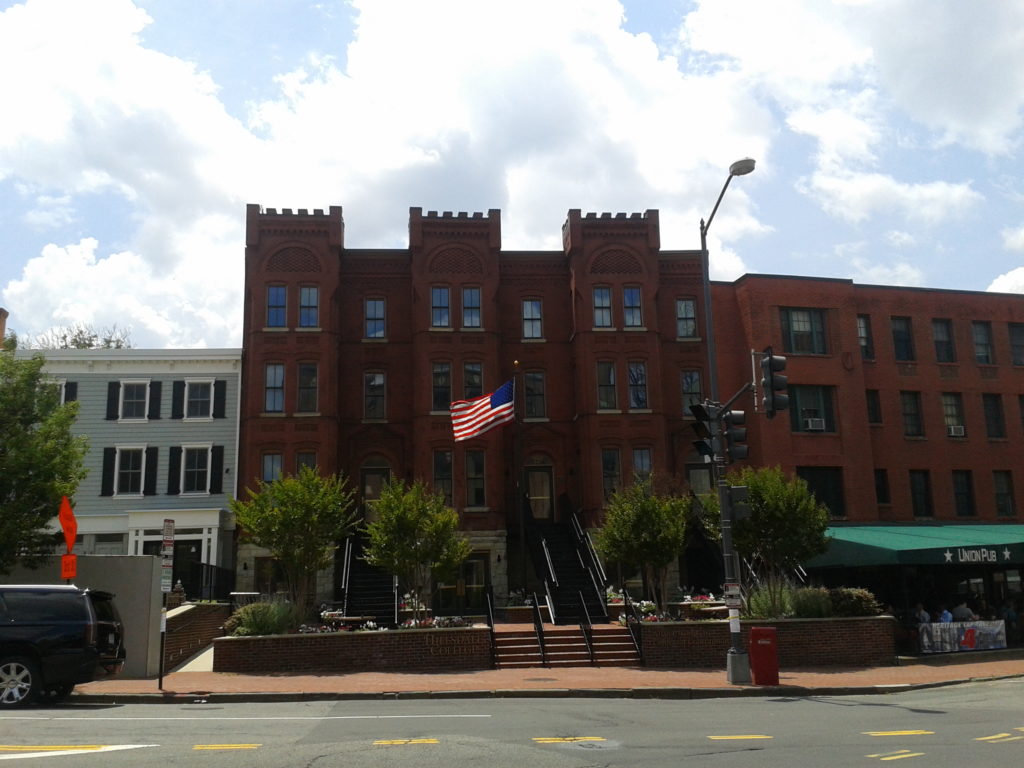
Overbearing bureaucracy and the suffocation of academic freedom drove associate professors of government Bradley Watson and Richard Samuelson to Hillsdale College’s Washington, D.C. campus, according to the two new faculty members.
“Each of them will enrich and enlighten our undergraduate and graduate students and, through them, the city of Washington D.C. and likewise our country,” Director of Academic Programs for Hillsdale in D.C. Matthew Mehan said.
Watson and Samuelson joined the Hillsdale faculty in D.C. over the summer. They are each teaching classes this semester at the Van Andel Graduate School of Statesmanship. Samuelson is also teaching a course for WHIP students.
Watson taught for 23 years at Saint Vincent College, a private Benedictine college in southwest Pennsylvania. A campus controversy that received national coverage arose last April over a conference hosted at Saint Vincent by the Center for Political and Economic Thought, a research and public affairs institute directed by Watson.
The conference last April, titled “Politics, Policy, and Panic: Governing in Times of Crisis,” featured nine speakers, including Assistant Professor David Azzerad of Hillsdale College, who spoke on “Black Privilege and Racial Hysteria in America.” The lecture sparked backlash among students at the college.
“Before the conference ended, I discovered the administration was drafting a formal letter of apology,” Watson said. “They issued the groveling apology, drafted by senior administrative officials at the direction of the president of the college. None of this was done with any consultation with me as the longtime director of the center.”
Following the conference and apology letter, the college instituted a new policy requiring administrative approval for any speakers invited to college-sponsored events. Watson said the new policy would have interfered with his work at the center.
“This makes it functionally impossible to run a speaker program, which greatly undermines a center like ours because we had a lot of speakers,” Watson said. “Even if you could imagine the sort of conditions under which that might function efficiently – getting multi-level approvals for every speaker you want to invite to campus – the implication was clear: certain kinds of topics henceforth would be off limits at Saint Vincent College.”
Watson resigned his position as professor of politics and Philip M. McKenna chair in American and Western political thought at the college. He said the administration’s actions were the main cause of his departure.
“I decided that I would resign over this rather than try to deal with an administration that doesn’t understand academic freedom or intellectual freedom more broadly,” Watson said.
Watson, who was also a distinguished fellow in jurisprudence at the Hillsdale graduate school during the controversy, sought and received a full-time position with Hillsdale. He said it was an abrupt transition over the summer.
“I reached out to see if, on very, very short notice, there might be a regular position for me at the Washington, D.C., campus,” Watson said. “Through the good graces of Dr. Arnn and Dr. Spalding, I was able to get a full-time position there on only a matter of weeks’ notice. I’m very grateful to them for that.”
Samuelson came from the other side of the country, where he taught American history at California State University San Bernardino for 25 years. He said education in California is changing, in some ways for better, in others for worse. But what Samuelson said drove him out was the administration’s increasingly restrictive bureaucracy.
“Things were changing on campus,” Samuelson said. “More and more, we worked for the administrators. It started off as a legitimate effort to have oversight to make sure that we were doing our jobs. Over time, they started managing how we behaved so that they could have some kind of formula to manage how we work.”
Samuelson said he was concerned about his ability to teach as he wished at CSU San Bernardino.
“I was always concerned the way I teach would get me in trouble,” Samuelson said. “But the culture at Hillsdale is much more open to the serious discussion of serious things.”
Samuelson is teaching a class this semester on the American Founding and Constitution, as well as a one-credit course on John Adams at the graduate school with Kirby Professor in Constitutional Government Matthew Spalding.
Samuelson is also teaching a class for WHIP students titled “Constitutional Conflicts in the Early Republic.” He described himself as a historian surrounded by political theorists and said he hopes to bring his historical perspective to the classroom.
“I seek to understand what happened,” Samuelson said. “The theory is part of that story.”
Junior Olivia Hajicek, who is majoring in history, said she is enjoying Samuelson’s mix of history and political theory in class.
“If you want to understand history from a more philosophical perspective and also understand the American ideals and trends supported by a historical perspective, I think his class has really helped me put that together,” Hajicek said.
Watson is teaching a course on constitutional jurisprudence this semester. He said he is bringing his focus on primary documents he used at Saint Vincent to his teaching at the Hillsdale graduate school.
“Virtually every course I’ve ever taught has been centered around primary sources,” Watson said. “I don’t use textbooks. The great books of Western civilization and the great writings of the American political tradition became sort of a motto in our department.”
Watson says his story is similar to the many others of faculty who have left positions due to infringements on academic freedom.
“My name is now just another name in the long, sad list of people who’ve been canceled in one way or the other,” Watson said. “I’d describe myself as a kind of intellectual refugee. Hillsdale, in addition to its considerable virtues, is a serious place that has also become something of a home for intellectual refugees.”
