
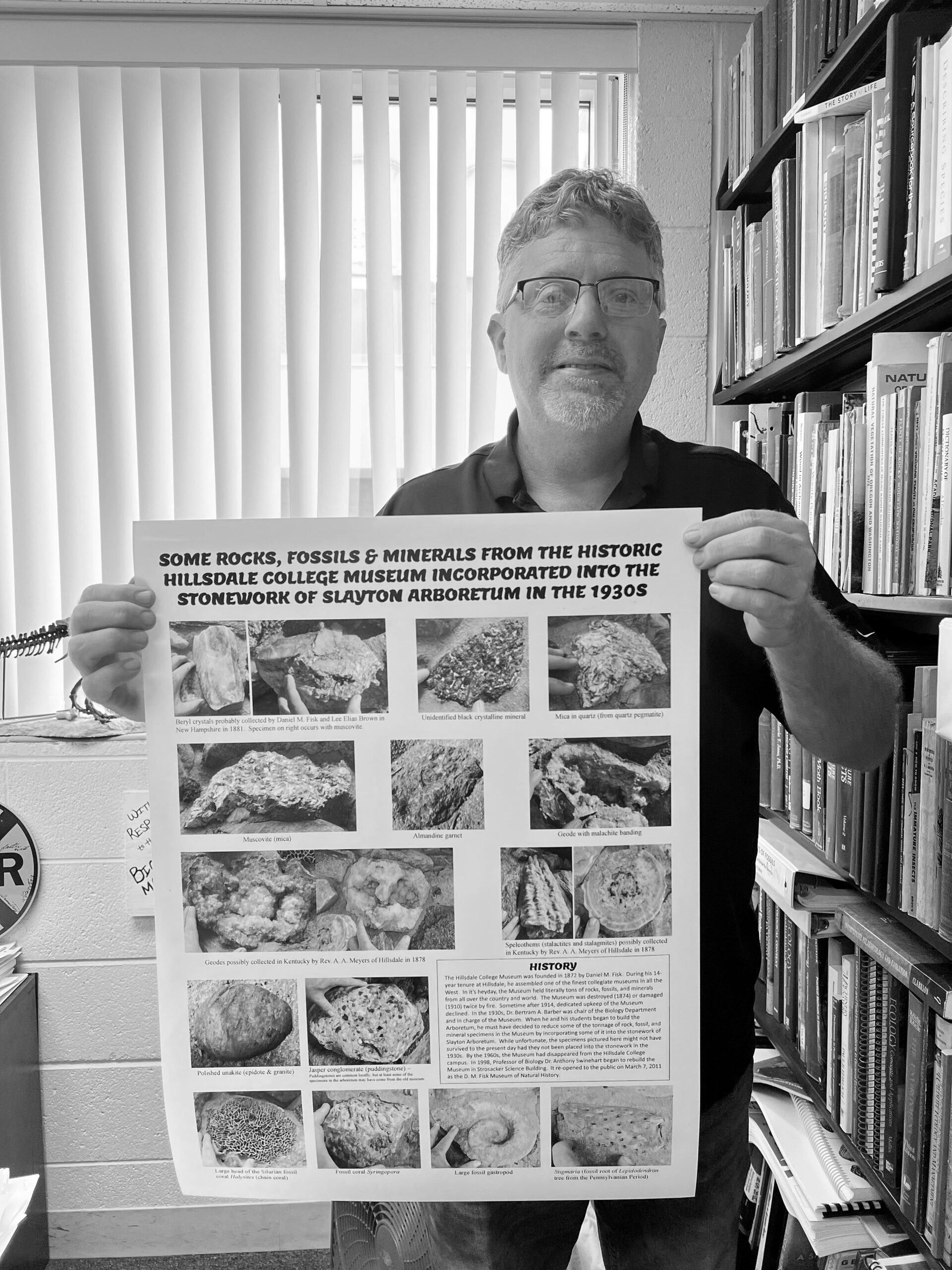
There’s an old Hillsdale legend that the stone walls of the Slayton Arboretum aren’t only built of local stones. An observant eye may notice that some of the rocks aren’t rocks in the traditional sense at all–and it was long-rumored that the walls contained various non-native fossils and gemstones. Thanks to the work of Professor of Biology Anthony Swinehart, the legend is confirmed, along with the origins of the fossils.
As the Arb approaches its 100th anniversary, Swinehart, curator of the D. M. Fisk Museum of Natural History, decided it was time to investigate.
“It brings a whole new meaning to the phrase ‘if walls could talk,’” Swinehart said. “It was just a legend or a rumor until I finally went out and decided, knowing enough about geology and fossils, to discern which ones could have come from the local rocks around here and which ones certainly did not. And so I went out there and found a bunch.”
By combing through historical records of the museum and cross-referencing the information with his fossil expertise, Swinehart began to piece together how the fossils became part of the Arb walls.
It all began with the founding of Hillsdale College’s museum in 1872, which was one of the largest college museums at the time, Swinehart said. It was housed in Knowlton Hall of Science, where Moss Hall now stands. Once the museum’s founder, Daniel M. Fisk, left the college in 1886, the museum started to decline. In 1910, it caught on fire.
“Most of the specimens survived but the ceiling collapsed and the building was badly damaged,” Swinehart said. “And the museum and all of its specimens pretty much remained in boxes strewn around campus for four years. Some things were taken and stolen.”
In 1914, the senior class decided to rebuild the museum as its class gift.
“The other option they were considering was a cluster of electric lights on campus, but they decided to save the museum, which tells you a lot about the value of the museum to the general student body at the time,” Swinehart said. “People would come to visit, we had an Egyptian mummy, colonial American currency and fossils, minerals, animals, and plants from around the world.”
In the 1920s, Bertram Barber, then-chair of the biology department and head of the college museum, founded the Arb. He continually added to it through the years, eventually using pieces from the museum in the 1930s.
“The museum at one time had literal tonnage of specimens,” Swinehart said. “So Barber must’ve decided and had the authority to use some of those museum specimens to incorporate them into the stonework of the Arboretum.”
As Swinehart searched the Arb and found fossils that matched old newspaper articles and museum records, he identified several types of fossils and minerals. He found beryl crystals, likely collected by Fisk and Lee Elias Brown in New Hampshire in 1881. Swinehart found stalactites, stalagmites, and geodes possibly collected in Kentucky by Rev. A.A. Meyers of Hillsdale in 1878. Other finds included chain coral, a gastropod fossil, and almandine garnet.
Swinehart wasn’t alone in noticing the Arb’s unique stonework.
“I have often admired many of the specimens while working around the stone structures of the arboretum,” said Angie Girdham, college horticulturist. “It was obvious that they were unique and it is certainly interesting to now understand how they came to be there.”
Barber’s use of fossils in the walls has a surprising upside: it may be the only reason they’re still around today. According to Swinehart, when the college built the Strosacker Science Center in the 1960s, it moved specimens out on the lawn for people to take and then dumped thousands in the garbage, only saving a few for teaching.
“Quite frankly, as much as I would love to have those in the museum, especially the coral and the ones for which we know a collector, date, and location, they probably would not have survived to the present day had they not been incorporated,” Swinehart said.
Jeffrey VanZant, associate professor of biology and director of the Arboretum, agreed with Swinehart that incorporating the fossils into the Arb’s walls could have been what preserved them for so long.
“By taking them and using them over there, they didn’t get put out or discarded or collected by anybody else,” VanZant said.
VanZant said he had noticed unusual rocks in the walls long ago. Before Swinehart’s research, however, he assumed it was because Barber’s brother and father were both stonemasons and had incorporated non-local rocks.
“There’s lots of rockwork that was done over there in the 1920s and ’30s,” VanZant said. “In fact, now that we know where some are, we’re searching for others.”
The precise location of the fossils won’t be publicly disclosed for security reasons, but VanZant and Swinehart both encouraged students to see if they can spot them. While the old legend is now confirmed, there may be more to the mystery—and perhaps fossils in the walls that are yet to be discovered.