
As I stood in front of Elizebeth Smith Friedman’s former house in Washington, D.C., I was overwhelmed with gratitude and awe for this American hero.
Friedman is a 1915 Hillsdale alumna who was a codebreaker in both world wars. Despite her tremendous impact on America, few people know about her greatness. But that’s about to change.
This past weekend I traveled with my classmates senior Christian Peck-Dimit, junior Maddy Welsh, and sophomore Jack Cote to Washington, D.C, and Lexington, Virginia to learn more about Friedman. The four of us are making a film about her for documentary filmmaking, a class taught by Adjunct Professor of Documentary Filmmaking Buddy Moorehouse.
Thanks to a generous donor, we were able to travel and retrace the steps of Friedman’s life. Welsh and I visited her former home in D.C. first.
Friedman raised her two children, Barbara and John, in a little house on Military Road. In 1925, the Coast Guard came knocking on the front door of that house to seek Friedman’s help fighting organized crime during the Prohibition era. She worked for the Coast Guard from home most of the time; in that very house she decoded communications to take down some of the most high-profile liquor smugglers working on the Atlantic.
While we were at Friedman’s home, Peck-Dimit and Cote visited Arlington National Cemetery to take pictures of her grave. She was buried with her husband, William Friedman, a codebreaker and a lieutenant colonel in the U.S. Army. The Friedmans rest in the very back of the cemetery. Their tombstone displays their names as well as one of their mottos: “Knowledge is power.”
At the time she was buried, all her codebreaking work was classified. No one knew the vital role she played in saving American lives and taking down criminals.
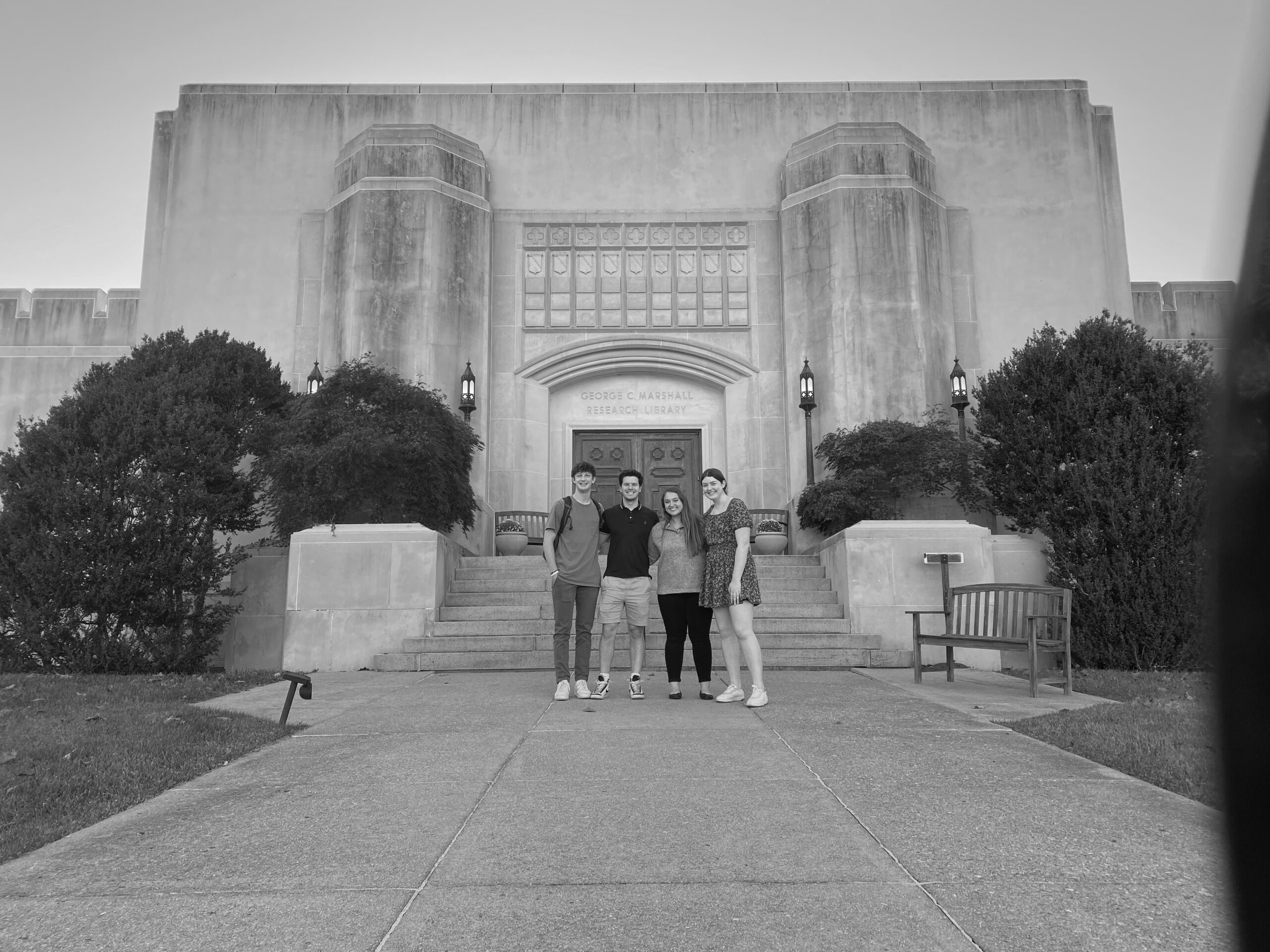
We headed out to Lexington, Virginia, the next day to research the Friedman collection at the George C. Marshall Foundation.
When we arrived at the foundation the next morning, we were greeted by Melissa Davis, director of the library and archives. We were overwhelmed with excitement as we saw 22 boxes filled with files from Friedman’s life containing love letters, Hillsdale essays and exams, pictures drawn by her children, Pi Beta Phi alumnae publications, and letters from the government with redacted information.
One file that stood out to us was a transcript of Friedman talking about their family dog, Crypto. We learned the Friedmans loved animals and always had fun pets around the house, mostly cats and dogs.
We looked through Friedman and her husband’s letters to each other when their work led to separation. He would end most of his letters by saying, “Save a million kisses for yourself, and give a few to the children.”
We had the chance to interview Davis and learn about a personal connection she has with the codebreaker. Her father was on a World War II ship that was almost sunk but was saved by someone, most likely Friedman.
As I listened to the story about Davis’ father being saved I couldn’t help but imagine how different our present world may be if Friedman had not contributed to history.
The Friedmans donated their entire library to the foundation, so we had the opportunity to look through their books. In the library also stands the Friedmans’ desk that was located in their home office while they were still living.
We related to her as Hillsdale students as we saw her English exams in bluebooks. Her professor wrote on the back of one of her essays that her “ideas and phrases were good but the style is choppy.”
We could better understand her struggles when we found an old copy of “The Arrow,” Pi Beta Phi’s monthly publication. Friedman wrote an article that expressed frustration in the fact that no matter how great her accomplishments were she would always simply be known as “William’s wife.”
Looking through these files allowed us to see the personality and character of Friedman. We encountered her in a different way than ever before, leading to a better understanding of who she was as a Hillsdale student, wife, mother, and spy. Now, it’s just the simple matter of making a whole documentary about her – should be easy, right?