
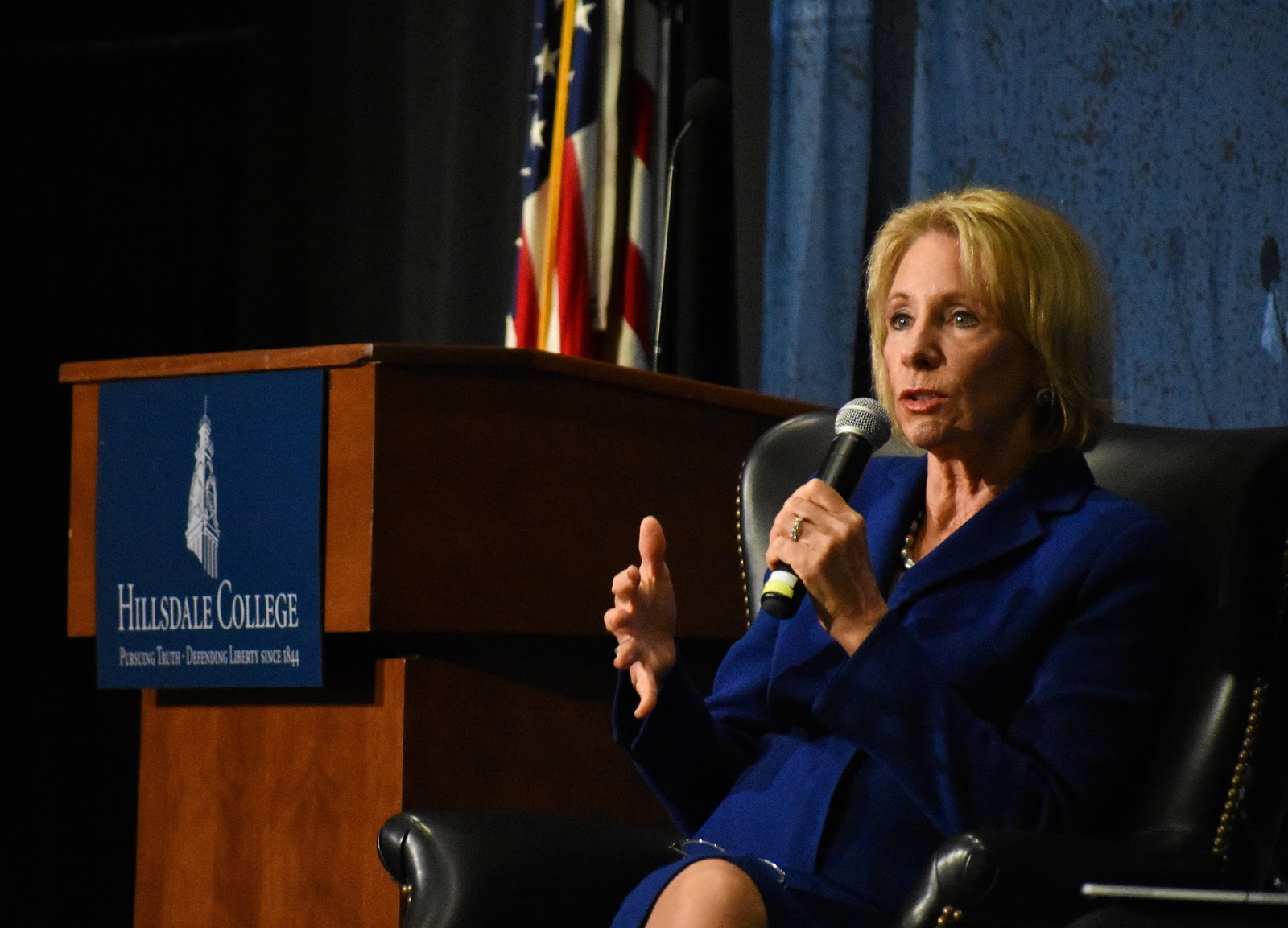
The American education system has put a generation at risk, Betsy DeVos said in the Drummond Lecture last week.
DeVos, the 11th Secretary of Education who served under President Donald Trump from 2017 to 2021, made her third visit to campus in three years, this time to address school choice. She argued that a pluralistic approach to education is the path forward for the United States.
“This dynamic gives us better restaurants and better businesses. An open market will give more empowered education options,” she said.
DeVos said coming to campus is always like coming home.
“Hillsdale is a sane oasis in a world that feels not so sane,” DeVos said.
In her lecture, she said that today’s public education is fighting against what G.K. Chesterton called the “triangle of truisms”: the natural family built around father, mother, and child. Even though the current culture is at war with it, DeVos said it cannot be destroyed.
“It can only destroy those civilizations which disregard it,” she said, quoting Chesterton
She cited how Gov. Glenn Youngkin of Virginia won his election last year. Parents revolted against critical race theory, fueling his victory.
DeVos said the people found out the “emperor” does not always have their best interest in mind. During the COVID-19 pandemic lockdowns, she said she heard constant echoes of parents worried about their kids.
“Their children were suffering,” she said. “It was one of the biggest health failures of our lifetime.”
Through Zoom meetings at kitchen tables across the country, parents witnessed the curriculum schools were teaching their children. DeVos said this revealed the longtime failures of the education system.
She gave examples of identity politics, such as “math-ethnic” studies in Seattle’s public schools, which claims that “mathematical theory and application is rooted in the ancient histories of people and empires of color.” In addition, she said that elementary school students learned about the fundamental difference between gender and sex and how to choose an identity.
“I could keep us here all evening reciting them,” she said. “It is force-fed identity politics.”
DeVos cited worsening test scores as an example of failed education. In a ranking of all nations, the United States dropped a rank in math scores for the first time.
“A generation is at risk,” she said, alluding to the 1983 report by the United States National Commission on Excellence in Education, titled “A Nation at Risk: The Imperative for Educational Reform.”
To fix the education system, DeVos suggested education should be conducted in a pluralistic manner.
DeVos challenged the government’s use of taxpayer money to fund only public schools instead of also supporting independent charter schools.
She said this is like allowing citizens to shop only at places that accept “Medicare for All” and food stamps. While there is a need for public schools to educate many, it does not mean that all education comes from there, DeVos said.
“There are many reasons you want to choose a different grocer or doctor,” she said. “I would argue that any school that provides education to the public is a public school.”
She gave a hypothetical example of a high school student who is an apprentice at John Deere, plays community football, and takes self-paced online classes instead of attending a traditional public school. She argued that the choice to participate in this type of non-traditional education should belong to the family and to the student.
“Imagine if we gave each student a standard amount,” she said. “That’s what it should look like: everyone getting educated by the best of the best.”
Associate Vice President for Curriculum David Whalen said DeVos’ comments on education were wonderful and timely.
“Her experience and principles both shed real light on what has become a crisis,” Whalen said.
Assistant Professor of Education David Diener said DeVos’ argument revealed how American education will be stronger if parents have the choice of where to educate their children.
“In a time when education is increasingly being controlled by centralized government bureaucracies, the essential role that parents should play in their children’s education needs to be highlighted,” Diener said.
Master’s student in classical education Brendan LaVoie said DeVos’ discussion of the political implications of education is particularly compelling.
“Having done both undergraduate and master’s work in politics, much of her talk of the institutional failures of our education system aligned with my academic experience, especially the progressives’ emphasis on ‘expertise,’” he said.
