
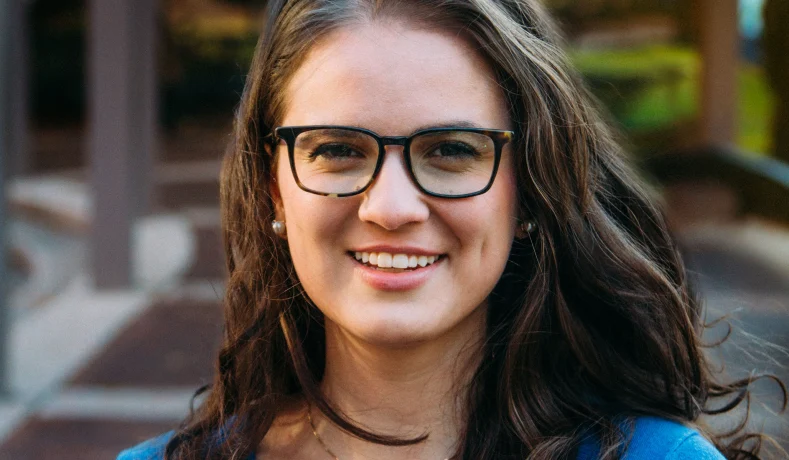
Alexandra DeSanctis is a staff writer for National Review and a visiting fellow at the Ethics and Public Policy Center. As the fall 2022 Eugene C. Pulliam Distinguished Visiting Fellow in Journalism, she taught a one-credit course on campus called Reporting in an Age of Controversy. Her recent book, co-written with Ryan T. Anderson, is “Tearing Us Apart: How Abortion Harms Everything and Solves Nothing.”
How did you first get started writing and reporting?
When I got to Notre Dame, I became a staff writer for the Irish Rover, which is the independent student newspaper. I wrote for that paper as a freshman, and then throughout college, I just kept rising up the ranks of the paper. I ended up as executive editor my senior year and managed layout for two years. By the time I graduated, I was able to get a fellowship at National Review as a writer. Once I got there, I just never really wanted to leave.
What is the biggest lesson you’ve learned while writing for National Review?
The most important thing for a young writer is to build expertise and credibility. I didn’t necessarily do it intentionally or consciously. But I really made a place for myself at National Review by finding a few issues that I cared about, building up my knowledge, and writing about them frequently to the point where my editors and my readers began to trust me on those issues.
How did you choose abortion as the focus of your journalism?
I grew up in a very pro-life home. I didn’t graduate college with the intention of becoming an abortion beat reporter. I wouldn’t have considered something like that even existed. But when I got to National Review, I was given a lot of freedom to write about what I cared about, even to do opinion writing. The more I was given the freedom to find what I was passionate about, the more I just came back to the life issue. I’ve always felt that this is the greatest human rights tragedy of our time. I’ve always felt very strongly that I had a responsibility to do something about that. It just happened that I was in the right place at the right time with the talents I had to do a small part.
What advice would you give to young aspiring writers and journalists here at Hillsdale?
Write a lot. Read a lot. Those are the first two things you can do to become a better writer in general. When it comes to journalism specifically or media, I think it’s a very specific calling. It’s not something that one should just do because they can write. It’s not something you go into if you want to be a millionaire. You really do have to feel called and feel a sense that this is how you’re called to use your talents. At that point, I think it’s just about finding where you fit. How do your talents and your desires fit into the media landscape? What kind of outlet is the best place for you? What kind of journalism is the best fit for you?
What is the biggest challenge facing the pro-life movement?
Unity is the biggest challenge. The strategy will look different for pro-lifers in Florida versus New York versus California because what the public supports is different in each state. But it will be important to have some kind of unified understanding that incrementalism is a great way of moving the ball forward. Everything we do as a movement, even if it looks different from one state to another, should be oriented toward the ultimate goal of protecting every unborn child and simultaneously building a culture where women and families don’t feel like they need abortion.
Why did you write a book about abortion?
Ryan and I wrote the book in anticipation of the Supreme Court decision. We didn’t know which way it was going to turn out, but our hope was it would overturn Roe v. Wade. We wanted to write a roadmap for pro-lifers in a post-Roe country. Of course, it’s important to make the case that abortion kills unborn human beings. But if that’s the case, how can we as pro-lifers learn to articulate how that fact harms everybody? If we really are killing hundreds of thousands of unborn human beings every year, how could it not be the case that this has destroyed every element of our society? Every chapter takes a look at all the ways in which legal abortion has harmed different elements of our society.
