
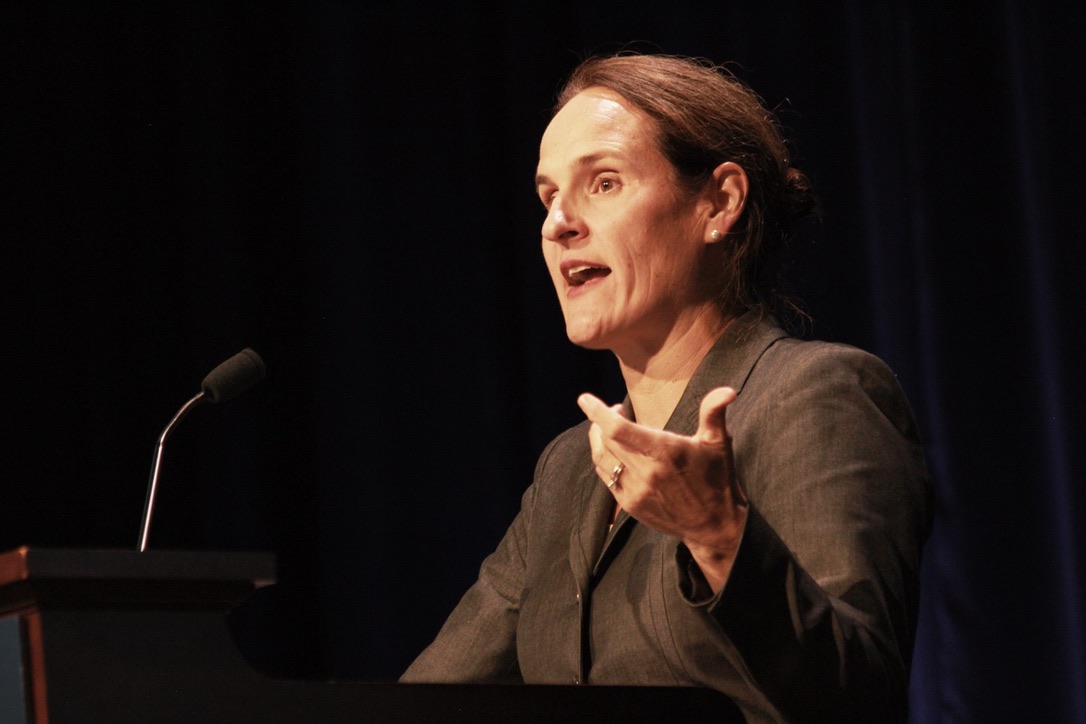
Abortion and women’s rights do not fit “hand in glove,” said Erika Bachiochi in her speech on Sept. 19, “Roe, Dobbs, and Competing Visions of Women’s Rights.”
Bachiochi is a fellow at the Ethics and Public Policy Center and the director of The Wollstonecraft Project at the Abigail Adams Institute in Cambridge, Massachusetts. She specializes in equal protection, jurisprudence, feminist legal theory, Catholic social teaching, and sexual ethics.
In her talk, Bachiochi said American culture argues women’s equality requires free access to abortion.
“Abortion has become the privilege response to the reproductive asymmetries between men and women—that is the basic biological fact that a man and woman engage in the same sexual act, but it is the woman who gets pregnant,” Bachiochi said.
Bachiochi countered this argument with historical context.
“This is not at all how women’s equality, indeed women’s rights were always understood,” Bachiochi said. “The earliest women’s rights advocates both in our country and abroad opposed abortion.”
The two U.S. Supreme Court cases which legalized abortion, Roe v. Wade and Planned Parenthood v. Casey, both interpreted the clause of the 14th Amendment to include women’s access to abortion.
Bachiochi said the Dobbs decision examined the 14th Amendment in its proper historical context which led to the overturning of these two court cases.
“No one, including the early American women’s rights advocates, thought that the 14th Amendment liberty included the right to intentionally end the life of one’s own child,” Bachiochi said.
Bachiochi quoted several women from the 19th and 20th centuries who wrote against the practice of abortion, including Alice Stockholm, one of the first female OB-GYNs, and Mary Wollstonecraft, author of “A Vindication of the Rights of Woman.”
Bachiochi said these women believed women were equal to men because they both served the same God.
Bachiochi said Planned Parenthood founder Margaret Sanger blamed women’s fertility as the source of inequality and offered birth control and abortion as the solution.
“Sanger’s widely successful campaign for birth control fundamentally and dramatically shifted our cultural response to reproductive asymmetry, no longer demanding chastity and social supports for mothers, as 18th and 19th century women’s rights advocates had, but technologically ‘freeing’ women from the burdens of sex just like men,” Bachiochi said.
In step with this radical change, abortion rates, extramarital sex, and single motherhood dramatically increased, Bachiochi said.
“Women are designed, unlike men, to nurture a vulnerable human being in our bodies, even if we never do so,” Bachiochi said.
President of the Catholic Society Noah Hoonhout said he met Bachiochi this summer at a seminar for the Abigail Adams Institute.
“She is a fantastic speaker and has some really sharp, unique thinking that seriously impressed me. I asked if she were interested in speaking through the Catholic Society,” Hoonhout said. “I think talking about Dobbs and Roe was great because it’s pertinent to Catholics and all Christians.”
Junior Lucy Fernandes said our culture must learn from the example of the first-wave feminists.
“I found it fascinating how the opinions of the first-wave feminists diametrically opposed that of modern feminists,” Fernandes said. “Their perspective is much fuller and more humanizing.”