
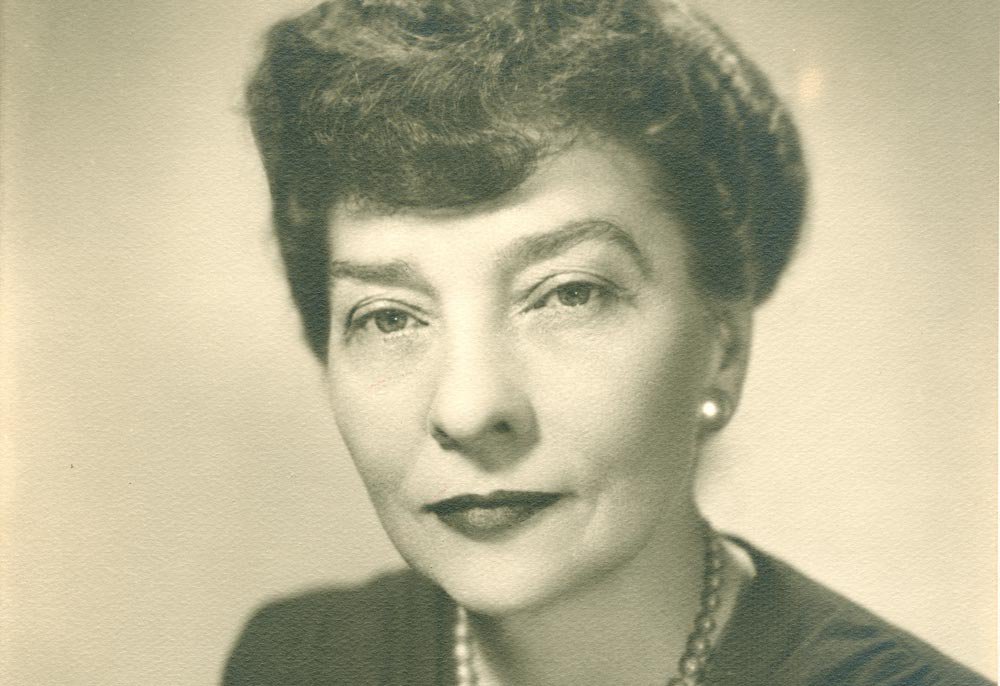
Elizebeth Smith Friedman is forgotten by many people, including her alma mater.
After graduating from Hillsdale College in 1915, she became an expert cryptanalyst who deciphered enemy codes in both world wars. She is one of the greatest, if not the greatest, graduate of Hillsdale College.
Friedman played a big role in both world wars, but her work was especially vital in defeating Hitler’s Germany during World War II. She swore an oath of secrecy until death, so nobody knew how great of a hero she was until 2008, 28 years after her death.
Although a commemoration of some sort is in the works at the Kirby Center, Friedman deserves to be remembered alongside people such as George Washington and Abraham Lincoln on the Liberty Walk. Hillsdale College sparked her passion for the liberal arts which made her a success in the world of cryptology.
When Friedman was a student at Hillsdale, she studied Greek and English literature. She became fascinated with the intricacy of language that was influenced by reading William Shakespeare’s plays, according to the documentary, “The Codebreaker”.
Her love of Shakespeare and language led her to work for George Fabyan after graduation. He was the first person to teach Friedman a method of encoding messages invented by Francis Bacon. After working with Fabyan for about a year, Friedman believed that her coding days were long over, but she could not have been more wrong.
When the United States entered World War I in 1917, Fabyan established the first dedicated codebreaking unit in America, Riverbank Laboratories in Geneva, Illinois. Friedman and her husband, William, were the first people he hired.
Up until this point, coding was nothing more than a hobby for Elizebeth and William, but now they were expected to break codes for the United States military in a world war. Their success or failure would determine the fate of the nation.
Friedman and her colleagues broke all messages for every part of the U.S. military and Department of Justice, according to the documentary, “The Codebreaker”. Friedman was forging a new science that would hold immense power, all while training the first generation of codebreakers for the U.S. military.
In 1925, a Coast Guard officer showed up at her house with an urgent request.
The Coast Guard’s network of radio towers had intercepted hundreds of encrypted messages, but no one knew how to break them. They needed Friedman to decrypt the messages. During Prohibition, the Coast Guard was supposed to stop the smuggling of liquor, but it was failing.
With hopes to put a stop to organized crime, she agreed to help the Coast Guard. During her first three months on the job, she decrypted two years’ worth of backlogged messages all by herself.
But, not only was she decrypting messages, she was weaponizing the data she was gathering. She could then tell the Coast Guard who owned the ships and when a ship was scheduled to leave. The Coast Guard used this information to arrest and prosecute smugglers.
Because of Friedman’s brilliant work, the Coast Guard approved her plan to build an official code-breaking unit, the first to be run by a woman.
Friedman was the key witness in a series of trials that put Al Capone and other gangsters behind bars.
In 1941, Friedman’s team switched from helping the Coast Guard to helping the Navy.
Her biggest accomplishment in World War II was bringing down the SS’s main man in South America and one of Hitler’s elite, Johannes Siegfried Becker, better known as “Sargo.”
She also intercepted many messages that gave her information about the location of German U-boats in the Atlantic, allowing the supply line to existing.
Her triumph was lonely. The Navy made her swear an oath of secrecy until death. She told her friends she was carrying on with a “routine Navy job.”
She could do nothing as she watched American FBI Director J. Edgar Hoover take the credit for her work. He took the 4,000 decrypts Friedman had sent and had them stamped with FBI identification numbers. Friedman and her team were erased from the official records.
Friedman created a new science of codebreaking that laid the foundation for everything that happens at American intelligence agencies today.
She died alone in a nursing home in 1980. She was poor and many people had forgotten her influence within the world of coding.
The government kept her files secret for 62 years. In 2008, they were finally declassified.
She is not just one of the most important people from Hillsdale College, but she is one of the most important people in American history.
Despite the fact that this information has been available to the public since 2008, there is not even a plaque to honor her at the Hillsdale campus.
Hillsdale College should recognize her achievement and add her to the Liberty Walk.