
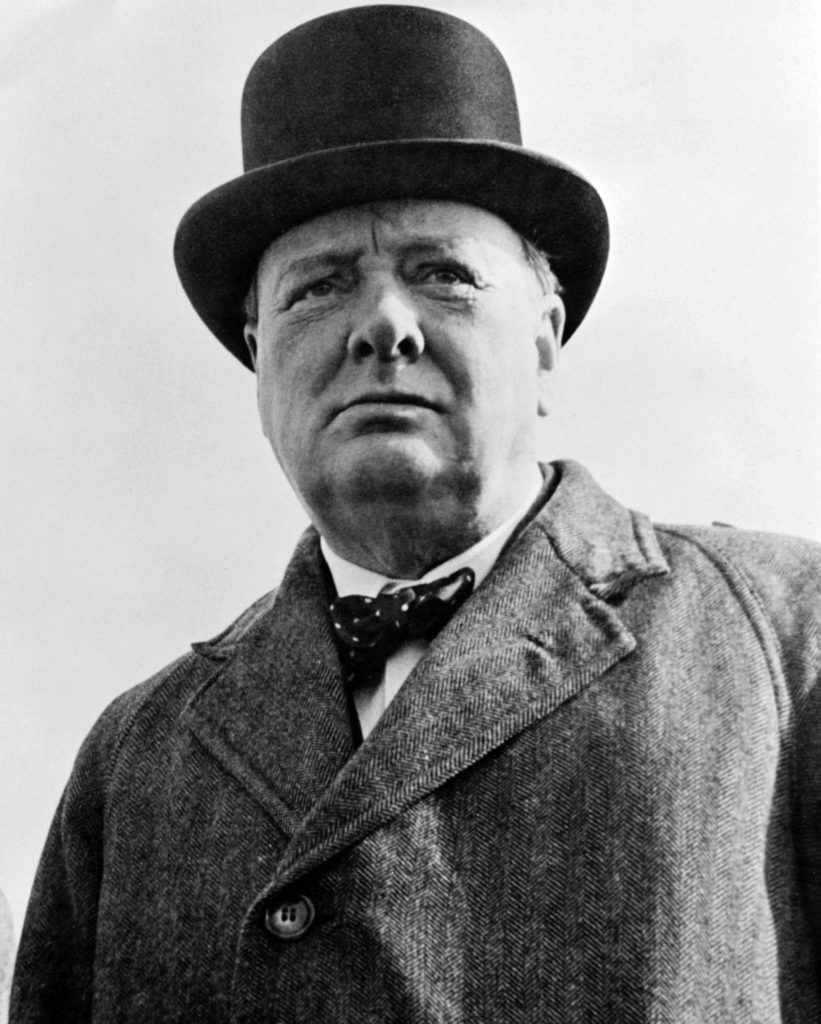
| Collegian Archives
Winston Churchill’s rigorous self-education laid the foundation for his later successes, said Christopher Harmon, a professor at the Institute of World Politics.
Harmon, who has worked in foreign policy and counterterrorism studies programs for the U.S. government, presented his research on Churchill’s self-education in a lecture titled “The Books Churchill Read: The Self-Education of a Statesman.” The president’s office and the Churchill Project hosted the event on Sept. 8.
“This is a fun subject for me which I’ve been investigating all the time,” Harmon said. “The glittering intellect that is Winston Churchill is hard to understand, and it is hard to fully appreciate such a remarkable mind.”
In order to understand how Churchill achieved his intellectual prowess, Harmon decided to research the books that Churchill read throughout his life. As a child and adolescent, Churchill developed an insatiable appetite for books, according to Harmon, especially war histories and adventure. Churchill even corresponded with some of his favorite authors, Rudyard Kipling and H. Rider Haggard, at a young age.
“He was very taken with history, military history,” Harmon said. “He read extensively, and he read pretty seriously. When he was 13, he asked his mom for Ulysses S. Grant’s memoirs.”
Churchill’s primary school and boarding school assigned a diverse curriculum of literature, and it was during these years that he came to learn Latin and appreciate Roman and Greek classics such as Horace’s “Odes,” Julius Caesar’s “Gallic Wars,” and Virgil’s “Aeneid.”
These and other great works of literature influenced Churchill’s writings and speeches for years to come, Harmon said. Churchill quoted Latin phrases in his speeches and used the rhetoric of epic poetry from works, such as Milton’s “Paradise Lost,” throughout his career.
“There’s so much in Churchill that’s about the highs and the lows, and the depths of the canyon but the sunlit uplands — you see those motifs in this rhetoric,” Harmon said. “I think the tragic dimension of some of the epic poems was really important to him.”
Because Churchill did not attend university or possess the rigorous educational credentials of many of his peers, he educated himself to perform on the same level as those around him.
“As a member of Parliament he always felt he was a step behind, not having gone through the big universities,” Harmon said. “As a self-educated man, he willfully studied classics that maybe he wouldn’t have if he had gone to Cambridge because he didn’t really want to be left out and he didn’t want to seem less than his well-educated peers.”
Churchill’s early fascination with history remained with him his whole life, Harmon said.
“The list of histories that he’d gone through are so numerous that it’s almost impossible to name them all,” Harmon said. “He read the record of debates in Parliament and all the classics of history. He studied his own father’s career and he studied the kings and queens.”
But it wasn’t all politics and history for Churchill, Harmon said. Churchill enjoyed reading the great works of English authors like Charles Dickens, John Keats, and William Shakespeare.
As he became an important figure in world politics, Churchill took it upon himself to read literature from around the world. He had a great affinity for American literature, especially the work of Mark Twain and Harriet Beecher Stowe.
Junior and George Washington Fellow Meredith Kottom said she enjoyed learning about the books that shaped Churchill’s character and skills.
“I was incredibly impressed with Dr. Harmon’s knowledge and research about the books that influenced Churchill, as well as the variety of literature Churchill read from a young age,” she said. “I learned how valuable reading great books in a variety of disciplines is in ordering one’s life and career.”
Senior George Washington Fellow Abigail Elwell said the lecture challenged her to read more purposefully.
“Dr. Harmon connected Winston Churchill’s reading across genres and authors to the prime minister’s genius and endurance as a leader,” she said. “I walked away challenged to read deeply and carefully for the rest of my life.”
