
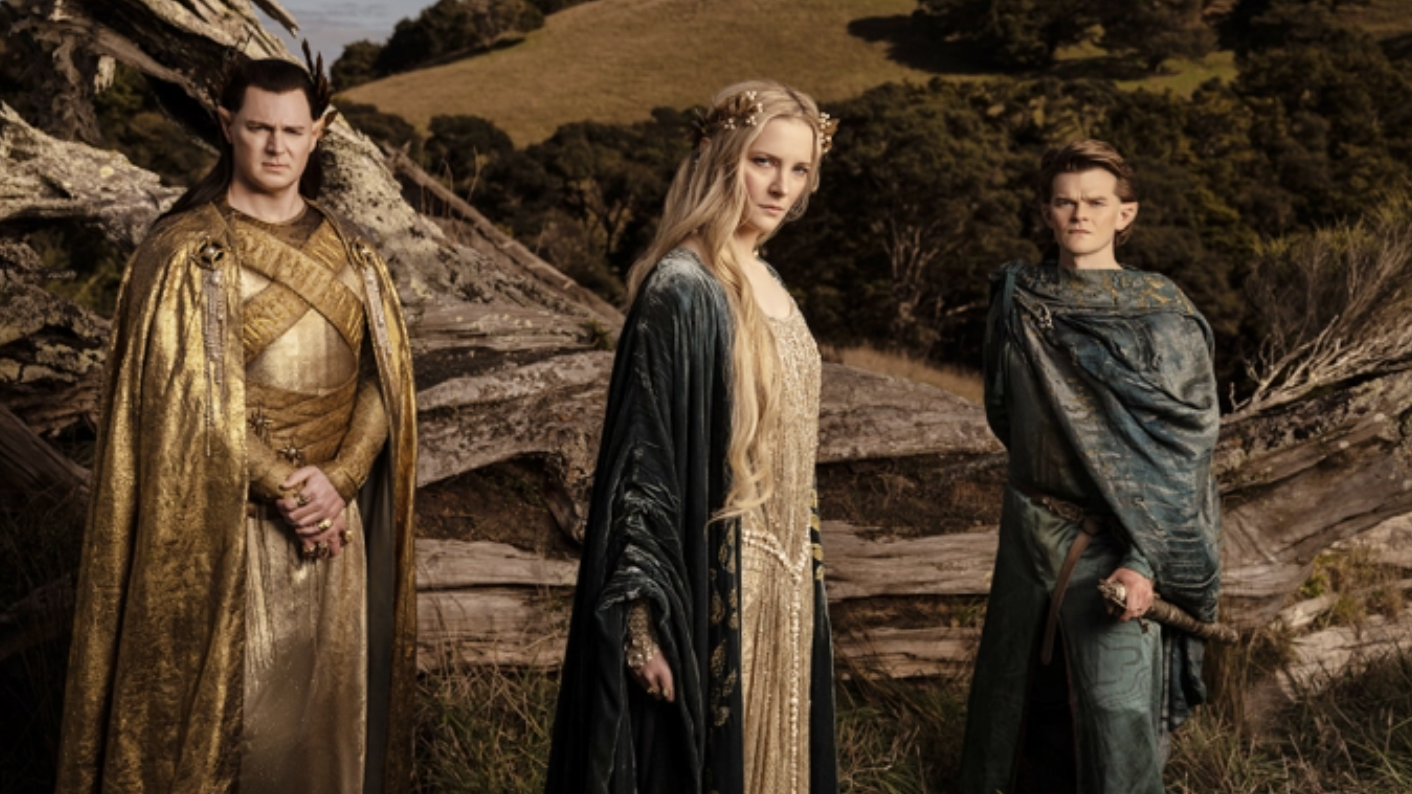
After a whopping $715 million budget, the producers and directors of the new Amazon show, “The Rings of Power,” should have remembered the old saying, “all that glitters is not gold.”
On Friday, Sept. 10 a group of friends and I sat down to watch the show’s first episode. There was quite a range of fans, varying from loyal followers of J.R.R. Tolkien’s books to those who had only a mild appreciation for the movies. But all were brought together in a mixture of trepidation and curiosity about Amazon’s take on Tolkien.
As I attempted to bring my friends together to sit down and watch the show with me, opinions started flying in group chats and in conversations between classes.
“It’s the death of Western Civilization,” said junior Liam Martin, who refused to attend the showing.
The nine of us who did attend the showing forged a new fellowship entering the wide world of Middle Earth’s prequel tv series.
The first episode, “A Shadow of the Past,” opened with a scene depicting Galadriel in the Undying Lands as a girl is getting bullied for trying to float a paper sailboat on water. After this incident, Galadriel, as a young elf-woman, narrates the elves’ flight from the Undying Lands to the shores of Middle Earth and the war they waged against Morgoth and Sauron. The episode mirrors how the older Galadriel narrates the history leading up to Frodo leaving the Shire in “The Fellowship of the Ring.”
However, that’s where the illusion between the trilogy and TV series is shattered. The Amazon series did not have the rights to “The Silmarillion,” Tolkien’s history of Middle Earth, so the producers and directors loosely referenced the appendices of “The Lord of the Rings” for source material. In contrast, Peter Jackson’s productions gained production rights to both “The Hobbit,” and “The Lord of the Rings.”
Some viewers, even those who did not attend my watch party, thought the show to be an excellent continuation of the trilogy. “It’s absolutely stunning from a visual perspective,” said professor of theatre James Brandon, “and matches up pretty well with my memories of both ‘The Silmarillion,’ and the appendices to the LOTR. The pacing hasn’t been a problem for me, and I am really enjoying Morfydd Clark’s take on Galadriel.’’
Junior Tomek Ignatik, however, disagreed with Brandon’s review. “It was generally uncompelling with one-sided characters,” said Ignatik. “They had some ideal for Galadriel’s character and every single thing about her character was about how she was traumatized by Sauron.”
“I didn’t even go into this expecting it to be bad. I was going into it expecting it to be uninteresting because most TV shows are,” said senior Andrew Buonincontro. “And I honestly enjoy the places where it made up something new… But it’s the points where it conflicts with the previous legendarium that bothers me.”
The question of whether or not the TV series fits nicely into the established world of Middle Earth was fiercely contested.
“The second you bring a work of fiction into performance, most of the rules for maintaining a reader’s verisimilitude go right out the window,” Brandon said. “TV and film are the results of thousands of decisions by the production team and actors to share the story with people who have never read it as well as with the many people who have read it (and have had their own experience). It will never be ‘the same’ and it will never be 100% ‘right.’”
The return of Howard Shore as a composer for the main title of the series provided a thread of synchrony with the trilogy, but Bear McCreary remains the main composer of the rest of the series’ score. As a result, the soaring musical themes the viewer is accustomed to in the films are missing. This leaves the most invested viewers unsatisfied and the least interested viewers with nothing to remember.
The most significant similarity between the original works and the tv series is the visual effects, which are nothing short of arresting. Yet, the huge production budget and the subsequent gap in technology between Peter Jackson’s works and Amazon’s show only demonstrates the skills of Jackson, and less the technical skills of the series.
Overall, if you’re willing to put aside comparisons both to the previous movies and source literature, you might enjoy the hour-long adventure. But if you’re looking for a joint heir to the original story, your adventure into Middle Earth will be dull and uninteresting.
