
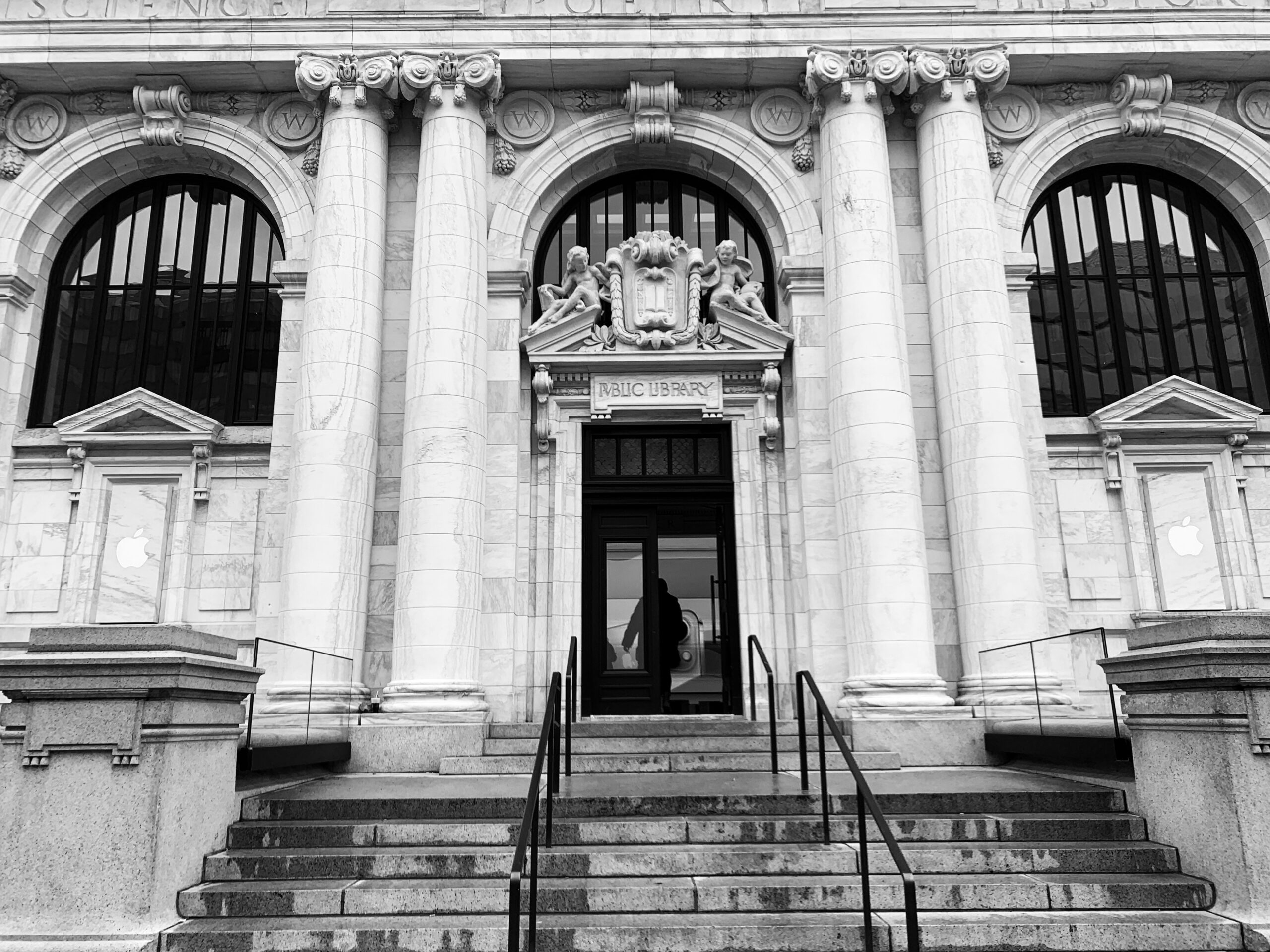
When my apartment-mate and I ventured out in D.C. one afternoon, we made sure to visit the Apple Store at the Carnegie Library. The Apple Store is in the repurposed Carnegie Library, located on Massachusetts Avenue, just north of Chinatown. In vaulted marble atriums, sleek modern tables showcase shiny new iPhones, iPads, Macbooks, and AirPods. This Apple store features an “Experience Room” and a boardroom for meetings. Names of prominent thinkers of the Western tradition are etched into the crown molding of the main atrium; “Shakespeare,” “Galileo,” and “Plato” watch over the tech giant’s day-to-day retail efforts. The modern feel of the Apple store at first feels jarring in the classical setting — it almost seems like a capitalist behemoth simply invaded and took over an unsuspecting center for learning. Almost.
The Carnegie Library was built by donations from the industrialist Andrew Carnegie with the intention of fostering public study and access to information. Since 1972 though, the Carnegie Library building has sat mostly idle, its contents moved to a larger building elsewhere. Different groups have proposed plans to repurpose the building, but most fell through. The D.C. Historical Society began using it as its headquarters in 1999, and still occupies the basement and second floor. Apple is the first private company to renovate and use the building. In 2016, after a long hiatus, the Carnegie Library opened to the public, this time as an Apple store.
Even as a devoted capitalist, seeing a beautiful library dedicated to the sale of iPhones was a bit strange. You get the sense that Apple is trying to claim its rightful place among the thinkers and visionaries of the past, as the cutting edge thinker of the current milieu. The company may even have a valid point. We probably would not have instant texting and smartphones if we still thought the sun revolved around the earth. Similarly, Apple has revolutionized the speed at which we can stay on top of the news, the efficiency of conducting business, and the ease of staying in touch with friends across the globe. Much of the modern economy and our society is built on these kinds of technological advances.
Faithful economists should not be surprised or disappointed at Apple’s use of the space. It’s not necessarily a testament to the bad education of Americans either. The library outgrew its space and has moved to a bigger building. Having an Apple store in downtown D.C. was more highly favored by the people in that area than having an empty, but beautiful former library. If anything, the Apple store at the Carnegie Library is a testament to the power of markets to channel resources to their best uses. The Austrian school of economics proposes that when allowed to operate freely, the market can use both the interests of the Apple executives and the interests of their customers to create the best possible outcome for both groups.
Today, the Carnegie Library functions as a small gallery dedicated to D.C. history, the headquarters for the D.C. Historical Society, and one of the most decked out Apple stores in the country. Carnegie may have been proud that his building is still being used for the betterment of society and the spread of information, even if the information is coming via iPhone rather than book. Not to mention he was a famous believer in the power of capitalism. Ultimately, economics is powerful and capitalism can be used to rescue historic beauty.
