
| Wikimedia Commons
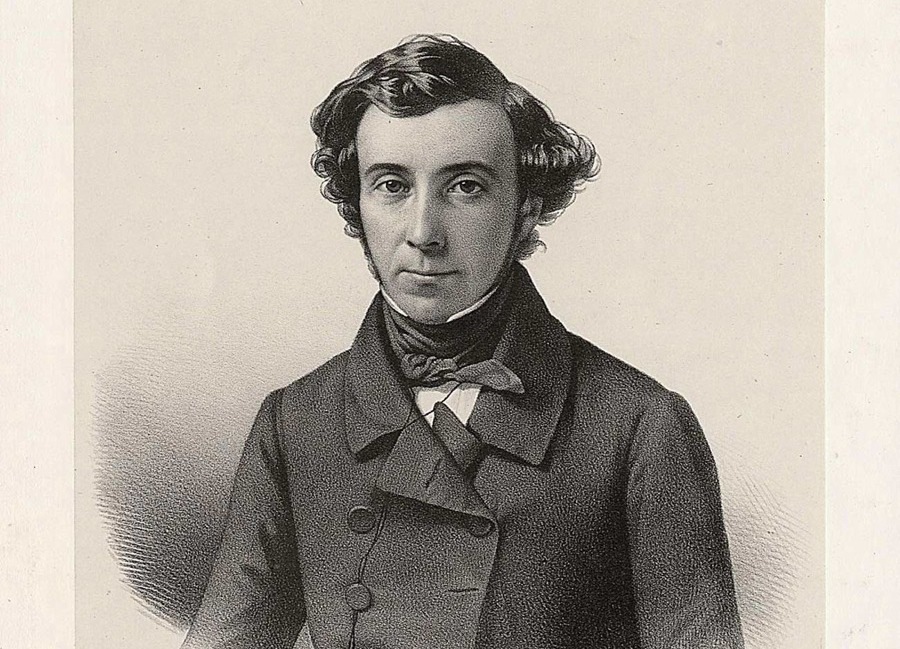
A former George W. Bush administration official spoke about Alexis de Tocqueville at an event hosted by the journalism department on Tuesday.
Leslie Lenkowski worked for the Bush administration from 2001 to 2003, and has experience leading multiple think tanks such as the Hudson Institute and the Institute for Educational Affairs. Lenkowski works at Indiana University as a professor emeritus at the O’Neill School of Public and Environmental Affairs and is senior counselor to the dean at the Lilly School of Philanthropy.
Lenkowski discussed Tocqueville’s observation of voluntary associations and philanthropy in America with journalism students.
Tocqueville “saw the use of associations as key to the success of the American political system,” Lenkowski said.
“If you don’t give a little, you accomplish nothing,” Lenkowski said. “So by serving in organizations and associations, we learn the value of compromise — of giving up on our self-interest in order to advance the interest of the group.”
Lenkowski expressed concern over public associations expanding at the expense of private associations, especially throughout the COVID-19 pandemic.
“During the pandemic, needless to say, the lead has clearly fallen to the public sector with a variety of agencies,” Lenkowski said. “We have been enjoined to trust the experts, rather than to place our trust in one another.”
Tocqueville predicted this in his examination of American democracy and civic associations, Lenkowski said.
“For many years, we have also been worrying that Americans have been neglecting what Tocqueville called ‘the science of association,’ and the challenges we have faced in responding to the pandemic, and the politicization we have seen inevitably occuring when government takes the lead role, may be the result,” Lenkowski said.
According to Lenkowski, Tocqueville became “the first documented grant-hustler” when he secured funding to study America’s prisons, but instead studied American democracy. Tocqueville noted civic associations “everywhere he turned” in his travels through the nation, Lenkowski said.
“What I want to talk about today is the uses he argues Americans make of civic associations,” Lenkowski said. “Everywhere he looks, he sees people joining organizations for all sorts of purposes, and his chapter tries to explain why their joining these organizations is important for democracy.”
Lenkowski said Tocqueville saw three main uses of civic associations: keeping the government in check, teaching people how to be good citizens, and how to moderate between desire and self-interest.
Lenkowski acknowledged the current variety of private charities, but explained public associations began to usurp private associations after President Franklin D. Roosevelt’s New Deal.
“The Works and Progress Administration employed lots of people who might otherwise have found things to do in voluntary groups. Social Security, of course, was enacted in 1935, and provided assistance to people who might otherwise have received such help,” Lenkowski said.
He said, even after World War II, disaster response had shifted away from the private sphere.
Conservative sociologist Robert Nisbet was one of the first to spot the decline in American civic associations, according to Lenkowski.
“Family, neighborhoods, church, and voluntary organizations were growing weaker. The causes, as he saw them, were a mixture of individualism — people preferring to do their own thing and statism — the growth of government to take over activities that were once done by community groups,” Lenkowski said.
At the same time, however, Lenkowski acknowledged that civic associations have been innovating their approaches.
“Comparing other nations to the U.S. associational life still looks very healthy here, we have lots of problems measuring things, and there are also new varieties that have been developed,” Lenkowski said. “You may have heard of social entrepreneurship, the merging of business and philanthropy, and new types of social media are allegedly creating virtual communities.”
Today, Lenkowski said, both the left and the right are conducting an “ongoing war on philanthropy.”
Opponents of civic associations argue “that giving is really ineffective, it is chancy, it doesn’t always address the real needs, and last but not least, that relying on associations — which are typically self-governing — is incompatible with democracy,” Lenkowski said.
One can advance Tocqueville’s idea of civic associations — a vital component of American life — in several ways, according to Lenkowski.
“First, do no harm. Stop doing things that reduce the role of civic associations. Secondly, look for ways to give more support to civic groups,” Lenkowski said. “In a sense, we’ve been doing that — they get a lot of funding these days — but with that funding comes a loss of autonomy.”
Lenkowski also applauded the growth of charter schools — particularly Hillsdale College’s efforts in this area — as vital to fostering civic associations. Funding people instead of organizations, Lenkowski said, can better provide resources to local groups.
Sophomore Jonah Apel said he enjoyed hearing Lenkowski discuss Tocqueville in a modern context.
“He made some interesting connections between Tocqueville and modern America that I found really enlightening,” Apel said.
Kent Heise attended the lecture with his wife Jean. Kent Heise said he was grateful for the opportunity to hear Lenkowski’s lecture.
“People with this character and background can come here, and we can all benefit from it. Not just you college students, but as a community,” Heise said. “I thought it was very interesting, he did a nice job.”
Lenkowski said his interest in civic associations began when he attended Franklin and Marshall College.
“It was in the ’60s, and a number of my professors were going down to places like Selma for civil rights,” Lenkowski said. “You ask silly questions when you’re 19, so I asked, ‘Why are we doing that when there’s a poor black community here in this town and a poor white community?’ So I created the college’s first tutoring and Big Brother program.”
Lenkowski traveled to a nearby state college to find women who could help run a big sister program to accompany the big brother program. There, he met his wife.
“My wife, who was a student there, stepped forward to organize the big sister portion, and we worked together for three years. We thought we had a pretty good partnership, and we’ve continued it,” Lenkowski said. “That is exactly the kind of activity Tocqueville saw, with developing the community and developing yourself.”
