
Ben Wilson | Collegian
As supply chain and hiring issues grip the nation, local restaurants in Hillsdale are learning to cope with staff shortages, price increases, and delivery hiccups.
“We can’t find new help,” said Terri White, manager at The Hunt Club. “We can’t find people that want to help.”
Covering for unfilled openings and frequent call-outs, White works an average of 60 to 70 hours per week.
“They’re giving the incentives to the wrong people,” White said, pointing to government unemployment programs as the reason people aren’t seeking jobs. “If they want to give people money, give it to people that are already working.”
Corporate companies can offer high signing bonuses and wages to counter government incentives, but small businesses can’t keep up, White said.
“Small businesses are suffering horribly,” she said. “Give money to the people who are trying to keep things going.”
Dena Walters, co-owner of The Local Eatery, said she can’t find anyone to fill her open cook position.
“The quality of people has been a struggle,” she said. “I have no idea where all the people that worked went.”
Walters said she spends hours each week engaging with interested applicants on Facebook, but they rarely work out.
“I have so many people set up interviews, come for the interview, and never come back on their first day,” she said.
Users will message back and forth with Walters until they reveal they live more than an hour away and are no longer interested.
“It has to do with the benefits,” she said. “They have to show they’re trying.”
State unemployment programs require applicants to show proof of work searches. But they don’t have to show up for interviews and shifts.
Aside from just personnel issues, restaurants face price increases across the board.
Lisa Slade, owner of the Finish Line Family Restaurant, used to spend an average of $350 per 50-pound case of fish. Now each costs almost $700.
“My grocery bill has easily gone up almost 50%,” said Slade. “Now, if I want to fix something, I have to think about it.”
Rising costs are hitting restaurants across Hillsdale. Products like meat, paper products, and dairy are the most commonly impacted.
“Everything has skyrocketed,” White said.
Robin Spiteri, co-owner of Checker Records, said she has been forced to neglect certain parts of her business to search for better deals.
“I cannot devote myself to the music part of our store because I am constantly trying to track down something for our coffee bar,” she said. “I’m spending a lot of time surfing the web.”
Even with the additional research, price increases are impacting her bottom line.
“Even though the blended drink went from $4.50 to $5.50, I’m making less on it than when I sold it for $4.50,” she said.
With dairy alone, Spiteri’s costs are up more than 20%.
Walters has avoided a lot of price increases because she’s begun traveling to stores as far as Jackson, instead of just relying on distributor deliveries.
“I am traveling a lot,” she said, “because I close at two I have a lot more time.”
Even as businesses pay more for their products, there is no certainty that products will arrive on time or be in stock.
“Ordering is a nightmare. It’s a true nightmare,” Slade said.
Unpredictable shortages and product delays have forced Slade to order far in advance and stock up.
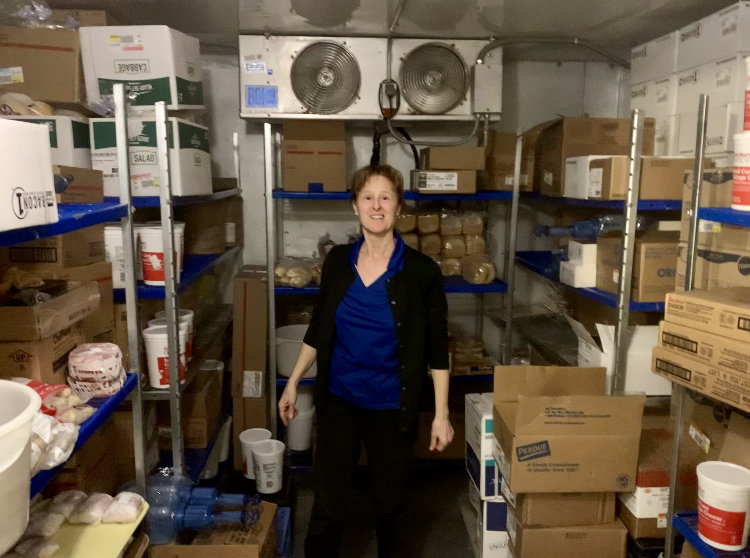
“I have money sitting in the freezer, on the shelves,” Slade said. “I have to keep way more money in my inventory.”
Items like bacon, sausage, and fish are frequently difficult to obtain, so Slade buys an excess amount whenever her distributor has the product.
“My freezer is totally full, you can hardly get in it,” she said.
Slade said she usually keeps around three to four cases of fish in the freezer for fish fries—now she has seven.
The types of products that prove difficult to obtain are “truly random.” Right now, it’s flavored coffee cream, though recently, it was chicken. The Hunt Club couldn’t get potato skins for four and a half months.
“We were out of chicken wings for three or four weeks,” Slade said. “It is truly random.”
Restaurant owners all said they have to spend much more time on inventory and ordering.
“It takes a lot more time and energy to keep track of these things,” Slade said. “The supply chain is broken.”
Through the difficulties, businesses have had to rely on each other for support.
“I know I can call a number of the other restaurants that carry the same product and ask, ‘Hey, can I buy it from you or throw it on your truck,’” Cindy Bieszk, owner of the Hillsdale Filling Station Deli, said. “That relationship has been really nice to have.”
Bieszk said helping others is the only way to make it in towns like Hillsdale.
“Everyone has their niche but we all have to work together,” she said. “It’s the only way small towns work.”
The combination of issues is making it “really hard being in business right now,” Slade said.
“It’s tough,” she said. “Anybody that tells you it ain’t isn’t paying attention.”
When Walters opened the Local Eatery, she set weekends aside for time with her family.
“But now I work every weekend because I can’t find another cook,” she said. “We’re doing our best.”
Owners ask customers to cut restaurants some slack as they work through the difficulties.
“When you go out to eat, be patient, be kind,” Slade said. “We are trying to do our best.”
