
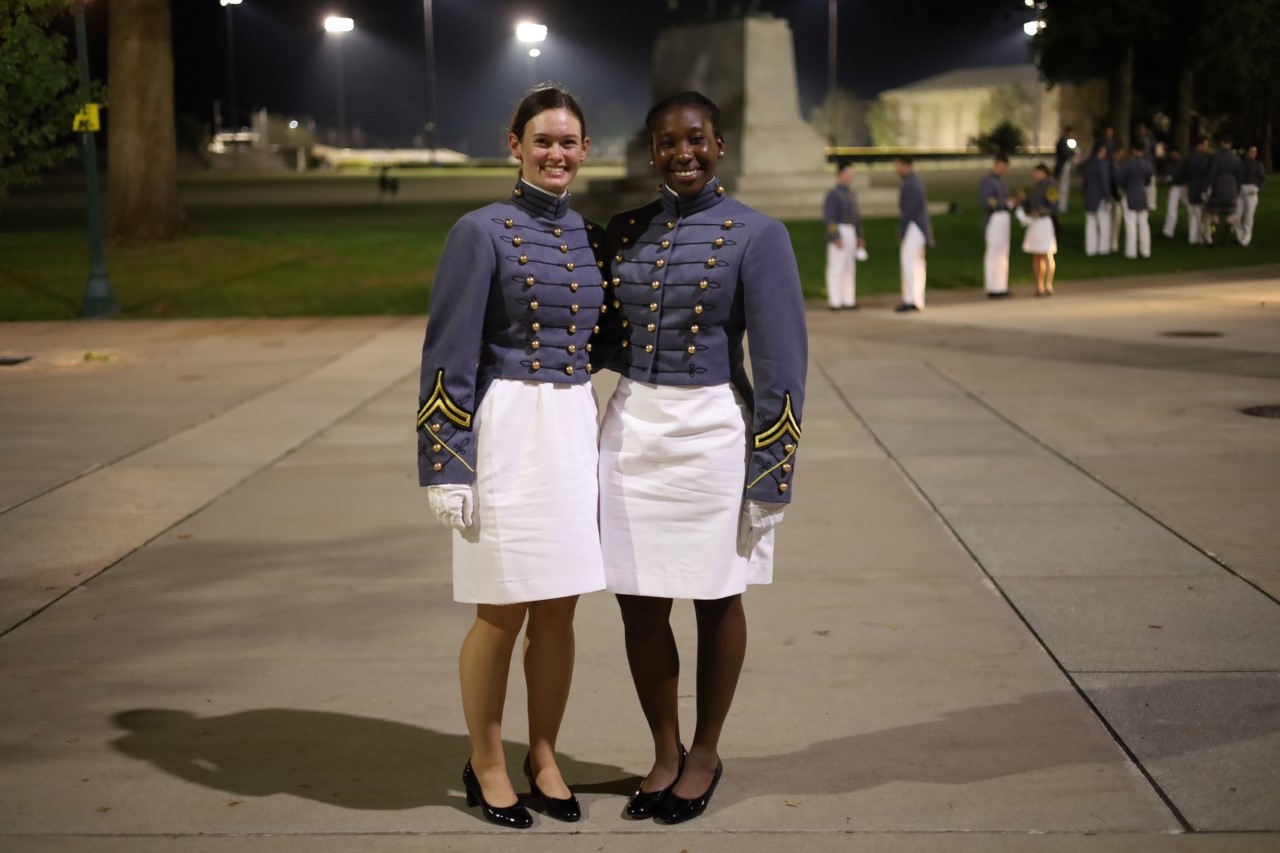
“When a dog has been abused and brought to shelter but they are still scared — that’s how I feel.”
For sophomore Nickaylah Sampson, life at Hillsdale College is a stark contrast from her experience at West Point Academy, where she was put in the “dirty platoon” and forced to share a bathroom and living quarters with 30 men during summer training. Her means of privacy was a tarp hanging from the ceiling.
The daughter of a military officer, Sampson enrolled at West Point ready to protect her country and follow in her father’s footsteps. Upon arriving at West Point, however, she faced name-calling, discrimination, and oppresion — all for refusing to take the COVID-19 vaccine.
“My solution was just to leave the army,” Sampson said. “As a Christian, the Bible says expose evil and take no part in it. I could never compromise my morals for a vaccine.”
When concerns about the COVID-19 vaccine began to circulate among cadets in the spring of 2021, West Point assured them that no unvaccinated cadet would be negatively impacted by their vaccine status.
“It was shocking how quickly people turned on us,” said Hannah McDonald, a former cadet who also separated from West Point due to the vaccine.
As summer training began, unvaccinated cadets were immediately set apart from their classmates. They were forced to wear masks both indoors and outdoors and called “crazy” and “science deniers” by their commanding officers.
“During the summer they actually started to treat us poorly,” Sampson said. “Cadets would point and laugh at us for wearing masks. We were put in our own platoon, and we got in trouble for not wearing our masks while sitting next to each other. We were all written up.”
West Point also violated the unvaccinated cadets’ medical privacy, according to McDonald.
“When they created the spreadsheet for our summer platoon, they had accidentally released it to our class, so all of our classmates knew our vaccination status,” McDonald said. “When we brought this up to our officers, they told us that HIPAA is not the be all and end all.”
According to Sampson and McDonald, they faced a myriad of other punitive measures. Unvaccinated cadets were forced to attend a “re-education brief,” and denied off-campus access.
Sampson said she was eventually kicked off the women’s crew team because her coach claimed it was unethical for her to continue coaching an unvaccinated cadet.
“It was clear that there was a lack of care for science and for logic,” McDonald said. “It led me to believe that it was all about coerciveness and not about health.”
Although the vaccine mandate was what eventually led Sampson and McDonald to leave West Point, both said they were also dissatisfied with the academy’s emphasis on diversity, equity, and inclusivity. According to Sampson, required reading in freshman English and psychology classes focused on racism, and the academy hosted a “stand down day” dedicated to racism.
“Everything was about feelings,” Sampson said. “But this is not summer camp — it’s the army.”
On Sept. 27, 2021, tensions finally came to a head.
West Point’s 35 unvaccinated cadets were brought to a briefing room and informed by their brigade tactical officer that the academy had instituted a vaccine mandate. The cadets were told that they would not be allowed to leave the room without signing a document acknowledging that they were disobeying direct orders. While they were told that they would be allowed to seek legal counsel, no lawyers or judge advocate generals were present at the time.
“We were essentially told in the most dystopian, draconian way that the legality of this order is not to be questioned. This is an order from the secretary of defense. You have no right to question it,” Sampson said.
Still, McDonald did.
“I explained that West Point did not have the FDA-approved Pfizer Comirnaty vaccine. It was not in mass distribution. Everything that we had was Emergency Use Authorization-approved. You cannot force a soldier to take something that is only EUA-approved.”
McDonald said she was told she was correct but that “the small legal distinction didn’t matter.”
Cadets were ultimately given the option to receive the vaccine, to apply for religious or medical exemption, or to separate from the academy. Sampson resigned from West Point in October with an honorable discharge.
Of the unvaccinated cadets, 10 chose to get the vaccine while the rest, barring Sampson, applied for exemptions. Since then, all medical and religious exemptions have been denied according to Samposn and McDonald.
McDonald applied for a religious exemption but withdrew from the academy before her appeal was processed.
“I read the writing on the wall and realized that it was going nowhere,” McDonald said. “I was deeply disappointed in the institution because I had been so eager to serve and to lay my life down for others, and that’s not what they wanted from me. It was all about a political game.”
Although Sampson’s friends and family supported her decision to leave West Point, she said that she still felt lost in the aftermath.
“I was forced out of the only life I knew,” Sampson said. “I didn’t know what to do. I had no job, no friends, no school.”
According to Sampson, it was the grace of God and Hillsdale’s Chief of Staff Mike Harner who led her to the college.
“He read about me and Hannah in a Gateway Pundit article and asked the author of the article for our information,” Sampson said. “He emailed us and told us that we were more than welcome to apply to Hillsdale.”
Harner, a retired naval officer, said he believes the unvaccinated cadets were treated differently by West Point.
“I understand what it is to make a commitment, and I understand what direct orders are, but West Point put a process in place to appeal those things and then they didn’t allow those appeals to occur,” Harner said. “They had this religious appeal process, but they did not approve any. Why have the process in place if you are going to do that?”
Since arriving at Hillsdale, Sampson said the welcoming community has been “like an answer to a prayer.”
“The amount of freedom I suddenly have is unnerving,” Sampson said. “But God is slowly bringing me out of that by helping me meet new people.”
Sampson, who plans to major in math with a minor in classical education, says she has been amazed by the quality of the education.
“I have already learned more about the country in one week of Constitution class than I have in a year and a half at West Point,” Sampson said. “This is the most patriotic, God-honoring place that I have ever experienced.”
McDonald, who deferred her acceptance for personal reasons, hopes to matriculate in the fall.
“Hillsdale seems like it emphasizes a lot of things that were missing from what I was originally looking for in West Point,” McDonald said. “It felt like there was such a spirit of thankfulness within the students at Hillsdale. They were thankful for the opportunity they had to learn there and they were thankful for America.”
Although Sampson said her experience has left her disillusioned with the military and doubtful of America’s ability to defend itself, it has also been a time of growth.
“I realized that my passion lies elsewhere,” Sampson said. “Originally I was going to do air defense artillery, which is typically revered as a good job, but I find that my passion lies in education—in raising kids to love God and to inspire others to seek Christ through education–basically in doing what Hillsdale is doing.”
