
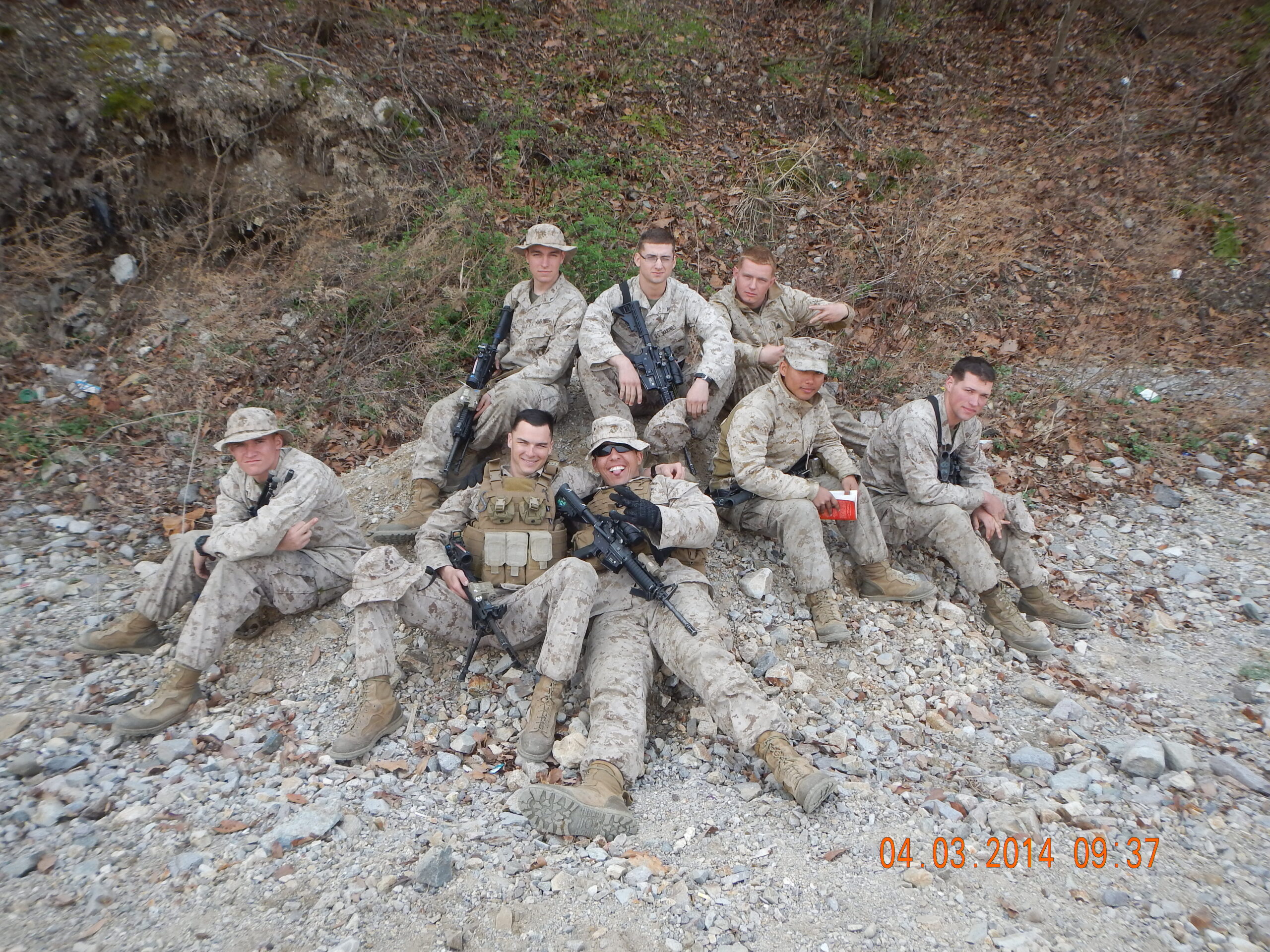
Courtesy | Anthony Iatropoulos
These interviews have been edited for length and clarity.
Jeffery Rogers, Associate Dean of Men
What is your military background?
I was in for 26 years. I’ve been all over the world. Seeing a little bit of this and a little bit of that.
What is Veterans Day about?
There is no place like the United States, because everyone that serves weren’t “voluntold,” they volunteered. We have an all-volunteer force of men and women who put it on the line, willing to give their lives. There’s some people who would disagree with me, but our country was founded on Judeo-Christian principles. And we’re so serious, we codified it not only in our laws, but we sent men and women, our treasure and our blood, to fight for freedoms both at home and abroad. We didn’t have to enter World War II, but we did. And now, the forgotten war in Korea. These men and women answered the call, and I’m just blessed to be counted among them. When people say, ‘Thank you for your service,’ I just thank God I’m able to be in a country where I can serve like that.
What does Veterans Day mean to you as a vet?
I remember those who are actually not here, and we have Memorial Day to recognize those who gave the ultimate sacrifice, but I also want to think of them on Veterans Day. Those who are not here. The Vietnam guys were treated so harshly. And in Korea, too. Our treasure has no value in price. It’s irreplaceable. Also, what’s most important to the veteran is his family. Everybody always talks about the veteran and gives him so many accolades. I have so many awards I’ve gotten. But they didn’t give my wife anything. She served with me. When I went to Iraq and I left my wife and my two sons in Japan where I was stationed, my son had his arm around my leg and they were all crying. And I was gone for like 10 months. My wife and kids didn’t sign up for that. But we do it because we love America.
How has your experience as a veteran impact your life?
I became a Christian when I was in the U.S. Navy, so I’m a debtor to my service in the Navy and being out at sea. I was running from God and I couldn’t swim, so when I came out on the water and we’re talking about Jesus on the ship, I couldn’t go anywhere. I went into a Bible study and eventually I bowed the knee.
Peter Jennings, Associate Professor of Management
What is your military background?
I was a Marine infantry officer for a total of about 14 years active service. It was broken time: I did five years active, then went in the reserves, and after 9/11 went back on duty a couple times. I did ground combat tours in the Gulf War in Iraq, Volusia, and Afghanistan.
What, in your own words, is Veterans Day about?
When you have three combat tours overseas, you learn how rare, precious, and fragile this liberty that we have here is. And when you see the violence, tyranny, and destructive ideologies — the evil that goes on in the world — you learn that this liberty we have here is not foreordained. It was bought for a price: a very heavy and high price. And that liberty can be very easily squandered and lost. I’ve seen it in Iraq, Afghanistan, the Gulf, and other places. So what Veterans Day means to me is that liberty must be defended everywhere, always. And everywhere and always there will be a need for young men and women who are willing to put down their books, set aside their paycheck, and pick up a rifle and fight for it.
How does Hillsdale treat Veterans Day?
On one hand, I think, beyond just token social media posts, we as a college should observe it somehow. Then on the other hand, it’s so remote and abstract to so many people who don’t personally know anyone who served that it’s too easily reduced to a cliché.
How can the students be more connected to the holiday and make it less abstract?
One way that we can try to be more connected to it is by learning not just the history, but the stories. As I’m researching the Civil War and learning about what our guys did in the Civil War, including some of our women who served as field nurses, the hardships that they endured are extraordinary. It’s remarkable that they put up with four years of the marching, the deprivation, the violence, the slaughter. And they endured it. Plato says endurance of the soul is the essence of courage, and the stuff that me and my generation put up with doesn’t even compare. We’re a college that values heritage, and I think we need to really learn the heritage at a more personal level.
Anthony Iatropoulos, ’24
What is your military background?
I was a US Navy Corpsman, which is a medic for the Marines.
As a veteran, how does the holiday feel to you?
It feels like it belongs to those who have sacrificed much more than I have. Therefore, it’s a time when I think about them and honor them and pray for them. And I hope others do similarly.
Are the veterans at Hillsdale doing anything for the holiday?
We’re doing the missing man table, which I’ll be watching most of lunch. Besides that, the college does enough for us on a regular basis already. Hillsdale has a good support network for veterans even though there aren’t too many of us, and I think that’s sufficient.
As a veteran, do you feel a difference between you and the average Hillsdale student?
Yes, absolutely. If not age alone, also shared experiences. But it’s not insurmountable or a hindrance. It’s just something that is. That answer would be different for everybody though, because I know some guys have a really difficult time adjusting.
Michael Murray, Legal Counsel & Administrative Director for Gift and Estate Planning
What is your military background?
I joined the Marine Corps in 1991. I graduated from officer candidate school, got commissioned, and then went to law school for three years. Then in 1994 I went back on active duty until 2002, where I served as a judge advocate and the marine officer instructor at the University of Michigan. And then in 2002, I transitioned to the reserve and I’ve been serving in the reserve ever since. Now I’m waiting for my last assignment before I hit my statutory maximum of 33 years in November of 2023 and retire.
How would you describe Veterans Day in your own words?
If you look at the history of it, it was Armistice Day: The 11th hour of the 11th day of the 11th month. That’s how it started out. So for me, it’s really just honoring the people who have gone before that I am privileged to follow in their footsteps. And to give thanks for that. It’s not as somber as Memorial Day. It’s more of an uplifting day.
As a veteran yourself, does the holiday feel different than other days of the year?
Well, the day before, November 10, is always a little more meaningful for most marines, because it’s the Marine Corps birthday. We have a long tradition of celebrating our birthday. We have a birthday ball. So to me, the Marine Corps birthday and Veterans Day are always synonymous, and it’s more of a celebration of not only the Marine Corp heritage, but the tradition of the armed forces. It’s about representing the ideals of the nation and the great people that bring it to life. I think it’s a blessing to work here, because Hillsdale recognizes that more so than other employers. And that’s because of what we stand for. So Veterans Day has become more special for me over the last 10 years since I’ve been working here.
Henry Thurston, Lecturer in Physics
What is your military background?
I enlisted in the U.S. Marine Corps. I drove the infantry and left as a sergeant after four years.
What does Veterans day mean to you?
For me, Veterans Day should be a happy day. It’s not a day to solemnly remember those who didn’t make it home. It’s a day to celebrate everyone who was willing to put their lives on the line for the country. I think it’s a good day to recognize veterans in the community as well, whether that’s Hillsdale or elsewhere. We have a unique experience, but then we come back home and we’re back in the general population — rush hour traffic, school, work, and so on.
Jason Gehrke, Assistant Professor of History
What is your military background?
I am a captain in the Army Reserve. I joined in 2010, three years after graduating from Hillsdale, and have served ever since. I’ve done two tours overseas.
What, in your words, is Veterans Day about?
It’s an act of collective memory: a call back to the gratitude that should define the character of a free people. We’re not free to forget. The peace we enjoy on a daily basis is a gift of those who give their time to protect it.
How can we better understand what it’s like to be a veteran?
You can understand through participation in the rituals of our community that mark the day. Every human experiences suffering and loss, but the rituals are a reminder of the specific suffering you haven’t been forced to bear because others have done so for you. We ought to remember that for the people who’ve accepted a life of service, they live in the daily knowledge that war is either a memory or a threat.
