
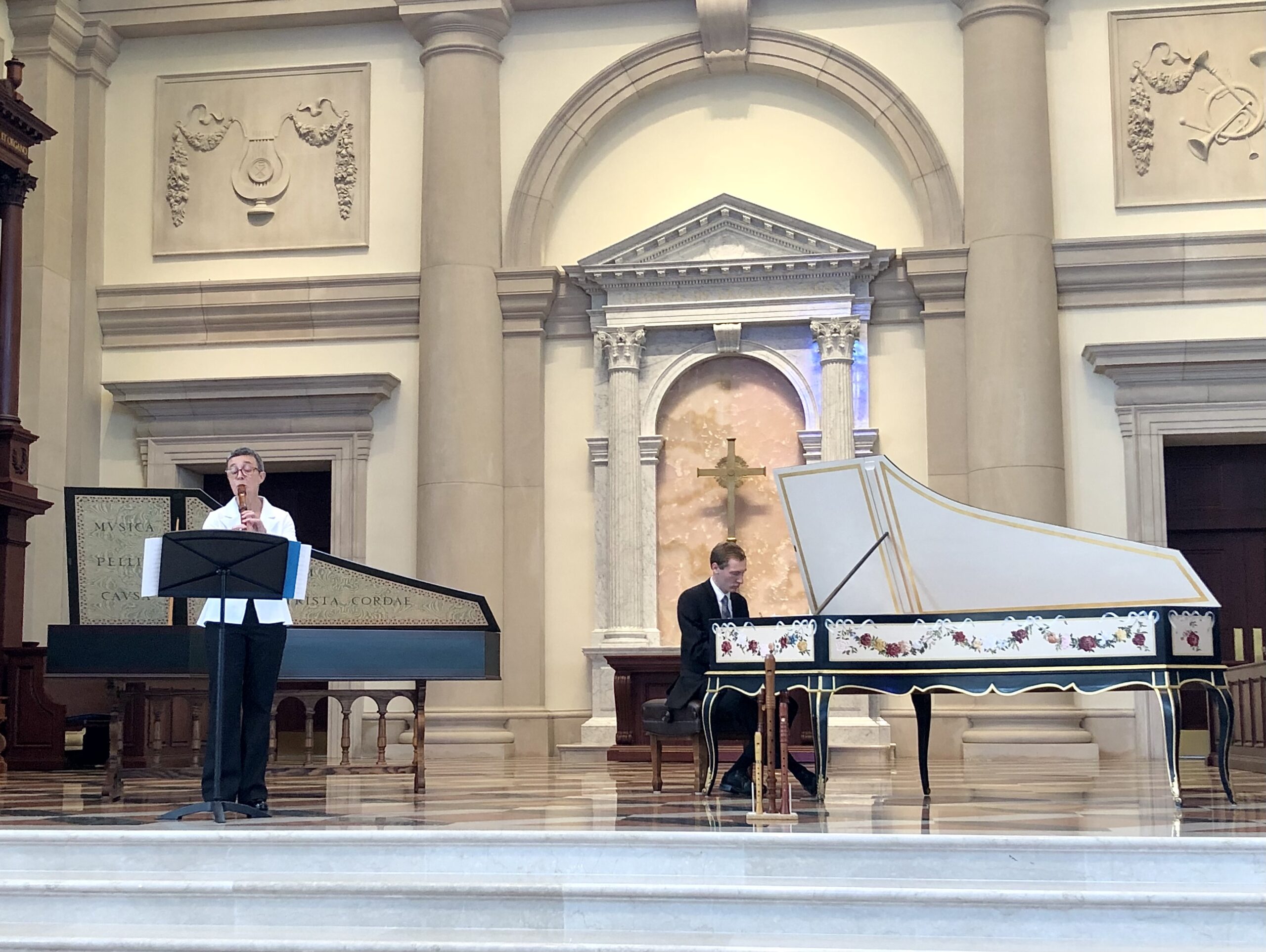
Last Saturday, classical music soared out the doors of Christ Chapel at the first recital of the semester.
Associate professor of music Daniel Tacke and assistant professor of Spanish Kátia Sherman presented a recital of Renaissance and Baroque repertoire on harpsichord and recorders, respectively.
Unbeknownst to most of her Spanish students, Sherman graduated from the Oberlin College Conservatory of Music with both undergraduate and master’s degrees in historical performance.
“Even though I reinvented myself academically, music has always been a fundamental part of how I communicate with the world,” she said.
Tacke recalls meeting Sherman for the first time at a Hillsdale College faculty dinner.
“At one point she just came up and said, ‘You know, we should do a concert sometime!’” Tacke said.
Saturday’s performance was the second recital in which Tacke and Sherman have collaborated. The first half featured repertoire from the Renaissance period, while the second half showcased Baroque compositions.
“The point of splitting between Renaissance and Baroque is to offer two very diverse types of music so people can first be exposed to the two aesthetics, and then illustrate that with the instruments that were peculiar to those periods,” Sherman said. “Each period has its favorite types of instruments.”
Sherman played a total of five different recorders during the course of the recital, while Tacke played two unique harpsichords.
“It’s quite demanding to be switching instruments for every piece,” Sherman said.
Sherman explained that using five different recorders requires alternating between two different tuning systems, each of which requires a different hand position to produce the same note.
Tacke said the process of determining which instrument best suited each piece was very interpretive.
“I think half the joy is finding just the right instrument for each individual piece,” Tacke said. “Each [work] invites that kind of search for the particular facets that you want to draw out.”
Tacke performed the recital’s Renaissance repertoire on a 17th century style harpsichord, reserving the Baroque pieces for a beautifully painted Parisian harpsichord from the mid 18th century. He explained that the two instruments have both stylistic and acoustic differences.
“They’re not just modern inventions, but they’re modeled after specific historical instruments,” he said. “Each harpsichord has a slightly different kind of tone and acoustic resonance.”
While impressed by all the instruments featured at this Saturday’s performance, sophomore Annie Brooks said the recital gave her a new appreciation for the recorder in particular.
“There’s a big range in what the recorder can do,” she said. “It goes from being bright and lively to warm and lyrical.”
