
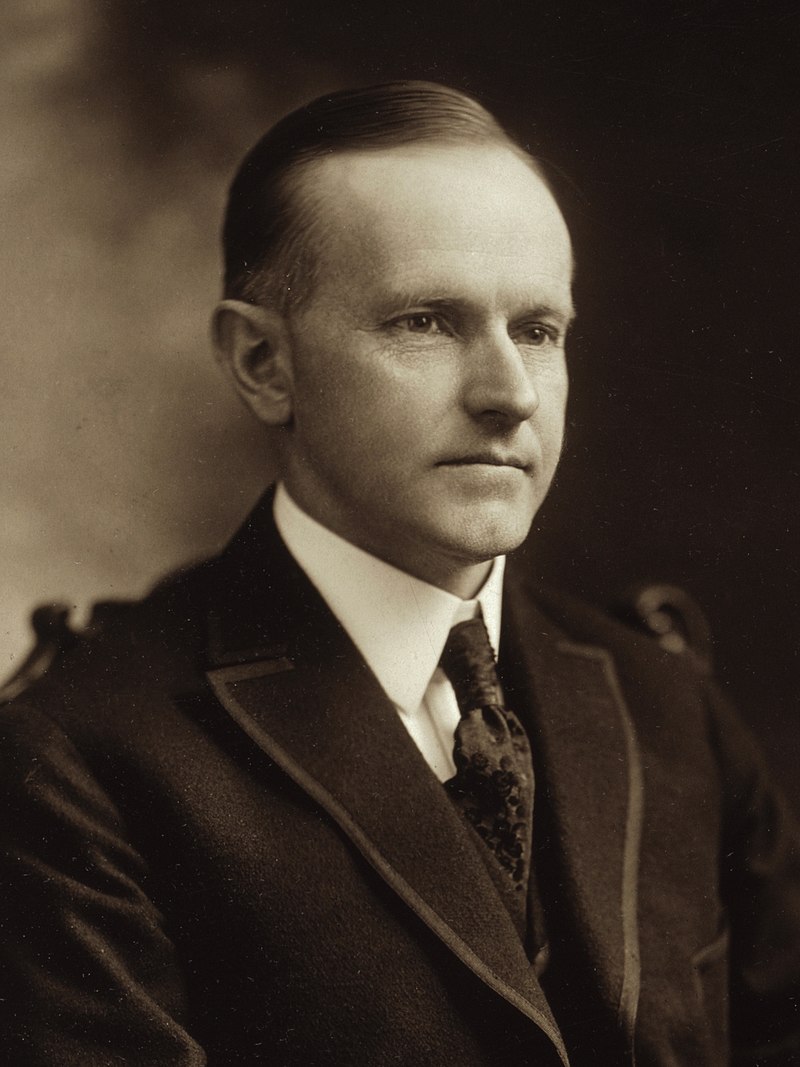
John Calvin Coolidge, the 30th president of the United States, was a man who supported the idea of self-government in a time of growing government intervention.
At Hillsdale, where “through education the student rises to self-government,” a statesman who greatly decreased the power of the federal government fits among the ranks of patriots on the Liberty Walk.
Coolidge was born on the Fourth of July in 1872 in the tiny village of Plymouth Notch in the Green Mountains of Vermont, where he worked on his family’s farm.
After becoming a successful lawyer in Massachusetts, he began to climb the political ladder. He went from a mayor, to state senator, to governor in just 10 years.
He served as vice president in 1921, and then president after the sudden death of Warren G. Harding in 1923. He was famously sworn into office by his father, a public notary, in the parlor of the family homestead at Plymouth Notch by the light of a kerosene lamp. This humble beginning reflected his servant-hearted approach to the presidency.
Coolidge’s work in office helped create the booming economy of the Roaring 20’s. While president, Coolidge helped the national debt drop from $22.3 billion to $16.9 billion, with decreasing tax rates and most Americans paying no federal taxes at all. The United States economy boomed with industrial production increasing 70%, real earnings for wage earners growing 22%. Unemployment averaged just 3.3%, according to the Coolidge Foundation.
While not as well-known as former presidents George Washington or Abraham Lincoln, Coolidge fought for liberty and self-government during an unpopular time.
Hillsdale Professor of Politics Mickey Craig called him “the last constitutional president.”
Coolidge argued for the preservation of the original interpretation of the Constitution in his 1924 speech, “Authority and Religious Liberty,” delivered to the Holy Name Society in Washington, D.C.
“To support the Constitution, to observe the laws, is to be true to our own higher nature,” Coolidge said. “That is the path, and the only path, towards liberty. To resist them and violate them is to become enemies to ourselves and instruments of our own destruction.”
Coolidge recognized that all men are created equal and endowed with unalienable rights. When Army Sgt. Charles Gardner wrote to Coolidge protesting the Republicans’ nomination of Dr. Charles H. Roberts, a black dentist, running for New York’s 21st Congressional District, Coolidge defended Roberts.
“The suggestion of denying any measure of their full political rights to such a great group of our population as the colored people is one which, however it might be received in some other quarters, could not possibly be permitted by one who feels a responsibility for living up to the traditions and maintaining the principles of the Republican Party,” he said.
When giving the commencement address in 1924 at Howard University, a historically black institution, Coolidge commended black Americans who fought in the World War 1 as having “proved their devotion to the high ideals of our country.”
“The black man showed himself the same kind of citizen, moved by the same kind of patriotism, as the white man,” he said.
Coolidge also had a great deal to offer on education.
“A trained intelligence can do much, but there is no substitute for morality, character, and religious convictions,” he said on July 4, 1924. “Unless these abide, American citizenship will be found unequal to its task.”
“Silent Cal,” was modest, to the point of choosing not to run for a second term even when support abounded. But his quiet nature did not stop him from his stubborn defense of freedom.
Coolidge is not just a figure of political liberty, but also economic liberty.
Amity Shlaes is a syndicated columnist for Bloomberg and author of the book “Coolidge,” wrote in the Hillsdale Imprimis about how Coolidge achieved economic success.
“Conservatives long for another Ronald Reagan. But is Reagan the right model?” she said. “Coolidge sustained a budget surplus and left office with a smaller budget than the one he inherited.”
This makes Coolidge a well-regarded figure in Austrian economic circles; whereas Hillsdale professors such as Professor of Economics Gary Wolfram often critique Franklin Delano Roosevelt, they praise Coolidge for his steadfast devotion to small business and free-market support.
Coolidge would add a layer of American history not represented on Hillsdale’s campus: no American on the Liberty Walk held office from 1891 to 1969.
In a time when progressive forces such as Woodrow Wilson challenged the foundational documents like the Constitution, Coolidge stood firm in his convictions that liberty is essential in the pursuit of happiness.
Let’s add this true defender of liberty to the Liberty Walk.
