
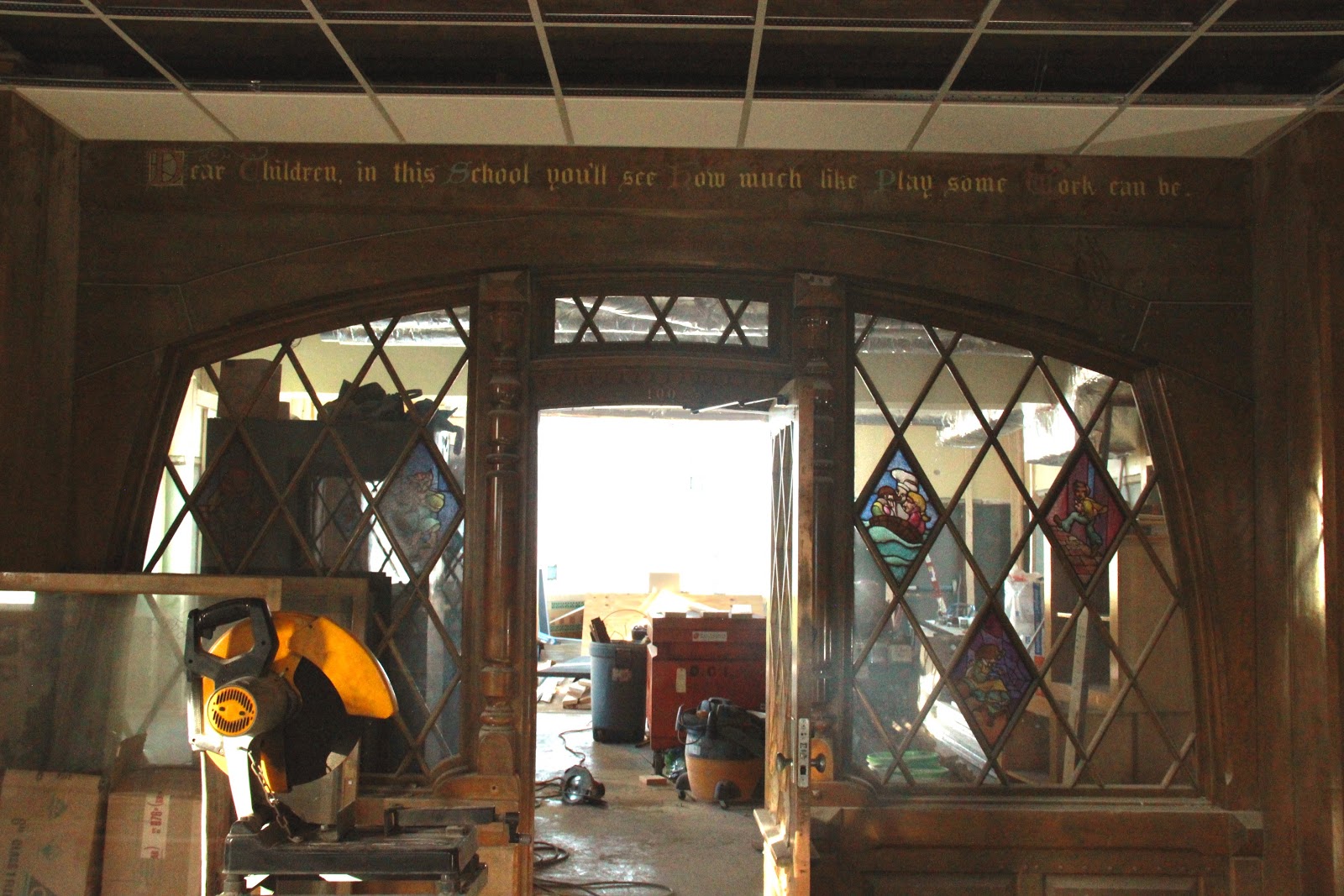
A little more than two years into its overhaul from abandoned school to educational hub, the old Mauck Elementary has acquired a new name: The Stanton Foundation Center for American Classical Education.
The 1930s-era building, which was out of use for eight years before the college purchased it in 2018, will be named for the Stanton family, which has supported Hillsdale College since the 1980s, according to Associate Vice President for Institutional Advancement Nancy Johnson.
“The Stantons have a strong interest in education, including K-12,” Johnson said in an email.
Hailing from Jackson, Michigan and Solvang, California, the Stantons are involved in the Hillsdale County “Teacher of the Year” award, which is administered by the Hillsdale County Community Foundation, according to Johnson. The family has also made significant contributions to the general operations of the college, the Barney Charter School Initiative, and endowed the “David J. and Laura Stanton Scholarship,” Johnson said. The college awarded the Stantons with honorary degrees in 2017.
Immediately after Hillsdale purchased Mauck, the softball team put the school’s gym to use as a hitting barn, where the women still take their swings today.
In 2019, the college began to renovate the building into office space for the rapidly-expanding Barney Charter School Initiative. The third floor renovations were completed and ready for BCSI employees to be the first to move in by March 2020 — just in time for the global COVID-19-related shutdowns.
“I wasn’t here at this point, but the BCSI staff moved over right before COVID hit,” said Catherine Johnson, assistant to the provost for K-12 education. “They had all their desks and things and everything was just there and then they told everyone to go home. So even though I didn’t start until July 6, they had only been back in the office for two weeks when I started.”
BCSI was the first group to move to the Stanton building, but it won’t be the last, according to Chief Administrative Officer Rich Péwé.
“The goal was to take pressure off of outreach — marketing, institutional advancement, Barney Charter School Initiative, online learning — all these areas that have grown tremendously in headcount in recent years,” Péwé said. “On campus, our offices are pretty much full. This building, because it’s close to campus, the academy, and the athletic facilities, was the perfect solution.”
The building was scheduled to be completed in 2020. While the third floor is finished and boasts five full-sized classrooms in addition to office space, a kitchen, and bathrooms, the second floor is about halfway done, knee-deep in painting, lighting and a stash of original wood paneling which will be returned to the walls eventually. In the basement, the remains of an old cafeteria, abandoned classrooms full of dust and chalk, and the gym-turned-hitting barn remain mostly untouched.
“That will be the next project to tackle,” Péwé said.
Péwé said the task of maintaining the original character of the school, which was built in 1939 through Federal Emergency Administration of Public Works funding, has slowed the renovation process. Elements such as medieval-style criss-crossed wood panes, glass, art fixtures, and much of the original floor tiles on the second floor will be preserved in the final product, Péwé said.
Initially, Hillsdale College planned to invest approximately $2 million in renovations on the 9,000 square foot building, which it had purchased for $395,000. The final cost may be closer to $1.6 million, said Péwé, because college maintenance workers have offered themselves to work overtime on the project, coming in early or staying late after doing other repair jobs around campus.
“That’s just under $600 per square foot, which is really good,” Péwé said. “If we had built this brand new, it would be well over that.”
Péwé said the college plans to move IT Services’ offices, as well as the digital platform team, out to Stanton as the lower floors near completion.
“The space is built to be flexible,” Péwé said. “These can be classrooms or open offices, conference rooms. BCSI has already used some of them for live demonstrations — we wanted to have that flexibility, since we still don’t know exactly how every room will be used.”
While just a handful of employees work in the building full-time, the school sees an influx of visitors on afternoons on Monday and Wednesday of each week, for Paul Rahe’s history courses.
Rahe, a professor of history, is 72 years old and has health conditions which he feared could make him vulnerable to the coronavirus. To accommodate Rahe’s desire to teach in-person, while avoiding the traffic of Lane and Kendall halls in between periods, the college worked with IT to set up a classroom on the completed third floor, where Rahe has taught since last August.
“I wanted to teach in person (rather than solely via Zoom), and so I sought a secluded spot where I would encounter my students but no one else,” Rahe said in an email. “My fear was that I would be exposed to the virus while walking through the halls from my classroom to my office.”
History major Rebecca Felton, a junior, is currently in Rahe’s “Origins of War” class, and took a class with him last fall as well.
“It was a little cryptic at first, because he sent these instructions in an email that said go to this Mauck Elementary School, take the back staircase, go up the stairs, and I’m in the room on the right,” Felton explained. “I was like, ‘I have never heard of this school before.’”
Felton said she went early the first day of classes to “scout it out.”
Rahe praised the college — and Kathleen O’Toole, assistant provost for K-12 education, “on whose turf I have been operating” — for being accommodating, and said he hopes to return to the main campus at the end of next week.
“I have now had the two Pfizer vaccinations recommended, and I will soon be liberated,” Rahe said.
Working amid the ongoing construction can be a challenge, according to Rahe, who said he can hear “the workers rejiggering the floor below,” but that it has never interfered with his teaching.
Catherine Johnson agreed.
“You definitely have to be careful about when you take a phone call,” Johnson said. “But it doesn’t really affect us too much. When anything major happens, they warn us, so that we can stay off that side of the building.”
