
Andrew Dixon | Collegian
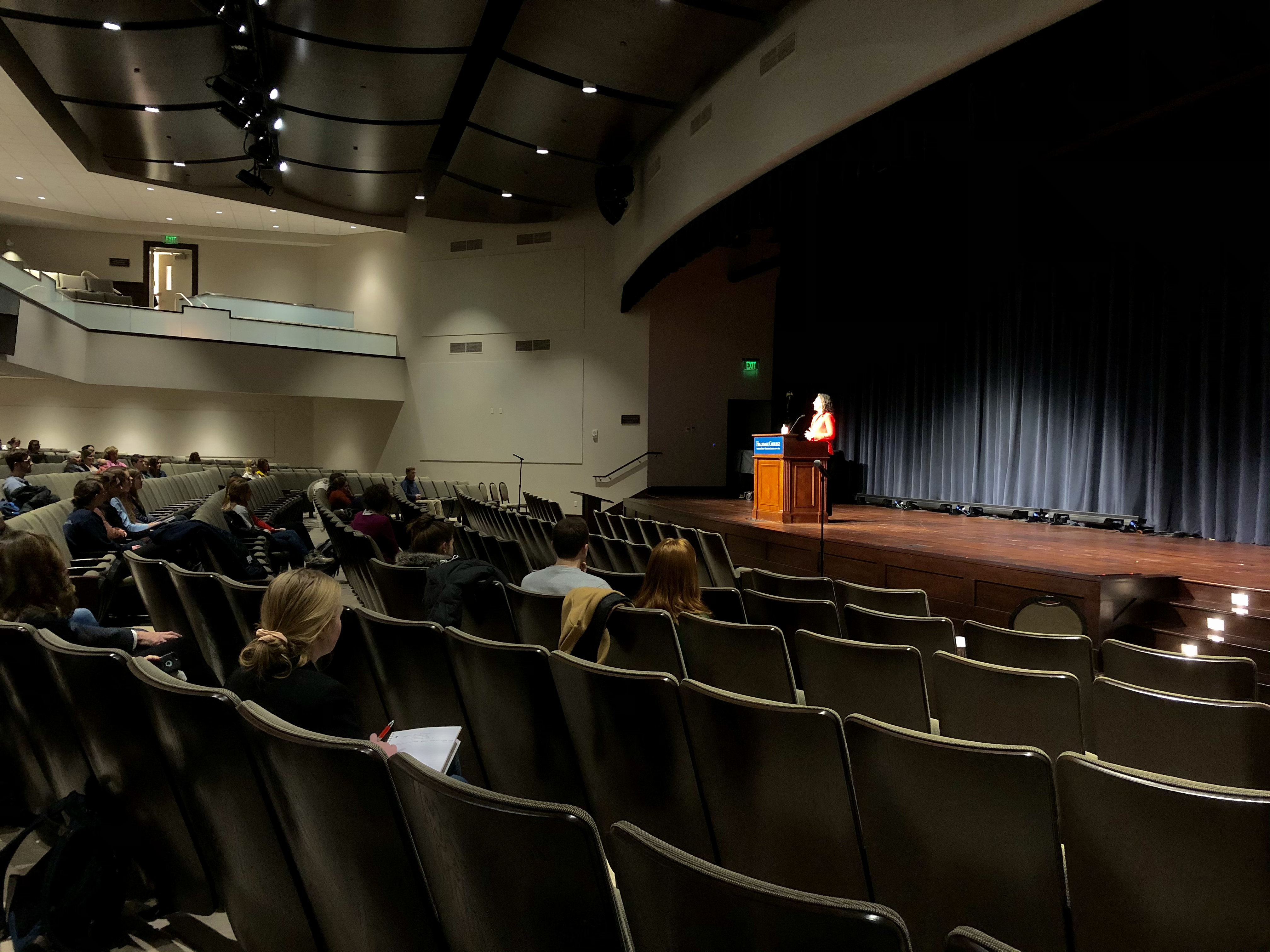
Katy Faust is an advocate of children’s rights and the author of “Them Before Us: Why We need a Global Children’s rights Movement.” She spoke on Hillsdale College’s campus on February 18.
Q: Tell me about your childhood and how it influences your work.
A: My parents were married until I was 10 and then divorced. Then, my dad dated and remarried and my mom partnered with another woman, and they’ve been together since I was like 10 or 11. I love them both, but I do not have two moms. I have a mom and a dad just like everybody else. But I really love my mom and I love her partner, and I consider her my friend. I didn’t get into this like crusading over some kind of absence that I had in my childhood, because I stayed connected to both my mom and dad through it. I really got into the battle because I heard the other side saying during the marriage battle that kids don’t care if they’re raised by two moms or two dads, and that all kids need is to be safe and loved. And the problem with that is that if kids are raised by two dads, that means they have lost their mom, and if kids are raised by two moms, that means they have lost their dad. The main reason I got into this was this lie that the other side was telling you about who children are and what they need. The problem is not the gay parent. The problem with gay parenting is there’s always a missing parent. And when you do that unintentionally to a child, it’s an injustice. And then, it was the added bonus of people saying that traditional marriage supporters are haters and bigots, and they’re not right. I love my mom, I love my gay friends, just like pretty much every other Christian and conservative out there. It’s not bigotry and homophobia that fuels our support for a traditional marriage. For most of us, it’s because we recognize that marriage is the cornerstone of society and life offers a social good that no other institution can.
Q: What do you mean by “Them Before Us?”
A: The whole world, our whole society, has an “us before them” mentality which is us, the adults, before them, the children. My needs come first. And that’s not true. We actually know what kids need to be happy, and there’s three staples of a child’s social emotional diet and it’s the mother’s love, the father’s love, and stability. The only place you’re going to get all three of those is in the home of their married mother and father. The idea is we have to put them, the children, before us, the adults. My husband is a pastor, so we didn’t do a lot of marriage counseling. Working through a difficult marriage is hard, really hard. But if the adults don’t do the hard work and put the children before us, the adults, what adults who take that easy divorce road are really saying is “we don’t want to do the hard work here, kids, you do the hard work instead.” Divorce has these massive lifelong implications for children’s mental, emotional, and physical health. And so, in all of the conversations about marriage and family we say, “put the kids before the adults.” That’s the point of the nonprofit.
Q: How do you integrate your faith with your defense of children, and also your defense of marriage between one man and one woman?
A: I actually say these two things should not go together in public policy. Marriage and family advocates have failed to not make their case based on natural law, and using the best stories, and the best studies. We have so long quipped “God made Adam and Eve, not Adam and Steve,” and walked away. When we’re talking policy issues, we need to appeal to the common source of authority, and that’s natural law, and the Constitution in matters of the United States laws. So, Christians have to become experts and we have to get off of the lazy excuse of always saying “that’s not what the Bible says.” And we need to do the hard work of really being able to understand and defend children’s rights appealing to the common authority. We just published a book, and there’s 30 pages of footnotes because we just crammed it full of studies and research, so that we can go into these conversations well-armed.
We have the five major religions of the world on our side, we have common sense on our side, and we have biology on our side. But we didn’t have the stories. The other side humanized their arguments. They told a better story. They pulled out the empathy and we’ve never been able to do that. So that’s one reason why “Them Before Us” has a story of kids who were created through sperm and egg donation or surrogacy, or kids who lost a parent to no fault divorce or abandonment, and those who had same-sex parents, so you can look these kids in the face and see how that went. When you really hear the stories, that is what changes hearts and minds and then you follow up with the gut punch of a massive amount of data.
Q: Where do you pull these stories from?
A: A lot of people submit their stories to us directly, because it’s one of the few places where they know they’re not going to be outed. A lot of these kids will not tell the truth, even about divorce, even if they’re 50 years old. I’ve got people who won’t use their real name when they’re talking about their parents’ divorce because they’re still trying to balance two Christmases. They’re still trying to be the intermediary between their mother and father who have been at war for 40 years or so. In terms of headlines, we try to flip the headlines. For example, New York’s law just came into effect legalizing commercial surrogacy. So, all of the news outlets are celebrating this is a great way for parents that have kids. What we do is we take that headline, and we flip it and say, “let’s tell this from the child’s perspective. In all of those articles, we tried to share at least one or two stories from real life kids who have lived through the kind of thing that the media is celebrating.
Q: What do you see as the biggest issues facing our culture today?
A: The thing that is affecting the most children is cohabitation. There’s a rise of shacking up and believing that it’s the same as marriage, or at the least a step toward marriage, when it’s 100% not. Cohabitation is incredibly risky for kids. It’s extremely risky if you’re cohabiting with someone who’s not the biological father of your child. Statistically, that guy is the most dangerous person in the child’s life, the person that’s most likely to abuse and neglect them. Even if it’s the child’s biological mother and father living together. It’s still incredibly risky. Number one, the couple are drastically more likely to break up than a child’s married parents. The child is more likely to perform poorly in school and also more likely to be neglected and abused. So, marriage does something for children in terms of bringing stability and bringing protection that no other relationship can do. But the rise of cohabitation reiterates the lie that marriage is just a sheet of paper.
