
Predictions that informed the government’s response to the COVID-19 pandemic were founded on problematic and incomplete data, according to researcher Philip Magness.
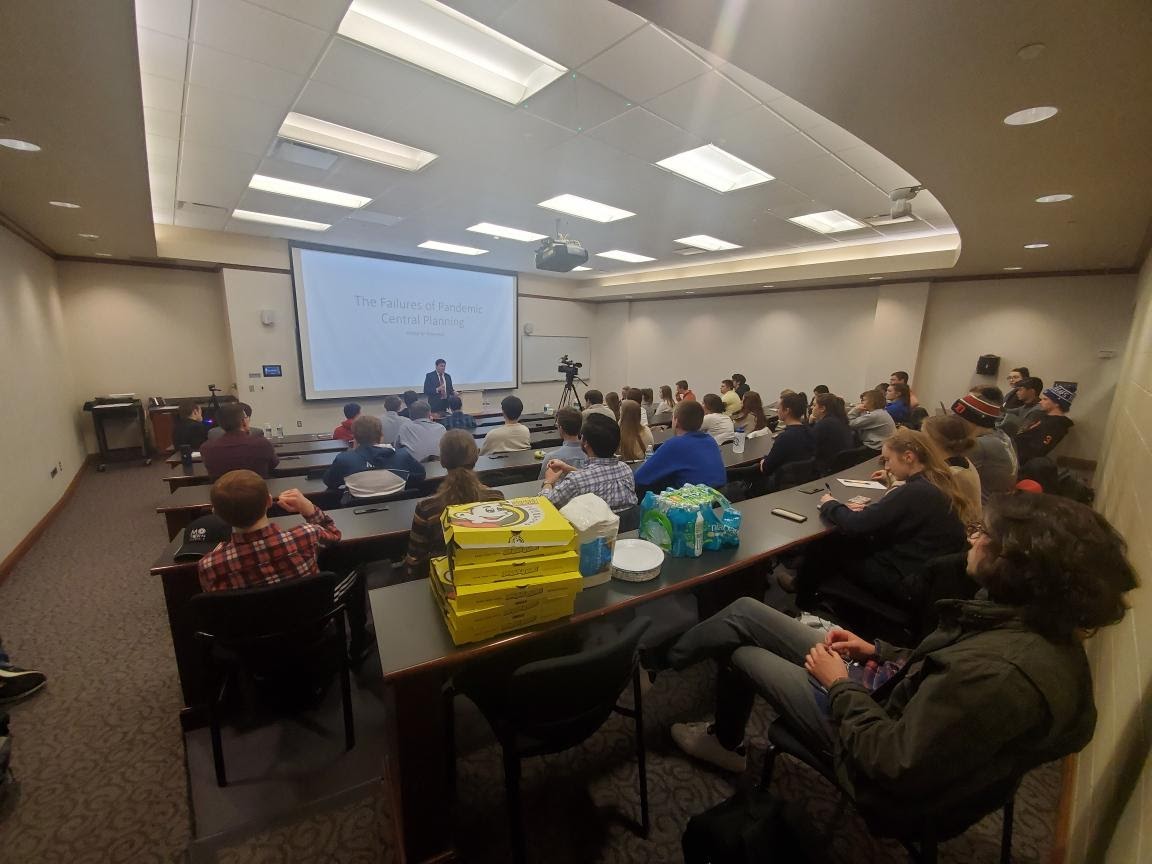
A senior research fellow at the American Institute of Economic Research, Magness spoke on “The Failures of Pandemic Central Planning” at a forum sponsored by Praxis on Thursday, Jan. 28, to an audience of around 50 students.
Magness was part of a conference of economists and epidemiologists who published a document called the Great Barrington Declaration on Oct. 4, 2020.
According to its website, the Great Barrington Declaration promotes a plan called Focused Protection, which would seek to protect the people who are most vulnerable to the virus, while lifting restrictions placed on individuals who are at lesser risk. By the start of February, the document had obtained nearly 800,000 signatures from concerned citizens, medical and public health scientists, and medical practitioners.
The declaration calls for limiting the lockdowns, social distancing, and masking mandates that have defined the global response to the virus.
“Sounds good in concept and in what it promises,” Magness said. ”What it delivers has been a very different story.”
Before last year, Magness said, most scientists believed “non-pharmaceutical interventions” were ineffective in preventing the spread of a virus.
The model influencing the decision to embrace these approaches tries to predict how a virus will spread by calculating population size along with infections, recoveries, and deaths. But the model fails to account for many other factors that can affect the spread of disease, such as the virus spreading through retirement homes, Magness said.
“I’m not saying that we should throw out the model as a conceptual tool,” he added. “But when you start jumping from that into making supposedly scientific policy, you often get into trouble.”
Instead of central planning, Magness suggested focusing on localized knowledge and local leaders making laws to protect citizens, rather than a federal or even a state government.
“We know that central planning itself is horrendously expensive, including the loss of rights and democratic institutions,” Magness said. “People imagine that they can design and map their way through an event that occurs in natural sciences and pandemics.”
Charles Steele, chairman of Hillsdale’s economics, business, and finance department, attended the talk and said Magness’s conclusions matched what he had seen in his own research.
“Epidemiologists have no training in looking at the full consequences of what they’re doing,” Steele said. ”Biologists have absolutely no training in that.”
Praxis invited Magness to campus because of the relevance of the topic and to introduce the economic perspective of the government’s COVID-19 response, said sophomore Jacob Risse, who serves as public relations officer for Praxis.
“You always hear we have to follow the science, but he pretty systematically disassembles all the major models that he was using that they were using,” Risse said. “It’s shocking how easily he took it down and how simplistic these models are.”
One of the major effects of the COVID-19 pandemic is the loss of public trust in scientific experts, Magness argued.
“We put way too much faith in scientific experts who claim to know what they’re talking about when they don’t,” Steele concurred. “You set it up as a false god. Science is a method, it’s not a set of results.”
