
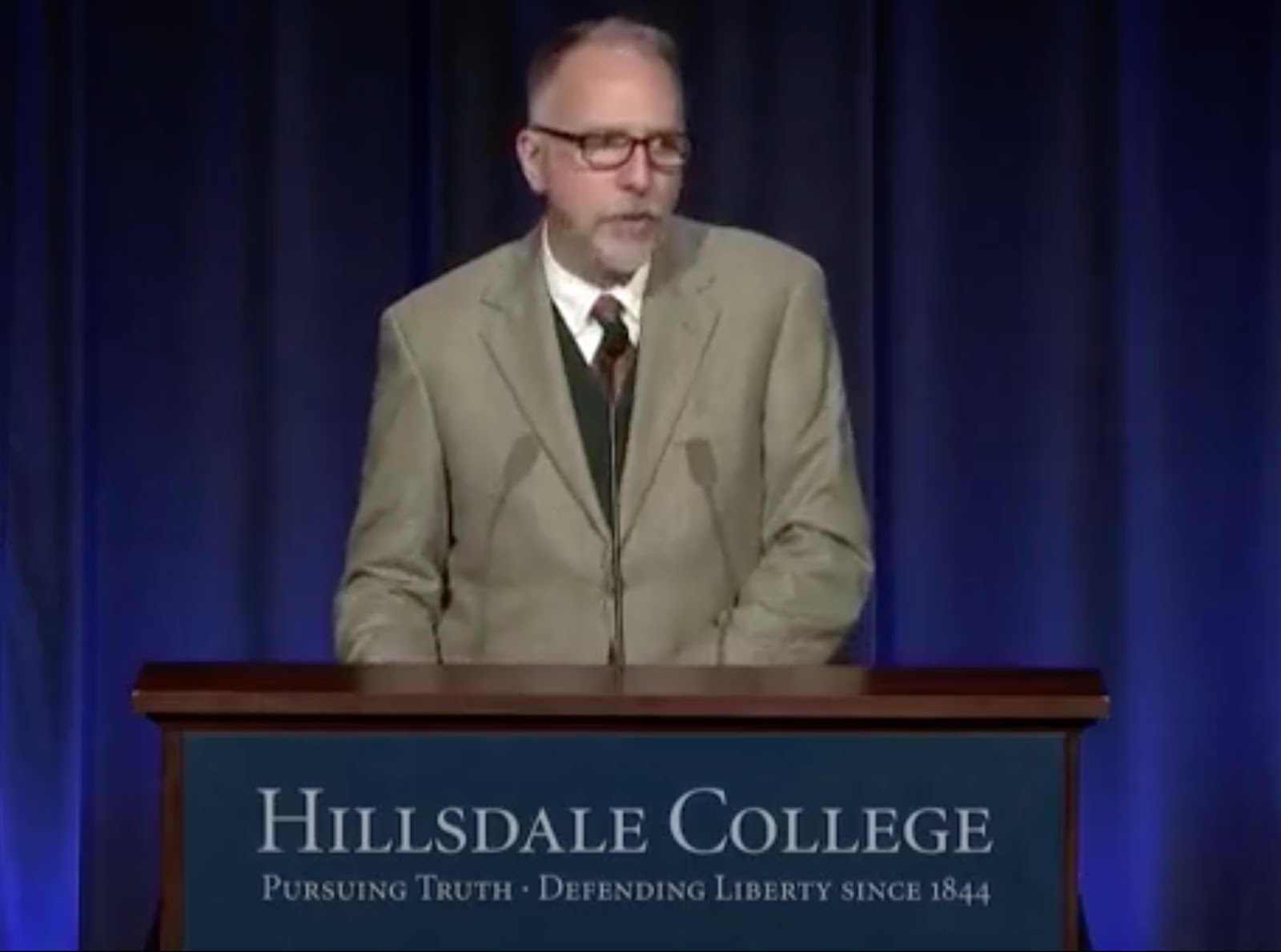
Many Americans have forgotten that a republic requires a certain type of education to maintain the American way of life, according to Williams College Professor of Political Science Darel E. Paul, and the nation is reaping the consequences.
The first Center for Constructive Alternatives of the semester, titled “The Liberal Arts and Education Today,” focused on the essence of a liberal arts education and its relationship to liberty, by contrasting it with the modern American education system from the perspective of educators, authors, and journalists.
Paul spoke on Feb. 2 about political correctness and its impact on modern education. Today, America’s system of higher education serves to produce an elite class, he said, while claiming to develop leaders.
“Jefferson advocated a system of education that would cultivate not only the population in general, but also the elite who would occupy the most prominent positions in society,” Paul said, referring to America’s third president. “The general objects of this law were to provide an education adapted to the years, to the capacity, and to the condition of everyone and directed to their freedom and happiness.”
Higher education from the colonial period until the late 19th century was intrinsically different from higher education today in its goals and structure, Paul said. In addition to a rigorous curriculum, chapel was mandatory for students to foster a Christian spirit and there was typically a code of conduct, which encouraged deference to authority.
By the late ’40s, many of these previously-fundamental elements of higher education were eliminated. What emerged in its place, in the wake of World War II, were mass universities catering to interests in professional advancement rather than the cultivation of character.
“This is the college we’re all familiar with today, one in which excellent performance on the LSAT, or a wealth of advanced placement courses, or a long resume — probably accumulated since middle school — demonstrates one’s capacity for leadership as the price of admissions,” Paul said.
In his famous correspondence with John Adams, Jefferson praised the role of what he referred to as the natural aristocracy, or those who possess both virtue and talent.
“One would hope, therefore, that a liberal arts is training not simply in talent and cultivation, but likewise, in virtue,” he said. “Now, fears that American elites are lacking in virtue are as old as the public.”
Today, however, college favors the rich which divides America, Paul said, all while perpetuating an idea of social injustice. He said social justice largely represents the ideology or faith of the American elite. Seeing social justice as a class ideology reveals how it gets passed from one elite to the next.
“As with any successful faith, social justice shows every sign of capturing the country’s institutions of political and economic and social power,” he said.
While Paul said modern day meritocrats are as animated as past generations of elites, prior generations had virtue, found in their ethic of service and self-discipline. Rather than embracing virtue, elites now condemn on the grounds of social justice.
After attending the lecture, sophomore Seoirse Weed said he appreciated Paul’s commentary on the social justice of the upper class and their relation to the liberal arts.
“I think today almost everyone is in agreement that we’re in some sort of crisis, and that education is the remedy to this disorder,” Weed said. “What those foundational principles are, however, and how we go about instilling those principles and values differ greatly.”
From America’s colonial period through the late 19th century, America’s colleges were dominated by Christian thought as America’s elite was Protestant and conservative. After the Civil War, a new liberal Protestantism emerged, focusing more on social responsibility and material progress than religiosity itself.
This opened the door for the meritocracy to begin, Paul said. The civil rights movement and the women’s movements of the ’60s and ’70s changed the face of America’s elite, and by the ’80s, diversity became an aim of higher education.
Not only has the mission and definition of the liberal arts changed over the last 200 plus years, but Paul theorized that American education may be entering a new era with altered standards of achievement, ideal of character, and social purpose. These values are vastly different than what traditional American education sought to cultivate.
Senior Kate Ford said the talk reinforced her understanding of a genuine liberal arts education.
“Dr. Paul’s talk served as a good reminder of the challenges education faces today and what we ought to preserve in education,” Ford said. “His talk reminded me of the importance of a true liberal arts education and what we stand to lose in this culture of social justice.”
