
Courtesy | Anthony Lupi
This weekend, the Tower Players will perform, “J.B.,” an artistic interpretation of the scriptural book of Job.
Directed by Michael Beyer, the play was set to run last fall, but due to changing state health guidelines and COVID-19 protocols, was postponed until this spring semester.
The play, adapted from the book of the same title by Archibald MacLeish, was published in 1958 as a response to the terrors of the Holocaust and the dropping of two atomic bombs on Hiroshima and Nagasaki.
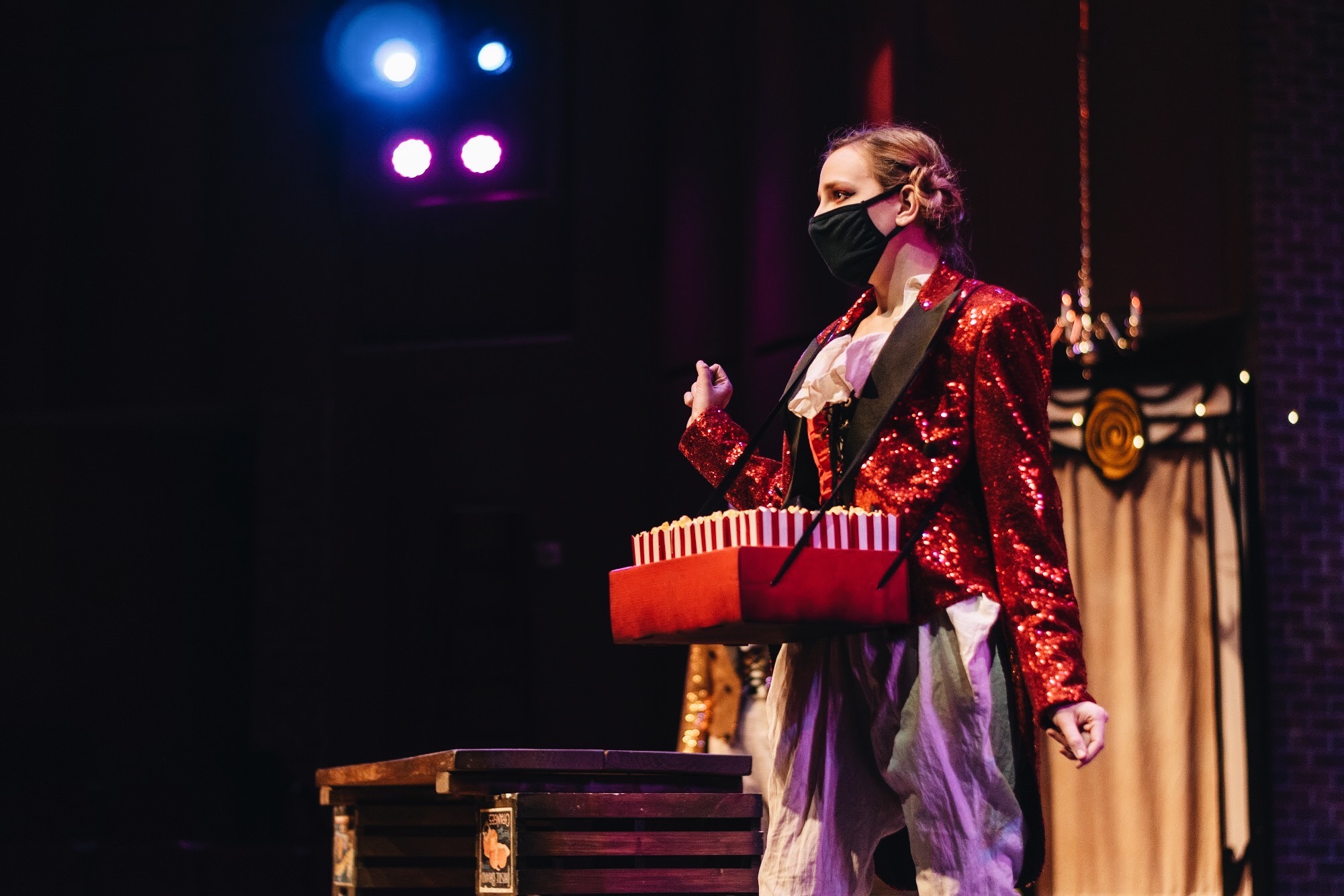
The story follows two circus vendors, Mr. Zuss and Nickles, who decide to play God and Satan — or at least some version of Good and Evil — and bet on the outcome of a wealthy banker named J.B., played by senior Johannes Olson, who falls into complete despair after losing his children to gruesome deaths, his land, his money, and eventually his wife. Zuss and Nickles wear theatrical masks when play-acting as the deities, as do most of the characters besides J.B. and Sarah, his wife.
After losing everything, J.B.’s three friends, Zophar, Eliphaz, and Bildad, try to comfort J.B., offering him three definitions of guilt in an attempt to quell his despair. Zophar, apparently a Catholic priest, says, “Guilt is reality.” Eliphaz, a man of science, says, “Guilt is an illusion.” Bildad, a historian of sorts, says, “Guilt is a sociological accident.”
J.B., not taken by any of these three offerings, instead concludes by saying, “I abhor myself, and repent.”
Eventually, Nickles confronts J.B. and tells him to kill himself. Zuss, upset over J.B.’s forgiving spirit and strength, invites him to start fresh. But J.B. ultimately refuses both options, and upon reuniting with his wife, they find comfort in each other.
The Tower Players offer compelling performances. It is apparent that the actors placed a good deal of energy, time, and care into their characters, particularly Olsen, who played the titular role. Olsen portrays J.B. as a thoughtful, non-sensationalist character. Throughout the play, Olsen clearly articulates and emotes J.B.’s good intentions, his reasonableness, and his alignment to certain moral principles.
Senior Ariannah Gaiser, who plays Nickels, and sophomore Olivia Kroh, who plays Zuss, aptly explore the relationship between agency and necessity in both characters, as well as their characters’ conflicting emotions throughout the play.
Additionally, the use of lights and sound and voice effects are impressive, adding depth to the environment — particularly when the two vendors speak their lines while wearing the God and Satan masks.
There are times when the use of a deep, booming sound effect, following the chilling, unseen voices speaking the words of both God and Satan, awaken the audience, even frightening them into being more attentive.
The quality of production and character development by the players thankfully outweigh the theological and philosophical implications which MacLeish’s story impresses upon its audience.These implications are evident since MacLeish’s version of the story clearly attempts to offer a specific take on certain philosophical problems.
I had my suspicions. Upon hearing the term “modern retelling,” the mind immediately jumps to those horrendous Shakespeare adaptations, such as “Joe Macbeth,” “Gnomeo and Juliet,” and “A Midsummer Night’s Rave.” Had not Job been through enough? Had he not suffered too much already than to be put through an “artistic interpretation?”
In the beginning of the play, Nickles sings a rhyme, “If God is good, he is not God, if he is good, he is not God.” MacLeish’s depiction of God is one who acts totally out of necessity: there is no inherent goodness in him. “He giveth and he taketh away,” just as the original scripture says. He acts according to his nature. This sort of Spinozan account of God, who acts from the “eternity of his own necessity,” means that when J.B. asks for reasons for the evil he sees around him, God responds with the description of his own nature. There is no why, no love — only an eternal necessity that drives his will.
The play appears to come to the conclusion that J.B., through his repentance and forgiveness, has actually overcome this necessity, and in a sense, defied God. J.B. forgives God for the evil done to him. Man’s strength overcomes God’s necessity, because God is limited by his nature, whereas man has the faculty of reason and can overcome, through his own intellect and the comfort of his beloved. J.B. rises above the unjust evil he has been dealt with and appears to choose his own values, following his own agency, and rebuking a new life for the simple domesticity of his wife.
Although I was deeply troubled by the story’s conception of God, good, and evil, there is a great deal of room for the audience to come to their own conclusions about the message presented by “J.B.” Perhaps the intention of the playwright was to leave a sense of angst within the audience. And the beauty of the theater is that the show is never the same each run. The acting, the combination of emotions, and the overall environment of the show are excellent. However, tread lightly, enter the play without suspicion, and be ready to think about the theological implications of this show.
The show runs Wednesday, Jan. 20 through Saturday, Jan. 23 at 7:30 p.m., and Saturday, Jan. 23 at 2 p.m.
