
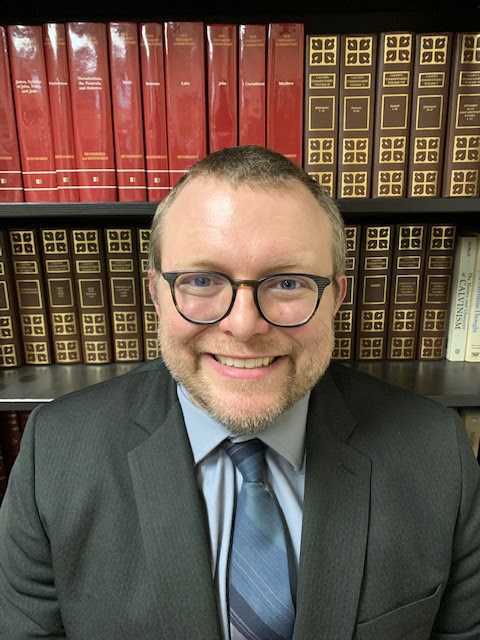
The Templeton Foundation has offered Assistant Professor of Philosophy Ian Church a grant totaling just under $2.5 million to fund a three-year project titled “ Launching Experimental Philosophy of Religion.”
“I believe this is the biggest research grant the college has ever seen,” Church said. “I don’t think it’s unreasonable to think that this project could make Hillsdale the epicenter for a new area of research, namely experimental philosophy of religion. The number of people who are serious Christians engaging with the philosophy of religion is almost unparalleled. Many scholars have argued that what we are seeing right now is unparalleled since the late Middle Ages.”
Church says his team will study how people use context to make moral and philosophical judgements about given situations. His previous project funded by the Templeton Foundation, titled “The Problem of Evil in Experimental Philosophy of Religion,” was what he described as “a testing-of-the-waters-type project,” in which he researched the potential of experimental philosophy of religion as a new field of study.
“Why is it that the world might seem to contain so much pointless suffering?” Church asked. “Think about how we learn about the world very commonly: via the news. Frequently, the news is reporting on tragic events and then cutting to a commercial break where you learn about a new fabric softener. You’re just jumping around and learning about terrible suffering and moving on. There’s no broader context. That might suggest that this way of reporting on the world might make it seem more dangerous, evil, and pointless than it actually is.”
The grant is competitive and Church’s is one of 31 awards the foundation has offered for 2021.
According to the Templeton Foundation’s website, the foundation aims to fund “infinite scientific and spiritual progress, in which all people aspire to and attain a deeper understanding of the universe and their place in it.” Church will work alongside Assistant Professor of Philosophy Blake McAllister and Justin Barrett, whom Church met at the Fuller Graduate School of Psychology and is now senior consultant on the project. Though the paperwork is still pending, Church and his team have already begun to make plans th.
The Templeton grant will allow Church and his team to establish experimental philosophy of religion as a new field of study, not only for Hillsdale but for the world of academia. Thomas Burke, dean of humanities and chairman and professor of philosophy and religion, said he hopes this grant will make Hillsdale one of the leading institutions in philosophy.
“This will help our college maintain a reputation for excellence,” Burke said. “Here, we are doing something very 21st century and doing it at the highest research level. I don’t think dismissing Hillsdale as a quaint conservative college from the past will be possible when we’re so involved in ongoing projects of this caliber.”
McAllister said he hopes the project would allow students and professors to come together in pursuit of philosophical truth.
“It gives us an opportunity as colleagues to engage in a long-term project with one another, which has not only benefits for us personally, but also for our students,” McAllister said. “I’m hoping this provides an opportunity for students to actually engage in cutting-edge debates on topics of import. That’s not an opportunity that many undergraduate students have.”
Church said he is thankful for Hillsdale’s help in launching this project and hopes to give back to the Hillsdale community through his research.
“The college has been enormously generous and I think the success of the grant is in many ways attributable to the support I’ve received from the college,” Church said. “The kindness and generosity that the administration was willing to put behind this project was really amazing.”
According to Church, both the grant and Hillsdale’s generosity will allow his team to fund a postdoctoral fellow, three to four undergraduate assistants, several undergraduate research projects on the project theme, six virtual workshops with top scholars, a special seminar on the project in the spring of 2024, a capstone conference, and numerous scholarly articles and monographs on the project theme.
Both Burke and McAllister said the grant testifies to Church’s excellence as a researcher.
“Dr. Church is a first-class human being,” Burke said. “He is very dedicated to his work, his family, his faith, and he has worked very hard to fulfill what he feels are his obligations as a professional philosopher. He is an excellent researcher, having gotten a couple Templeton grants in the past and now this major one.”
“What Dr. Church has done is truly an incredible accomplishment,” McAllister said. “He has, from the get-go, been the primary driver of all of this. I think he should be applauded for bringing something to Hillsdale that it hasn’t seen before.”
Church said in order to dedicate more time to this project, he will have to take some time away from teaching.
“I’ll still be teaching at least one class but I’ll be spending a lot of time focusing,” Church said. “I want to make sure that the infrastructure is in place and that it’s a well-oiled machine.”
McAllister said one potential challenge of this project will be finding people as dedicated to the goal as he and Church are.
“We’re kind of starting a new field,” McAllister said. “When you’re trailblazing something like this, obviously there’s the challenge of getting people on board and helping them see the promise in the project.”
Church said he looked forward to the work ahead of him and his team.
“It’s an extremely exciting time to be doing philosophy, especially from a Christian perspective,” Church said.
